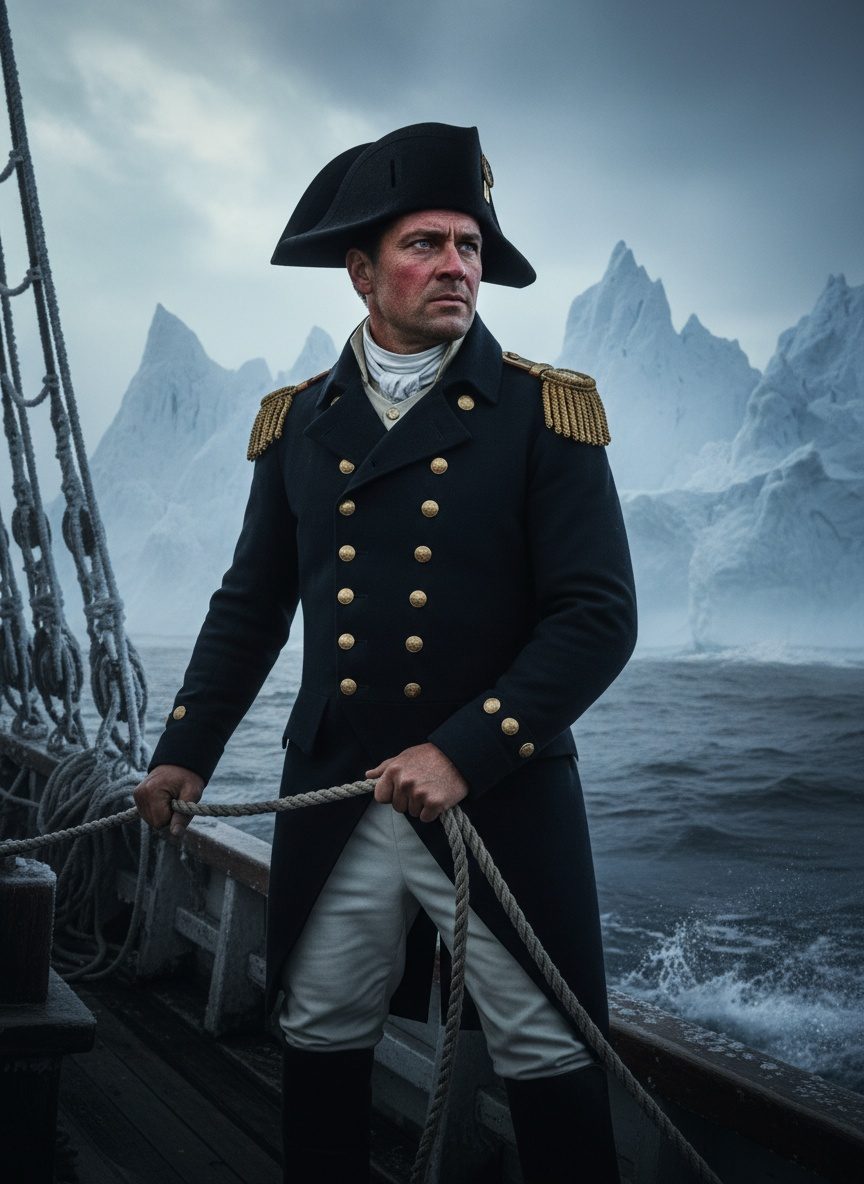
The Southern Ocean howled like a pack of wolves, its icy breath lashing against the creaking timbers of the brig. Lieutenant Edward Bransfield braced himself against the helm, his eyes narrowed against the biting wind that seemed determined to push him back to the safety of known waters. But Bransfield was a man driven not by safety but by discovery, compelled to seek out secrets hidden beneath the shroud of the sea’s endless horizon. Somewhere beneath the churning whitecaps, he believed, lay the counterpoint to the world's known lands—a hypothesis as chilling and vast as the very ocean he dared to tame.
The Voyage South
In January of 1820, the Mark of the Royal Navy under the hand of its Cornish lieutenant, Edward Bransfield, carved its path into the skin of uncharted waters. Sailing further south than any Briton before him, Bransfield embraced the chaos of the Southern Ocean, his ship rocked mercilessly by waves that seemed intent on swallowing them whole. Chunks of ice drifted past like ghostly sentinels, warning of the approaching unknown. Yet, in these treacherous depths, Bransfield found exhilaration, driven by tales of Terra Australis Incognita—a land some claimed was merely ocean’s myth.
As the bow of the ship cleaved through the frothing sea, the relentless spray of salt cut against the men’s faces like daggers. Yet, for Bransfield, the harshness was a song, one that sang of unexplored coastlines and the chance to pen humankind’s knowledge of the world anew. The air crackled with the raw energy of discovery, each gust of wind a whispered promise that perhaps, just perhaps, they were not alone in the frigid grip of the southernmost seas.
Glimpse of the Unknown
On the 30th of January, Bransfield’s patience and perseverance yielded the ultimate reward. With the sun struggling to pierce the thick veil of cloud, the opaque shroud parted momentarily, revealing an awe-inspiring spectacle that none aboard had dared hope for: ice cliffs—monolithic, ancient, and impossibly real—jutting starkly against the grey. To Bransfield, this was no mere piece of floating ice. It was the first tangible evidence of an entire continent, waiting silently beneath its mantle of white.
Read next: The Day a Scots Surgeon Walked Into Timbuktu Alone
Bransfield recorded the moment in his log with three words that would echo through the annals of exploration: "Terra Australis Incognita." A continent found, not merely a legend from stories spun in gentlemen's clubs or academic lectures. The sight of the Antarctic Peninsula was a silent testament, a call to arms for the world’s geographers and explorers who would battle the icebound wilderness for generations to come.
The Man Behind the Discovery
Edward Bransfield's journey southward was not merely a matter of enviable luck. Born in the coastal county of Cornwall, Bransfield had the sea in his blood, his formative years shaped by the windswept ruggedness of his homeland. Joining the Royal Navy as a child, his life became an apprenticeship in survival and mastery of the oceanic ways, rising through the ranks because of his navigational prowess and his unyielding spirit of inquiry.
Yet, his achievement was initially overshadowed by the fame of others. While Bransfield charted the Antarctic Peninsula, his accomplishment was all but forgotten as explorers like James Clark Ross later capitalized on his discoveries, their names forever etched in history’s cold embrace. Bransfield's legacy lingered in obscurity, a cautionary tale of glory overshadowed within the silent pages of archival logbooks.
The Legacy of Ignored Insights
Despite the oversight that shrouded Bransfield's contribution to Antarctic exploration, his discovery on that fateful January day redefined perceptions of the world. He proved that the relentless sea did indeed cradle land at its bottommost reaches. With indomitable determination, he shattered preconceptions of an endless ocean veil, illuminating a frontier that would captivate the imaginations and ambitions of explorers for centuries.
The story of Edward Bransfield serves as a poignant reminder of the relentless human drive to uncover the unknown, to chart paths through tempest and ice where none came before. His legacy invites reflection not merely on the act of discovery but on the endurance of those who dare to transgress the edges of their maps. It reminds us that sometimes, the world’s greatest truths lie waiting beneath a fragile hypothesis and in the willing hearts that pursue them to corners once thought empty and boundless.