He had a crippled leg. It never stopped him from changing the world.
The Shoemaker's Sanctuary
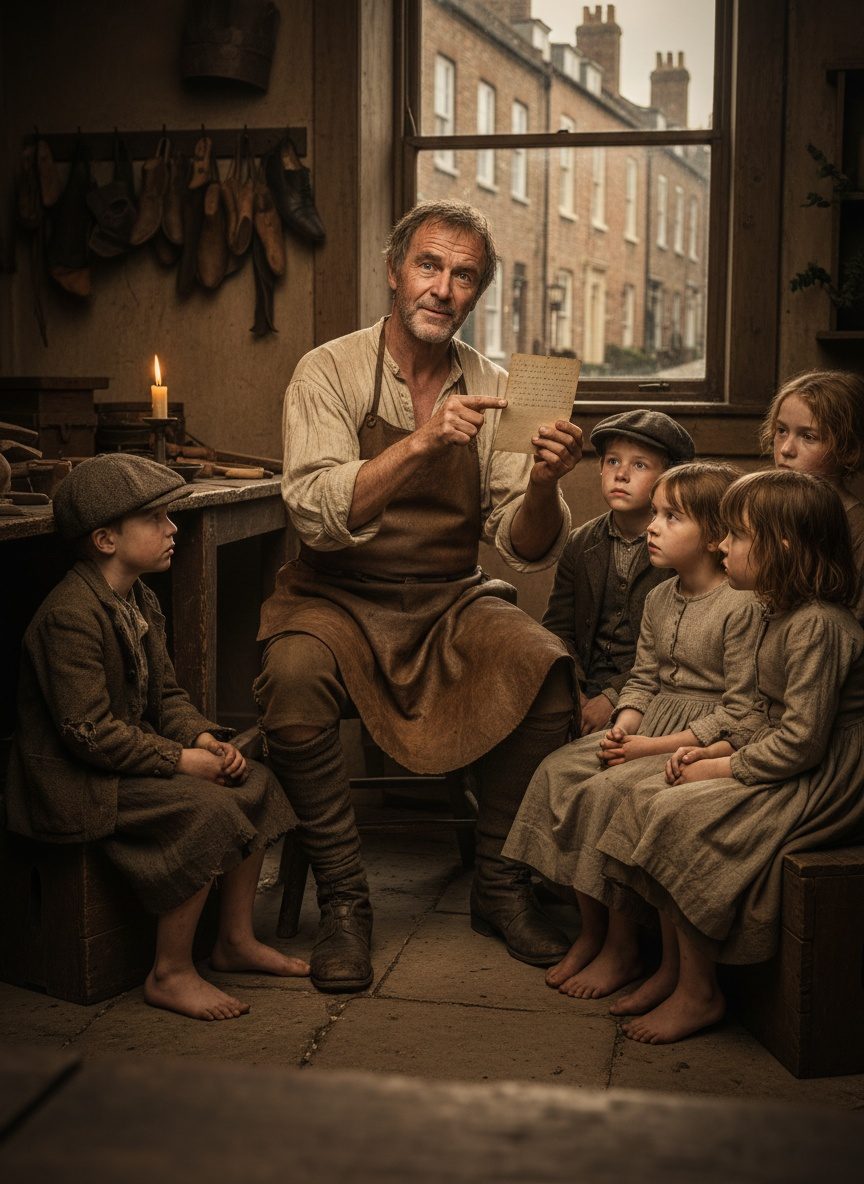
In the bustling and often unforgiving streets of Portsmouth in 1818, a humble shoemaker named John Pounds lived and worked. A twinge of irony hung in the air about him: despite his own limitations, he offered boundless opportunity to those less fortunate. Pounds was no ordinary craftsman. He was a cobbler with a heart as steadfast as the leather he worked, and it beat in time with a calling far greater than shoes. Though lame in body, he was mighty in his resolve, transforming his meager working space into a sanctuary for the city's forgotten children. With no formal school, no funds, and no official approval, he opened wide the door of his workshop to a throng of ragged youngsters who roamed the streets, untethered by the virtues of education.
John's own life was sculpted by hardship. Disabled from a fall down a dockyard ship, he never succumbed to bitterness. Instead, he saw in the faces of orphaned and destitute children the reflection of opportunity denied. Resolved, John turned his shoemaking bench into a makeshift classroom. As he crafted soles and repaired boots, he simultaneously stitched together letters and numbers for his eager, wide-eyed pupils. The children, starved for knowledge, clung to each syllable and sum he imparted. Outside, the dissonant clamor of Portsmouth’s docks hummed, but inside John's hallowed nook, there was harmony in the symphony of learning.
The Syllabus of Survival
Pounds' curriculum was as unique as his classroom. Traditional lessons were woven with practicality, ensuring the children were armed not just with academic prowess, but skills for survival. Reading and writing were taught through stories shared amidst the shuffle of leather, while arithmetic was ineradicably tied to practical experiences, like tallying the cost of goods in the marketplace. John folded these lessons into the very fabric of the shoemaking process, elucidating on measurements and financial settings with deft transitions between patching soles and patching holes in the children's education.
Read next: The Day a Blind Pauper Boy Sang Before a Queen
More unconventional still was the cooking skills he shared. Galling stomachs encouraged attention, and Pounds knew that filling a child's belly could quieten the chaos within their hearts. Together, they would boil morsels of food, creating banquets from what seemed meager. Over steaming pots, John served wisdom seasoned with laughter, turning a simple meal into an unspoken promise: a promise that the value of knowledge often exceeds the glint of gold.
Some looked upon John Pounds as the mad shoemaker, shaking their heads at his audacity—a crippled man daring to teach those whom society forgot. Yet others, who saw the transformation his kindness wrought upon the children, knew they witnessed something divine in simplicity: the gentle heel of a cobbler molding not just shoes, but futures.
A Legacy Unwritten
Before he passed away, John Pounds had taught over 500 children, leaving an indelible mark on their lives, though the full scope of his influence remained confined to whispered tales and grateful, private hearts. These children, once astray, carried forward the lessons taught by the kindly shoemaker. Many assumed roles as teachers, laborers, and shopkeepers—individuals who might otherwise have withered into anonymity.
Yet John never lived to see the full breadth of his life's work ripple outward. Unperturbed by formal acclaim or the fate of statues, his fiduciary was none other than the fleeting moment in which a child's eyes lit up with understanding. To him, each word absorbed was a victory unmeasured by scales other than those of the heart.
In modern terms, John engaged in formative social work long before the term was coined. His story challenges our perception of heroism and defies the constraints of circumstance. One might miss the scope of his impact, nestled in quiet corners of Portsmouth, unheralded by grand edifices or lofty inscriptions. But therein lies the very crux: the power of change wields silently yet profoundly, and true greatness often hides in plain sight, bustling in humble cobbler’s stalls, just like John Pounds'. This tale, entwined within the lives shaped by a man with no title or medal, prompts us to view education as both a gift and responsibility. It beckons us to consider what, in our abundance, remains unopened for those in need.