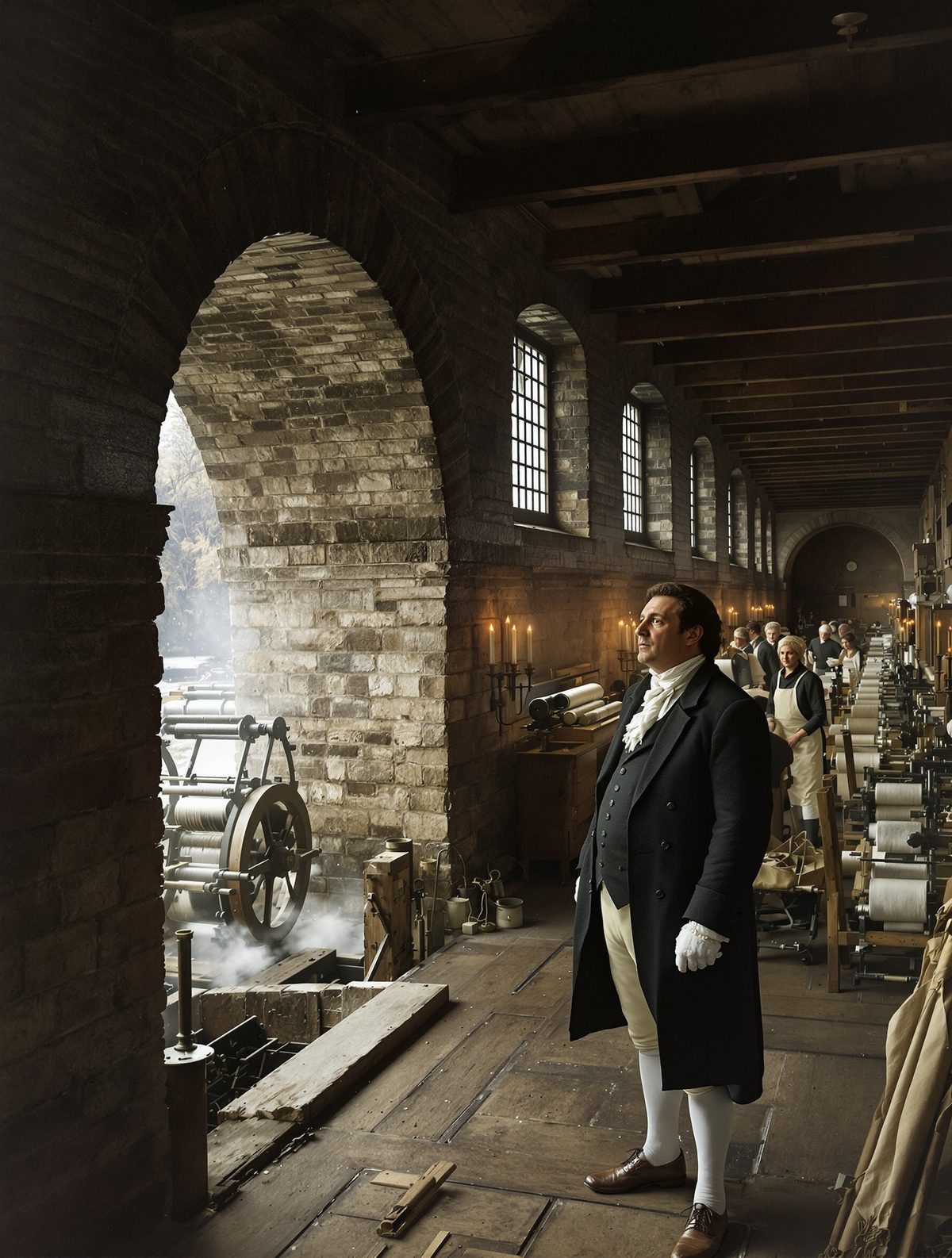
In the misty Derbyshire morning of 1771, the air hummed with a new energy. The trickling waters of the River Derwent, usually left to their solitary journey, had been harnessed to an innovation that would ripple through history. Richard Arkwright, a former wigmaker, and barber from Preston, stood at the helm of his audacious creation: Cromford Mill. Unknown to those gathered in that sleepy village, they were witnessing the dawn of a revolution that would change the world forever.
The Wigmaker with a Vision
Richard Arkwright was an unlikely industrial pioneer. Born in 1732 to a humble family in Lancashire, he initially followed a modest path, fashioning wigs for the upper crust of society. Yet, beneath this ordinary facade lay a restless mind captivated by the challenges of textile production. Arkwright understood that improving the spinning of cotton was key to revolutionizing the industry.
Partnering with John Kay, a clockmaker with a knack for invention, Arkwright edged closer to his groundbreaking idea. The duo devised a spinning frame capable of producing strong, consistent yarn. But creating a device to automate such precision required more than just ingenuity. It demanded a sustained power source—something not readily available in the heart of the British countryside.
Fortune favors the bold, and Arkwright's adventure led him to the untapped potential of the River Derwent in Derbyshire. Just as the waters of the river refused to halt their relentless flow, so too did Arkwright's determination, as he set his sights on harnessing this natural force to drive his spinning machines.
Read next: The Day a Mill Owner Kept Paying Wages He Could Not Afford
The Birth of a Factory
The vision Arkwright set out to realize in 1771 was daring—a building where hundreds of workers could operate machinery under one roof. While the spinning frame was the beating heart of his project, the newly constructed Cromford Mill became its pulsing veins. It was more than just brick and stone; this mill represented the integration of man, machine, and nature.
Onlookers were astonished by the towering waterwheel, a colossal titan of iron and wood channeling the Derwent's power into mechanical motion. Within the walls of Cromford Mill, this energy drove the spinning frames at a pace previously unimaginable.
The factory's scale and purpose were unprecedented. Never before had so many workers been employed collectively in synchronized effort, with machines dictating the rhythm of their labor. The age-old craft of hand-spinning yarn was suddenly thrust into a world of automation and economy.
Scaling the Heights of Industry
Despite its location tucked away in Derbyshire's green hills, Cromford Mill resonated across Great Britain and beyond. Arkwright's model was transformative—yet not without its critics. Some feared the implications for traditional hand spinners, thousands of whom faced an uncertain future.
But Arkwright was undeterred. By 1776, as the American colonies declared independence, he had expanded his enterprise, opening a second factory at Birkacre. Soon, these 'manufactories' spread rapidly, with Arkwright's insights adapted and adopted by entrepreneurs eager to capitalize on this mechanized march. By the end of the century, Britain boasted over 150 cotton mills, each a testament to the power of Arkwright's dream.
However, Arkwright was not immune to controversy. His relentless pursuit of patents often sparked legal battles, the most notable being the case of 1785, where Arkwright's claim to have invented the water frame was invalidated. Even so, his role as a catalyst was undeniable, with British textiles igniting the Industrial Revolution, which would soon blaze across the globe.
A Community Transformed
Arkwright's influence extended beyond industry, forever altering the communities around his factories. Cromford, once a quiet village, burgeoned into a thriving hub of activity. Arkwright constructed housing for his workers and implemented a rigorous schedule, emphasizing discipline and productivity.
He established a factory school for children, intertwining education with labor - a precursor to the modern compulsory schooling we know today. Far from the Dickensian stereotype of oppressive industrialist, Arkwright allowed workers some autonomy, such as allowing them half-day Saturday shifts, a humane innovation in an era of relentless labor.
This community model began to reverberate through factory towns across Britain, forming the backbone of modern industrial societies. It was in places like Cromford where the dual promises and perils of industrialization were first realized.
The Ripple Effect of Innovation
The world that arose from Richard Arkwright's Cromford Mill was one of accelerated progress and complex consequences. With his vision crystallized into reality, the gates opened by industry demanded attention to social, economic, and environmental impacts—issues still grappled with today.
Arkwright's heritage is etched into the fabric of modernity, weaving through the threads of time to remind us of the labor, vision, and ingenuity that turned the gears of history's grand machine. The factory was a triumphant idea that reshaped life's possibilities, breaking boundaries and inviting a multitude of voices to the conversation of what the world could be.
As we stand at the forefront of our own technological era, Arkwright's echo challenges us: What rivers of potential, like the Derwent, might yet propel us to new heights? His legacy urges us to consider how we might harness our innovations with an eye towards shared prosperity and mindful stewardship of our shared future.