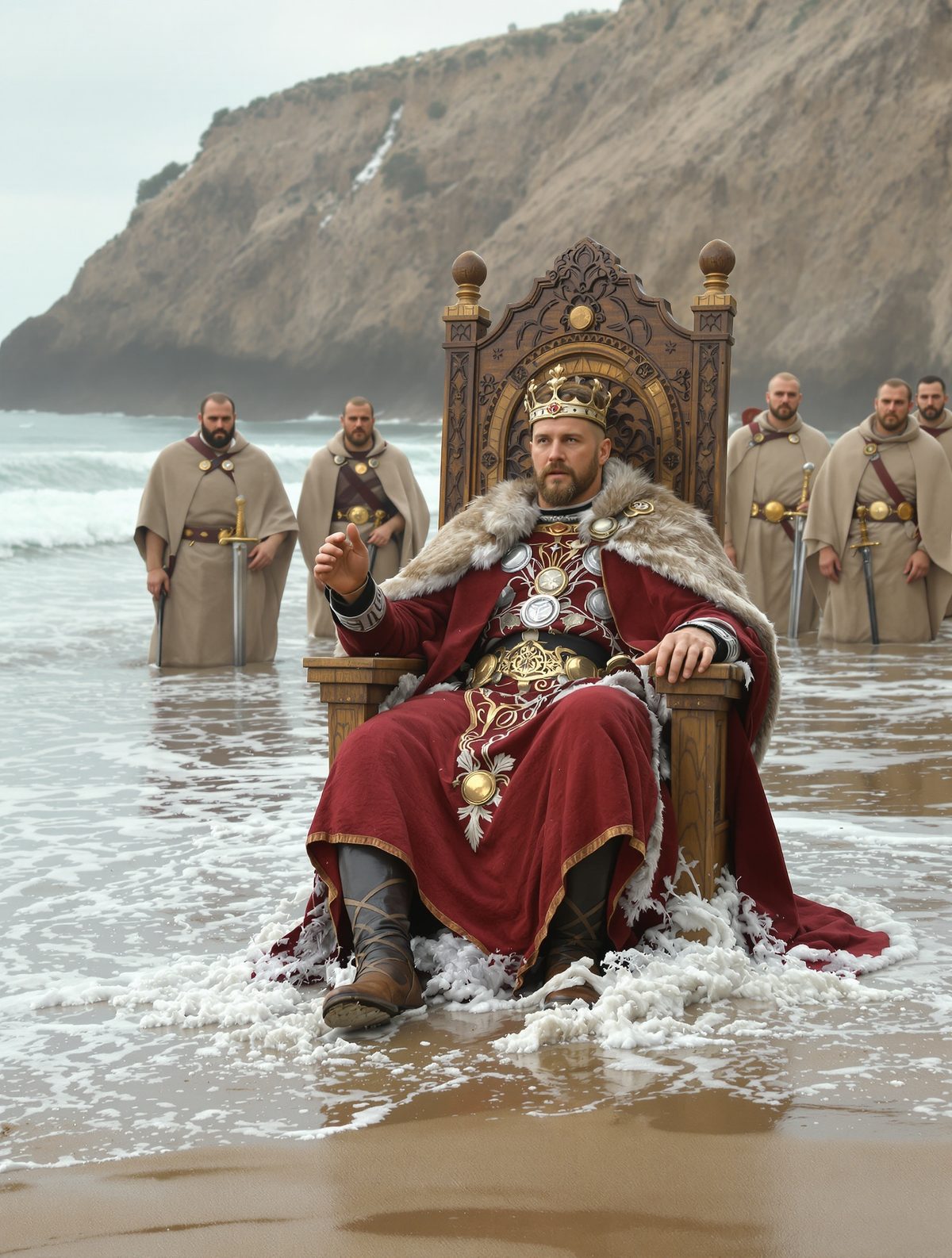
In the heart of the early 11th century, a scene unfolded upon the shores of England that would transcend time—a tableau of humility and power that echoes through the ages. It was a day when the might of a king was measured not by the grandeur of his conquests but by the wisdom in a simple act of defiance against the natural order. This is the story of King Canute the Great, a ruler who, despite his empire-spanning power, reminded his courtiers and posterity alike of the limits of human authority.
The Gathering on the Shore
Imagine the salty breeze sweeping across a stretch of English coastline, perhaps near the historic town of Bosham in West Sussex, around the year 1020. The squawking of gulls overhead is almost drowned out by the rhythmic crashing of waves upon the sands. Here stands an unlikely assembly: King Canute, sovereign of a North Sea Empire that encompassed England, Denmark, Norway, and parts of Sweden, with his court in tow. Among them are lords wrapped in furs and clinking chainmail, their eyes fixed admiringly on their king, a figure cut from the robust fabric of legend and lore.
Canute was not only a king but a charismatic figure, born circa 995, whose prowess in battle matched his acumen for governance. He was revered by his noblemen, each eager to extol his virtues, marking him as the greatest ruler alive. Perhaps he tired of their sycophancy, or perhaps he sought to share a sliver of profound truth. What follows is an episode often misremembered as folly, but in reality, it was a calculated demonstration of wisdom.
A Throne at the Tidal Edge
Those present watched as Canute commanded that his throne be placed at the very edge of the sea. A beautifully carved seat of oak and precious metals, it gleamed dully under the grey skies. As he sat, the waves lapped closer, pushed by the inexorable hand of the tide. Canute, the embodiment of earthly power seated amidst the eternal pulse of nature, must have been a sight to behold.
Read next: The Day a King Knelt to Wash a Beggar's Feet
The courtiers, perhaps jokingly, had lavished Canute with declarations of his omnipotence. Some claimed he could control the elements themselves—an absurdity Canute was keen to dispel. As the sea edged towards his seat, Canute, with a voice strong as the tides, addressed the brine. "I command thee, O sea, to retreat and do not dare wet my robes." The sea, indifferent to crowns and kingdoms, continued to roll forward.
The Lesson in the Waves
While some may have gasped, others surely understood the symbolism that crested higher than the waves. The sea, of course, did not recede, and soon King's feet were submerged, the waters rising defiantly. Turning to his followers, Canute declared, with an undeniable force of humility, that all earthly power is fleeting and subject to the divine majesty of God. In this singular moment, Canute dismantled the facade of regal omnipotence, reminding his court that even a king's authority has its limits.
In this simple yet profound act, Canute showcased a humility rare among rulers, rebuking the flattery of his advisers and asserting that the true king who commanded the sea was God alone. This incident is not just a story of waves and kings, but a narrative of wisdom and the wise use of power. Such tales were precious in a time where rulers were often deified beyond their mortal scope.
Beyond the Shoreline: Canute’s Reign in Context
Canute’s demonstration at the seashore was emblematic of his reign. At a time when pillaging and conquest marked the era, Canute was a ruler who maintained peace within a vast empire. Upon assuming the English throne in 1016, he implemented policies that harmonized the Anglo-Saxon and Norse traditions, thus ensuring stability and prosperity.
A fond adopter of cooperative overlordship, King Canute sought to unify under the umbrella of northern Christianity, even embarking on a pilgrimage to Rome in 1027. During his reign, he established churches and encouraged the spread of Christianity, fostering a sense of shared cultural identity within his dominions. To his people, he was a king divinely anointed; to future historians, a ruler whose legacy was tempered with the wisdom of humility.
The Enduring Legacy of King Canute
The tale of King Canute and the tide finds its ripples in contemporary reflections on power and its constraints. It serves as a poignant reminder of the humility requisite not just in leadership, but in the acceptance of one’s human limitations. In modern times, it compels us to question where true power lies and how best it should be exercised.
While Canute's empire eventually receded, much like the inevitable tide, the lesson he imparted continues to resonate: No matter the magnitude of our achievements, they remain dwarfed by the cosmic forces that rule both sea and sky. Almost a millennium later, his act of humility serves as a clarion call for leaders and citizens alike, invoking a respect for the natural and divine that transcends time and tide.
This narrative reminds us of history's most compelling figures: a king who, through one symbolic gesture, taught a timeless lesson in humility and the relinquishment of ego. It is a legend left out of many textbooks but cherished by those who remember its telling, witnessing the profound wisdom that once graced the shores of 11th-century England. Such is the legacy of King Canute—a legacy of waves and wisdom, of throne and truth.