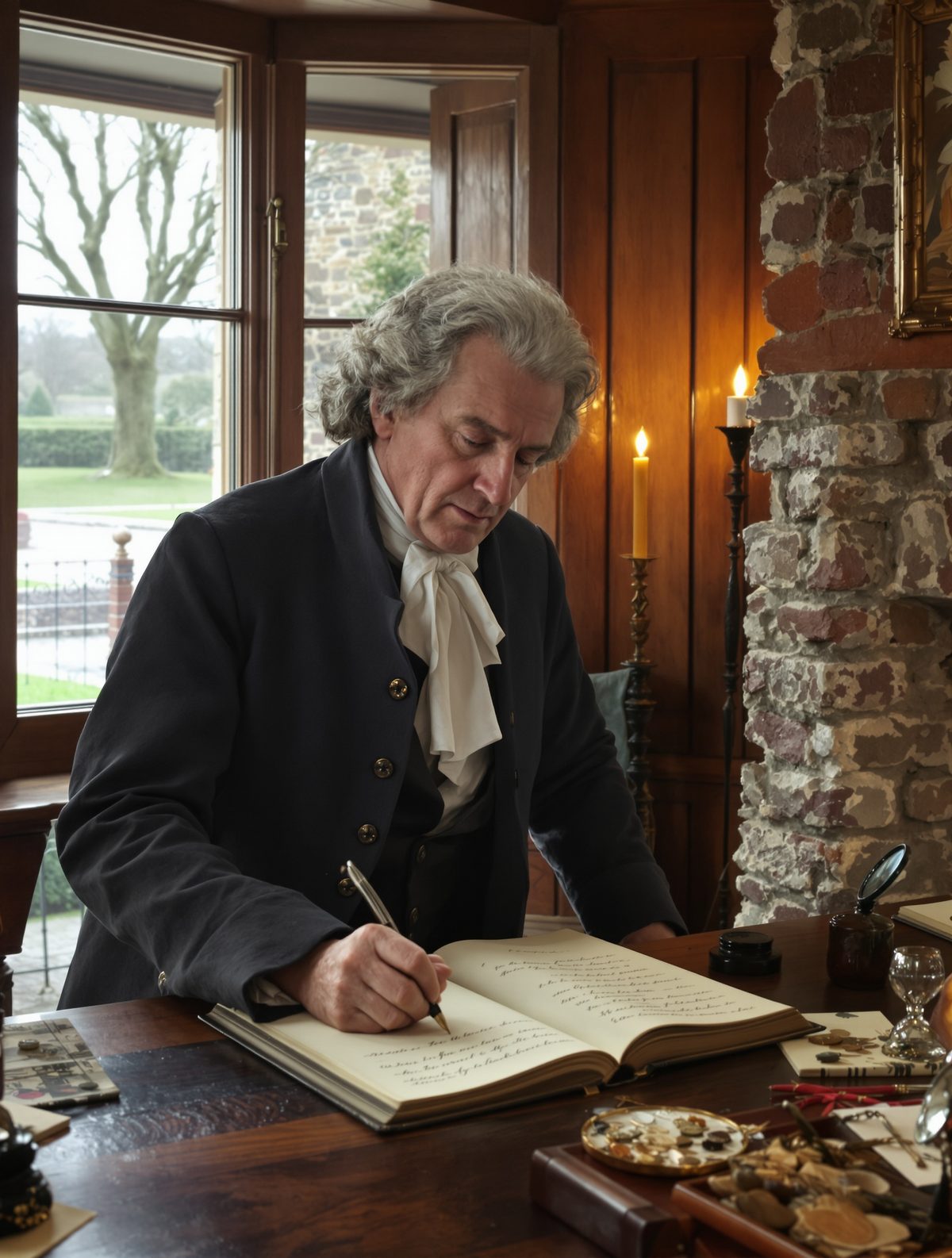
The morning dew settled gently on the fields of Selborne, a small Hampshire village delicately cradled among the lush folds of the English countryside. It was an ordinary start to a day in 1789, not unlike countless mornings that had come before. Yet this day would become extraordinary, thanks to one man whose life was a testament to the profound power of observation. Gilbert White, a country parson whose world rarely extended beyond the quaint bounds of his garden, was about to change the face of natural science forever.
The Parson in the Garden
In an era dominated by grand voyages and scientific expeditions across the globe, Gilbert White stood quietly apart. Born in 1720, his anchor was firmly sunk into the tranquil soil of Selborne, where he wore the gentle mantle of his parish duties with humility and devotion. White was a man of modest means, yet his life was rich with the beauty of the natural world. For thirty years, he meticulously chronicled the rhythms and secrets of the life around him, filling his notebook with observations that would later form the backbone of his seminal work, The Natural History and Antiquities of Selborne.
White’s method was deceptively simple: observe deeply and record faithfully. Whether it was the habits of the area's swallows or the delicate dance of dewdrops on a spider web, his eyes missed nothing. In an age where scientific knowledge was largely dominated by imported findings, White offered a radical idea — that there was a universe of discovery waiting to be found in one's own backyard.
The Naturalist's Notebook
Gilbert White’s notebook was more than just a repository of facts; it was his dialogue with nature. In it, he made an astounding claim based on his direct viewers’ observations: birds migrated. This was in stark contrast to the prevailing belief that swallows hibernated underwater during winter. Through persistent observation, White noted the annual disappearance and return of the Selborne swallows, providing compelling evidence for migration long before it was widely accepted.
Read next: The Day a Baronet Stood Up in Court and Freed His Slaves
Surprisingly, White’s most revolutionary moment came not from the great birds of the sky but from the humble drop of dew on a leaf. Equipped with a simple magnifying glass, he peered into the dewdrop and unveiled a bustling microcosm teeming with tiny organisms, challenging existing notions of life and its complexity. This revelation of microscopic life was a pebble that rippled throughout the scientific community, inspiring future pioneers like Charles Darwin.
Correspondence with the World
Though White never ventured far from his parish, his ideas flew far and wide through correspondence. He exchanged letters with prominent naturalists of his time, among them Thomas Pennant and the Honourable Daines Barrington. These relationships not only enriched his understanding but also amplified his voice in the choir of natural science.
His letters are a charming mix of inquiry and exposition, occasionally bordering on poetry. White’s exchanges were laden with an inquisitive spirit and a genuine warmth, enticing his peers into the narrative of Selborne’s living tapestry. Some might say that Gilbert White was as much a storyteller as he was a naturalist, spinning tales from his garden that captured both heart and intellect.
A Legacy Cast in Ink
When White finally published The Natural History and Antiquities of Selborne in 1789, the book distilled nearly three decades of minute observation into a comprehensive survey of local flora and fauna. It stands as one of the earliest concerted efforts to document the world as seen directly through the lens of empirical inquiry.
The work was immediately recognized for its groundbreaking authenticity and meticulous detail. Considered a foundation stone in natural science, its chapters brimmed with insights that would reverberate through future generations of naturalists and curious minds alike. To many, Gilbert White’s book was not mere documentation; it was a love letter to the world around him, penned with quiet reverence and relentless curiosity.
The Evolving Measure of All Things
In the echoing halls of time, why does Gilbert White’s story still matter to us today? In part, because his life serves as a gentle reminder of the power of patience and observation. In an age where the world feels smaller — shrunk by the immediacy of technology and constant connectivity — White encourages a return to the natural pace, to breathe deep and look close.
Moreover, his discoveries underline an essential truth: the potential to make meaningful contributions is not confined by grandeur or geographic expanse. Great science can begin right at home, just as White’s did, in the solitary wonders of our immediate environment. As curiosity leads to discovery, the vastness of the universe reflects back from the simple stillness of a garden — a lesson that, perhaps now more than ever, we are called to remember.
In commemorating Gilbert White, we celebrate the unsung poet of natural history. The day he peered into a dewdrop in a sleepy Hampshire village, he illuminated for us the vast potential within the micro and the unexpected wonders that the familiar world conceals. His legacy lives on, echoing through the rustle of leaves and the return of swallows marking the dawn of endless possibilities.