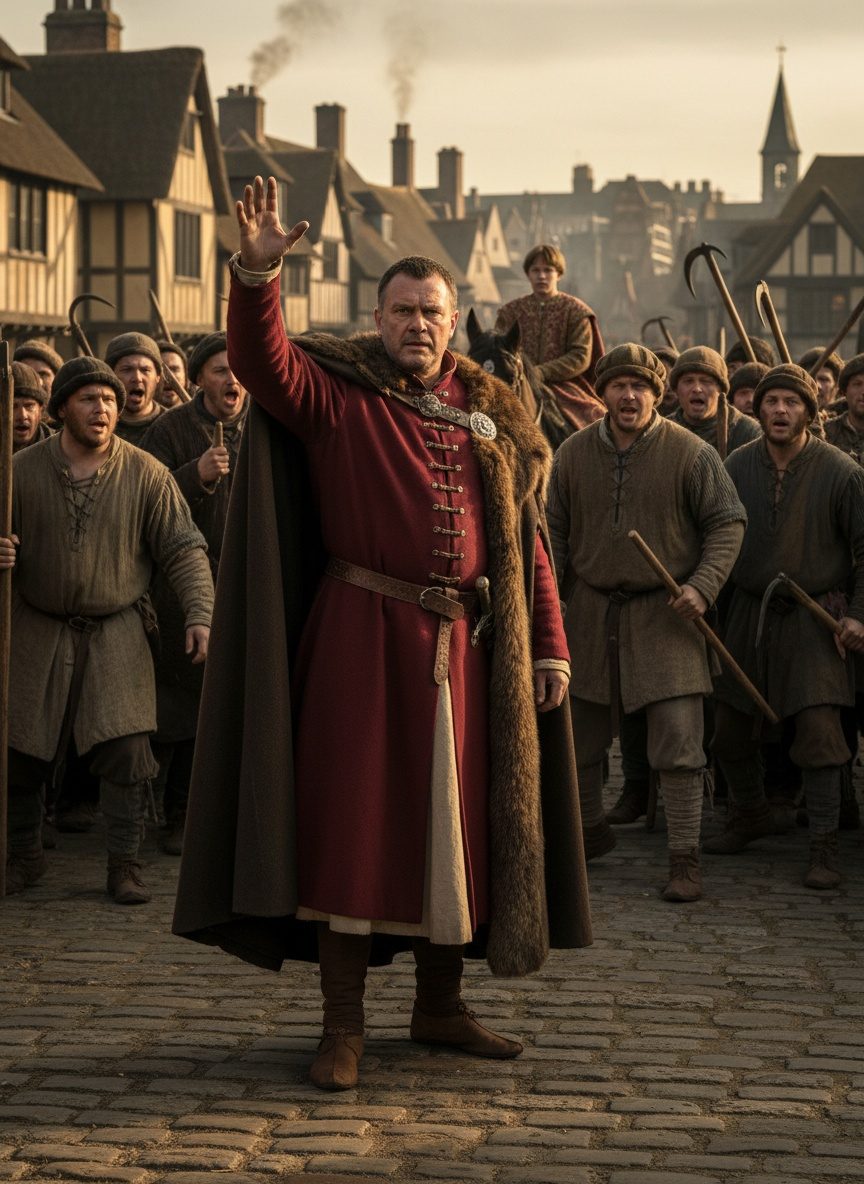
A dagger flashed under the gray, churning sky, its point aimed menacingly at the young King Richard II. Wat Tyler's hardened face twisted into a fierce snarl, his uprising behind him a smoldering beast threatening to engulf all of London. As the rebel's knife curved through the air, poised to decide the fate of the kingdom, an unexpected hero emerged from the chaos: not a knight in gleaming armor, but a simple cobbler with a spirit as unyielding as the shoemaker's awl he wielded daily.
The Shadow of the Flames
The summer of 1381 held a heavy, acrid air over London, clinging to the skin like a grim pall. The Peasants' Revolt had blazed its way across the English landscape, ignited by years of oppressive taxes and social unrest. London was a tinderbox, buildings smoldering as if the devil himself had stoked the furnace of rebellion. The boy king, Richard II, though only fourteen years old, sat precariously on the throne, the crown almost tumbling from his youthful head.
The cobbled streets of London, usually bustling with merchants’ shouts and the rattle of horse-drawn carts, now echoed with the thunder of angry footsteps and the clamor of revolt. It was on these very streets that William Walworth lived and labored, his world of worn leather soles and stitching needles suddenly invaded by the specter of civil chaos. The son of a humble tanner, Walworth had risen through the ranks to become the Lord Mayor of London, a testament to his craftiness and dedication. Yet, no amount of experience could have prepared him for the flames of insurrection that threatened to consume the very heart of English society.
The Determined Cobbler
Amidst the tumult, Richard II rode out to Mile End, flanked by an uncertain escort, their armor clanking with each nervous twitch. Yet mile by mile, the ranks of supporters thinned, many lost to fear or expected defeat. All but one. William Walworth, unwavering and resolute, stayed close to the boy king whose crown teetered on the precipice of oblivion. As they arrived at Smithfield, where the final confrontation had gathered like a storm, Walworth knew in his bones that everything would be decided in the next few breaths.
Read next: The Day a Blind Pauper Boy Sang Before a Queen
Eyes narrowed beneath a heavy brow, Walworth watched as Wat Tyler advanced. Tyler, eyes blazing with the fervor of revolution, represented the raw power of the multitude, a leader born of frustration and fury. His followers, the downtrodden masses of England, were tired of being ignored and exploited. But Walworth, with the steady mind of a craftsman, understood the delicate balance of power that the kingdom required, a balance he believed the rebels could never comprehend.
The Strike That Changed History
The clash at Smithfield unfolded with the claustrophobic immediacy of a nightmare. Tyler's dagger cut through the clamor as a shout erupted from a startled bystander. In that instant, Walworth lunged forward, driven by an impulse more primal than fear. A well-aimed blow with a sword at Tyler’s exposed side felled the rebel leader, the air crackling with the electricity of tension suddenly broken. Gasps echoed through the gathering, with every soul realizing the precariousness of their gamble against the crown’s forces.
As Tyler lay fallen, his followers, shocked by the sudden loss of their leader, hesitated—freedom wavering uncertainly before vanishing altogether in the face of royal retribution. Walworth’s act was not merely one of violence; it was a guardian’s intervention, a measure of steel that restored order where it teetered on the brink of anarchy. In those moments of pandemonium, as the city continued to tremble with residual anger, King Richard II's hands trembled less, the crown slightly more secure upon his brow.
An Unseen Legacy
History is often written in the ink of kings and knights, of great battles and grand conquests. Yet amid the annals of England’s storied past lies the humble but essential narrative of the everyday hero. William Walworth, a cobbler-turned-mayor, proved that courage and loyalty do not always conform to lineage or lineage-born privilege. His swift action on that fateful day at Smithfield, wielded with the precision of a craftsman's blade, secured not only a crown but the delicate remnant threads of a nation poised to unravel.
Though largely overshadowed by knights and nobles, Walworth's legacy whispers through the cobblestones of London, a testament to the impact of those who stand firm amid upheaval. In our age, as we navigate the complexities of modern society, the cobbler’s story reminds us that heroism wears many faces, often emerging from unexpected quarters to shape the destiny of nations. In William Walworth's resolute stand, we find inspiration that sometimes the threads of history are held together by the simplest of needles.