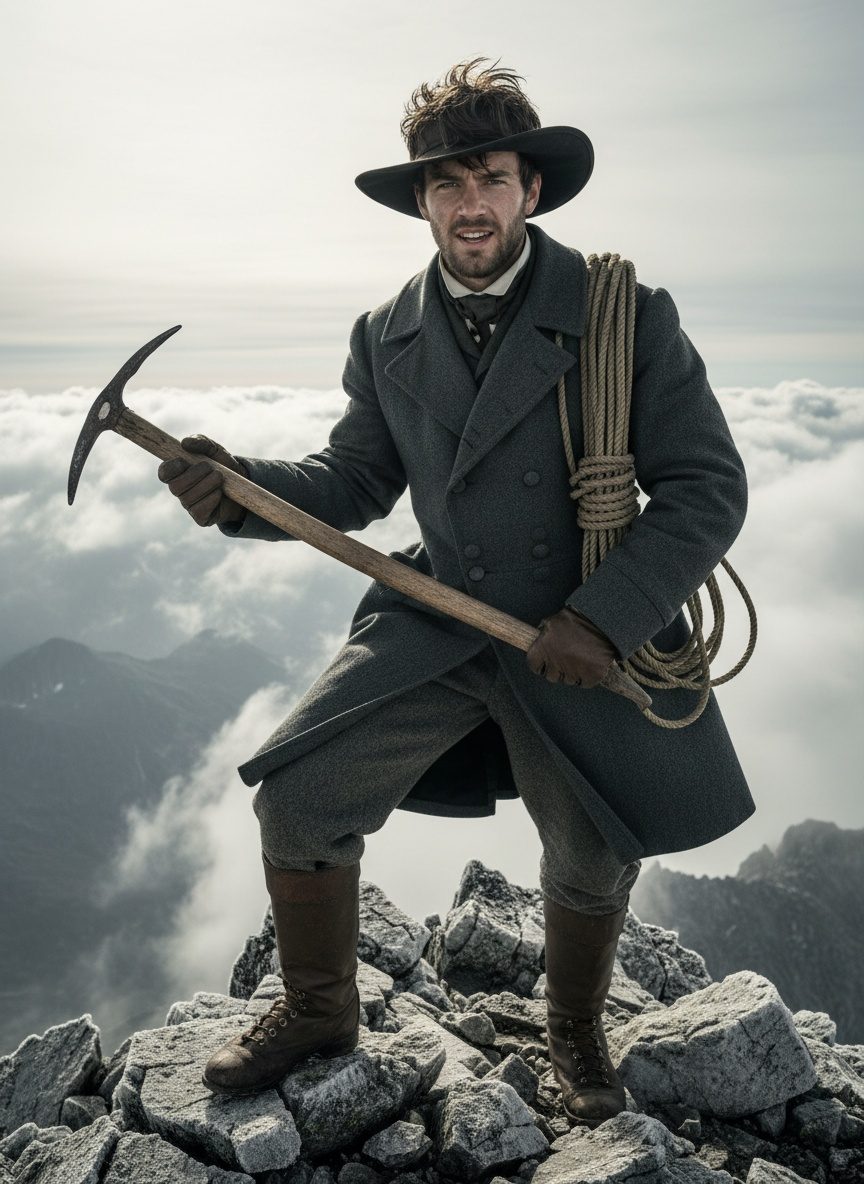
August 1865. The brilliant alpine sky stretched wide and endless, a canopy of crisp blue framing the daunting monolith of the Matterhorn.
A Landscape of Defiance
The Matterhorn, that jagged sentinel of the Alps, stands as a guardian, austere and enigmatic. Its crags and precipices had mocked climbers for decades, its unforgiving nature soaking in the aspirations and bones of those who sought to claim its summit. The mountain's characteristic pyramid, wreathed often in mist and shadow, seemed almost to growl its defiance against taming. With each abortive attempt, the Matterhorn earned its reputation as both a final frontier and a mountainous muse of legend and calamity.
In the swirling winds and blanketing snows, tragedies had unfurled on the Matterhorn’s unforgiving slopes. Yet, for every story of defeat, the mountain whispered its siren call of challenge and glory. By the mid-19th century, it lingered as the untouchable peak, emblematic of the ultimate conquest in an age of burgeoning exploration and scientific wonder.
An Unexpected Challenger
Edward Whymper, a young wood-engraver from London, was not the quintessential climber of his time. He was equipped more with determination and ambition than with seasoned alpine expertise. Yet, his love for the high mountains rapidly evolved from a professional focus on documenting mountain landscapes to a personal crusade to stand atop peaks no man had yet claimed. The Matterhorn became his obsession, a towering sculpture dared to be drawn anew on cartographic records.
Read next: The Day a Widow's Son Lit Up the Victorian Night
Whymper's 1865 expedition was not his first to the Matterhorn. He had tasted the bitterness of defeat, confronted by walls of stone that jealously guarded their heights. But this time, he plotted his ascent meticulously, employing not audacity alone but reinforced by an experienced team, albeit one plagued with internal tensions and disagreements over prior unsuccessful attempts.
The Ascent: Skyward Bound
August 1865 dawned clear and bright. With the steely determination of a man summoned by destiny, Whymper and his team began their uphill battle. Zermatt, nestled innocently in the shadow of the Matterhorn, seemed to fade away with every laborious step over the moraine, snowfields, and serrated ridges.
The climb unspooled like a harrowing symphony, each movement more precarious than the last. Technicality wrestled with fortitude on dizzying ledges merely the width of a climber’s foot. Whymper, aided by secure ropes and the pioneering alpine use of crampons, felt both uplifted by the majesty of his surroundings and burdened by the harrowing proximity to disaster.
On the morning of their final push, precarious footholds were less daunting than the psychological riptides of the journey’s apex. Every gust of the biting alpine wind dragged the lure of the abyss closer. Yet as the sun reached its zenith, casting the mountain in blinding clarity, Edward Whymper stood higher than any person had ever stood before on the Matterhorn. In those precious moments, he tasted ethereal triumph over the unconquerable.
A Descent Shrouded in Darkness
The summit, an unveiling of fears conquered, was only part of the Matterhorn's sinister enigma. As Whymper and his six companions began their cautious descent, the mountain extended its dread and infamy. While traversing the near-vertical slopes, disaster unfurled swiftly with the severing of a rope, sending four of Whymper's companions plunging to their deaths in the icy void below.
It was a horror unfathomed, the echoing cries mingling with the grief of those left clinging to life and the mountain. The boundary between triumph and tragedy is often hauntingly tenuous, and on that day, victory was stained with profound loss. The ride down the Matterhorn’s daunting face was no retreat; it was a grim odyssey of survival and the beginning of a tale sharper than its chiselled silhouette.
Reflections Beyond the Peak
The news sent ripples far beyond the confines of alpinism, catching fire in the imagination of an enthralled British public. Whymper’s survival brought fame, but the irony of the cost lingered like an unbidden spectre. In an era captivated by the indomitable spirit of exploration, the Matterhorn's conquest became a vivid dichotomy of human aspiration versus nature’s omnipotence.
In a modern world, Edward Whymper's experience finds resonance as a narrative of ambition and its pivotal, occasionally inevitable, brush with disaster. The pursuit of transcendental heights mirrors our eternal confrontation with the vast and unknown—each summit claims a piece of the climber’s heart just as it etches its myth into the annals of time.