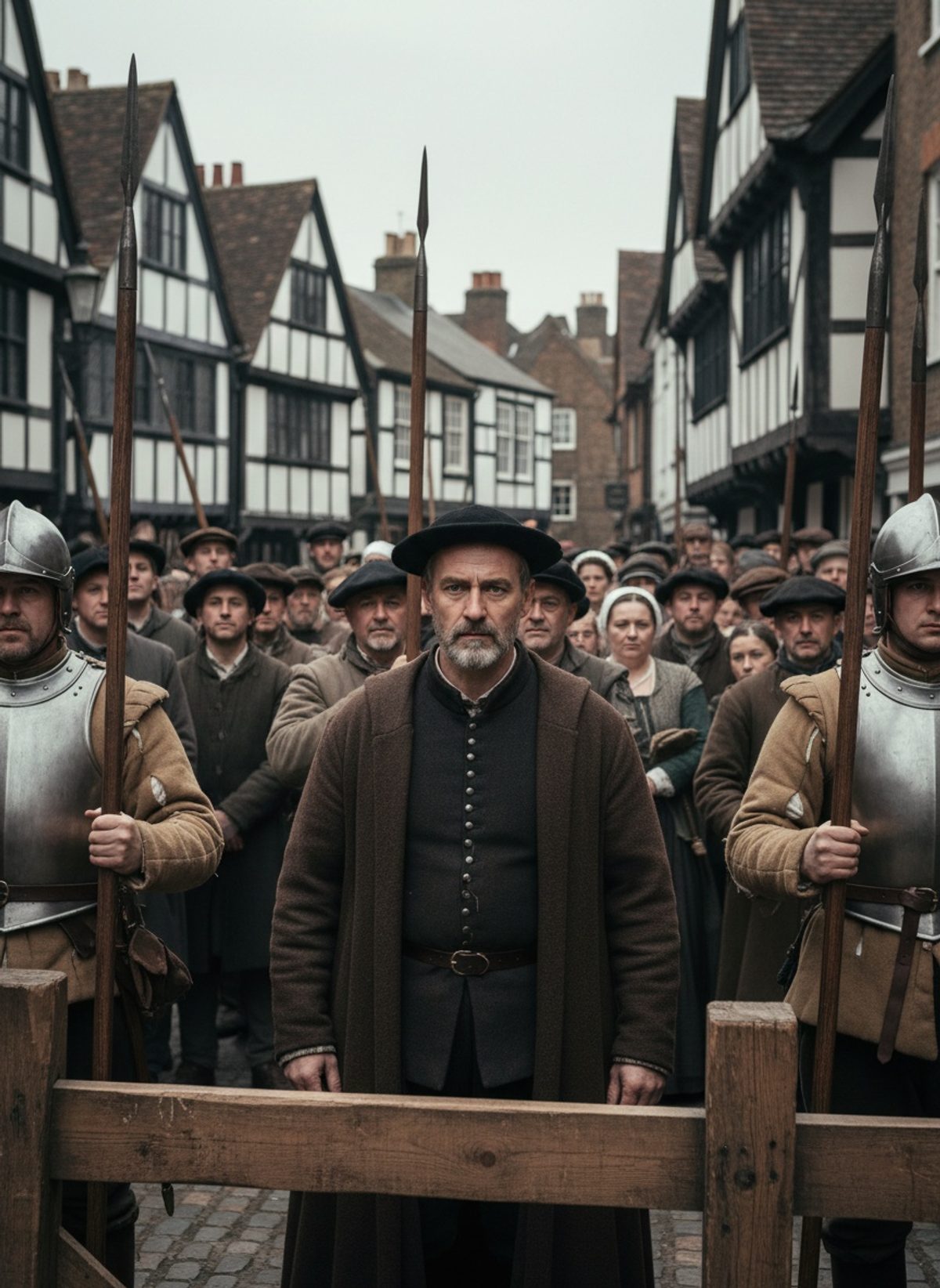
It was a quiet morning in 1628 when the foundations of medical science trembled. In a hushed room at St Bartholomew's Hospital, London, Dr. William Harvey stood poised to rewrite over two millennia of accepted wisdom. Before his circle of incredulous colleagues, Harvey would confirm a discovery that defied the unchallenged texts of Galen and set the stage for modern cardiology. This is the story of the day a lowly London surgeon boldly demonstrated that even the mightiest king — the master of medieval medical thought — could indeed be mistaken.
The Pulse of Change
Picture a bustling morning at the Guildhall of Physicians, the air thick with the anticipation of new findings mingling with skepticism. Among those gathered, the elite of London's medical society, William Harvey had earned a reputation as a meticulous observer. This unassuming man from Kent, born on April 1, 1578, seemed hardly the type to stir controversy. Yet, his observations would spark debates fracturing medical consensus across Europe.
For centuries, Aristotle's and Galen's works held sway over the medical world. According to these ancient authorities, blood was created in the liver and consumed by the body as it flowed through unseen pathways. The heart, they believed, gave it a sort of spiritual vitality. Yet here was Harvey, with his book Exercitatio Anatomica de Motu Cordis et Sanguinis in Animalibus, proposing a radical idea: the heart was not a mystical furnace but a muscular pump pushing the same blood around the body in a circular motion.
The King's Confidence
Despite the widespread scoffing from fellow scholars, Harvey's theories found support in an unexpected patron — King Charles I of England. Known for his fascination with the sciences and as a collector of curiosities, the King lent Harvey not merely his ear but the royal animals from his menagerie for experimentation. In a time when social risk often carried more weight than scientific valor, the backing of a monarch was no small windfall.
Read next: The Day a Stuart King Walked Calmly to His Own Execution
Harvey, Royal Physician since 1618, knew that challenging the status quo required more than eloquent argumentation; it demanded proof. Through a series of experiments, he demonstrated that blood flow involved both the heart and the intricate network of veins and arteries. A sheep’s heart here, a dog’s exposed vessels there — his systematic approach was unmoored from the superstition that had governed the medical thoughts of his peers.
The Experiment That Turned Tides
Harvey’s demonstration on that fateful day was deceptively simple, yet it held unimaginable power. Among his methods was the use of tourniquets to show how veins swelled on the side closer to the heart. He measured the capacity of the heart's ventricles and multiplied this by the pulse rate to drive home how exceedingly small the chances were that such vast quantities of blood could be consumed as previously thought — it simply must circulate.
The results were stunning in their clarity. More extraordinary than the pulsations of his subjects was Harvey's steady hand guiding 1628's audience through these foreign concepts. By the end of his experiments, any skepticism poised in the room was quietly surrendering. You could almost hear Galen's revered texts gently sliding from their pedestals.
The Ripples Across Europe
As news of Harvey’s conclusions spread, so too did the unease it caused. From Paris to Bologna, protestations arose, reminding us that revolutions, be they political or scientific, are seldom peacefully born. Yet his findings were remembered and repeated, and slowly they began to take root among younger scholars willing to challenge antiquated doctrines for a richer understanding of the human body.
Yet the resistance Harvey faced wasn’t solely based on academic pride. His theory inadvertently questioned the divine order and man's place in it. The celestial analogy of the heart as a radiant force was displaced by an unfussy biological pump. Still, with the support of students like Thomas Bartholin, who discovered the human lymphatic system, Harvey’s work began to reshape medicine, breeding a culture less about unfounded adherence and more about empirical investigation.
The Legacy of a Courageous Heart
Reflecting on Harvey’s life is a reminder of the power of conviction rooted in evidence rather than tradition. His quiet revolution paved the way for Lumpectomy to Lister’s antiseptics, each evolutionary step built upon the courage to question, to observe, and to prove.
In today’s era, wherein misinformation can gallop faster than fact, Harvey's example is potent. With our broader knowledge pool, we inevitably return to the importance of evidence and inquiry. Medical science progresses through doubting and testing the "immovable" truths of yesteryears — an enduring narrative fostered by Harvey himself.
So, next time you feel your own pulse, consider how a resolute man, his king, and a quietly ticking heart in a small London room, altered the course of medicine. Reminding us, perhaps, that some of history's greatest revolutions occur not with a bang, but with a steady, rhythmic beat.