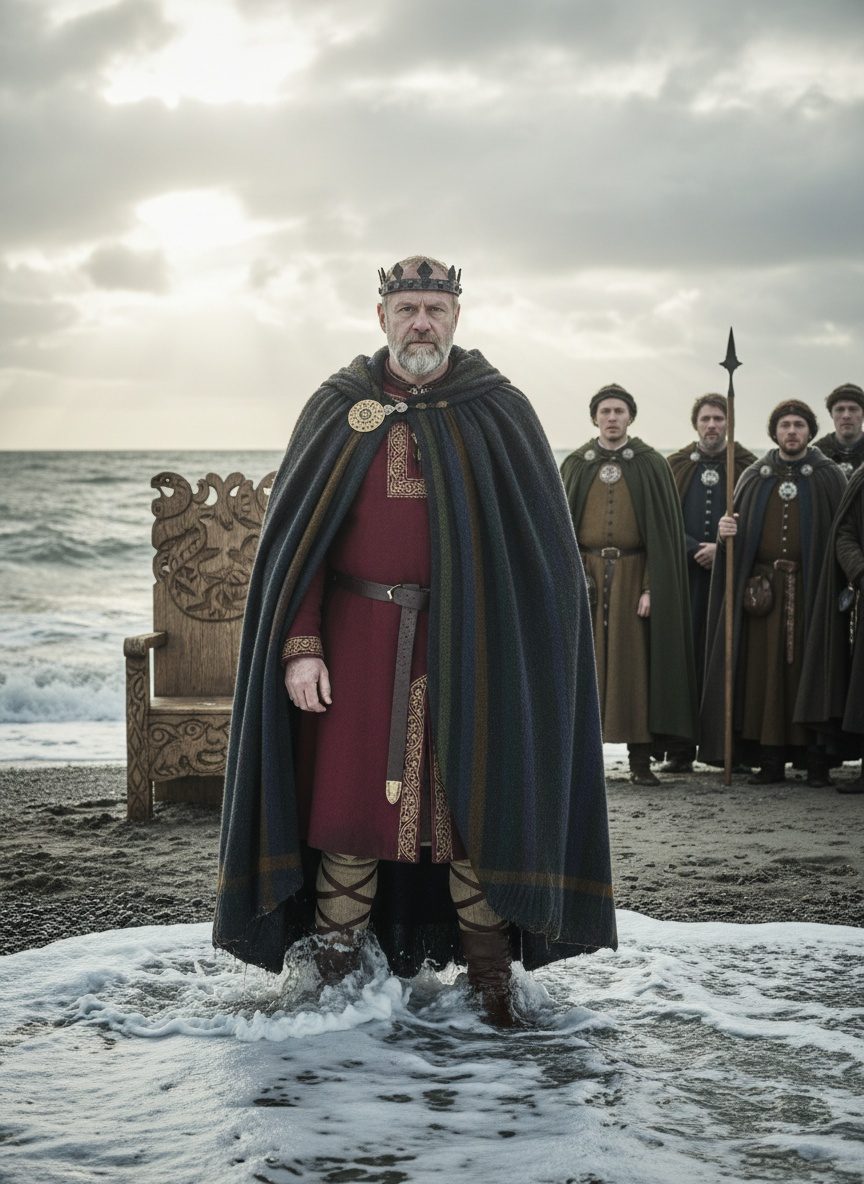
He defied the sea with the composure of a sovereign. Cnut the Great, King of England, Denmark, and Norway, is often remembered as a quintessential Viking — fierce, unyielding, and a master of the waves. Yet, on that fateful day in AD 1020, he took his place at the edge of the vast, relentless ocean to demonstrate a very different kind of power.
As the story goes, Cnut's advisers had been lavishing him with praise, insisting that his reign was mighty enough to shift the land and sea themselves. Such a notion must have intrigued and amused the king, for he decided to stage a demonstration. Imagine the sheer spectacle as the court retinue processed to the shoreline, the king's throne carried like a sacred artifact through the bustling throng. Under the watchful eyes of his courtiers, the sound of crashing waves as a steady background, Cnut seated himself and issued a proclamation that no mere mortal ought to defy—the tide was commanded to halt its advance.
The scene on the shore would have been a tapestry of vibrant pageantry juxtaposed with the wild tapestry of nature. Mist rose from the crashing surf, the salty tang mingling with the scents of the land and the whispers of the gathered nobility. It was an atmosphere thick with anticipation, mingled perhaps with a touch of the absurdity. Here was a man capable of commanding armies and building empires, turned now to act as king against the relentless, unfeeling force of the tide.
And yet, as every onlooker likely suspected, nature held its course. The waves continued their inexorable approach, ignoring the edict of the king. Despite the command of an earthly ruler, the sea, indifferent to power or persuasion, wet the feet of Cnut in silent defiance. In that moment, a shroud of realization descended upon those gathered—a poignant reminder of human limitation.
Read next: The Day a Saxon Abbot Walked Into a Slave Market Alone
Rising from his throne, Cnut turned to face his retinue, soaked but unbowed. He did not utter a word of rebuke or disappointment. Instead, through the simplest of gestures, he communicated a profound lesson. Here was a declaration more potent than any proclamation of power—it was a humbling recognition of the natural order and the ultimate futility of human pride against the vastness of the world.
What Cnut demonstrated that day was an understanding that transcends generations; a quiet acknowledgment that no matter the scope of human ambition, the earth and seas move to their own ancient rhythms. His action revealed not weakness but wisdom, providing a stark contrast to the hubris that often clouds the judgment of rulers. Far from indulging in delusions of grandeur, Cnut's performance was notably rooted in clarity—an understanding that true leadership lies not in wielding power, but in recognizing its limits.
The image of the king walking back up the shore offers a haunting picture of soaked dignity, each step a silent testament to the futility of human arrogance. It was a sight that would echo through time, a nuanced parable of rulership that transcended the simplicity of grand conquests or architectural feats. Though many details of Cnut's life and reign slip into the shadows of history, this singular episode endures vividly, encapsulating a truth often left out of grand historical narratives.
Today, the story of Cnut's confrontation with the sea serves as a timeless allegory, teaching that wisdom lies not in the ability to bend nature or fate but in the humility that comes with understanding one's place within it. As history is penned and rulers rise and fall, Cnut's day at the beach remains instructive—a reminder that the truest form of might is married to modesty, a legacy not captured in conventional tales of triumph, but in the tranquil wisdom that lasted beyond the swelling tides of his time.