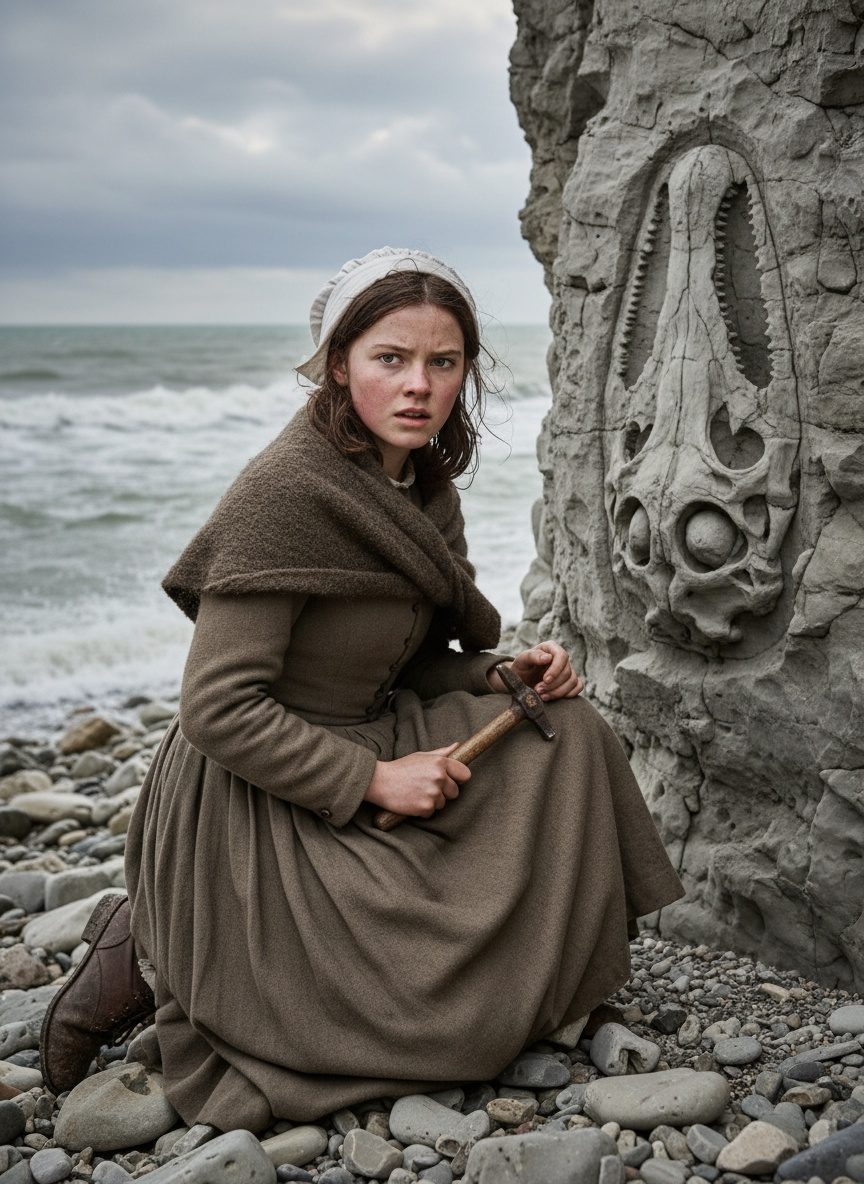
Her fingers were raw, the cold seeping painfully into her bones as Mary Anning clawed at the damp earth. Beneath her hardworking hands, the cliff crumbled away to reveal a mysterious, massive skull emerging like a secret from the bowels of time itself. The air was sharp with the salt from the sea, but all her senses were attuned to this fossil, its grotesquely foreign shape lying half-buried in the cliff face. Its serpentine jaw, lined with razor-sharp teeth, spoke of a monstrous creature. In this moment, amid the pummeling of waves and the whispering wind, Mary was not a mere carpenter’s daughter digging curiously; she was an unwitting harbinger, her find destined to make even the greatest minds of Regency England question what they thought they knew about life on Earth.
The Unearthly Secret of Lyme Regis
Winter in Lyme Regis was a season for hardy souls. The tourists, who thronged the beaches in summer seeking curiosities to carry back in velvet-lined trunks, were long gone. The narrow streets of the Dorset township, nestled between the blue expanse of the English Channel and the rolling green hills, lay silent under gray skies. Here, on a nippy December day in 1811, young Mary Anning was determined to find her way through the grip of poverty. Her father, a humble carpenter, had passed, leaving the family to navigate financial uncertainties. Fossil hunting—a pastime for some but a necessity for Mary—filled their means of survival.
The Anning family business was in selling "curiosities"—ammonites, belemnites, and such—to the fashionable classes increasingly intrigued by the emerging science of geology. But on this day, the girl met with something beyond the mundane. Chipping away with stick and iron nail, she unearthed not a trifling trinket but a fossilized head of a creature that bore no resemblance to any animal known to roam the hills and hedges of England.
The jaw, wide and menacing, seemed coiled with a silent scream. The eyes, or where they once must have been, spoke of an intelligence suited for underwater supremacy. Yet, no naturalist of the time had cataloged such a beast. Here lay evidence of a world erased by time, a time when monstrous reptiles reigned where now only the cry of gulls echoed in the craggy promontories.
Read next: The Day a Miner's Son Gave the World Safe Light
Challenging the Great Scientific Minds
With the skull transported painstakingly to her family's humble home, Mary Anning turned her discovery over to a small cadre of local scholars. The like of this creature had never appeared in the annals of known fauna. This skeleton promised to lift the veil on mysteries that had lingered since antiquity. It was christened *Ichthyosaurus*, a “fish lizard,” belonging to a reality stripped from the eons.
The find struck a nerve in the world of science, which stood at the precipice of discovery yet shackled by the orthodox interpretations of the natural order. It was a world wherein giants like Georges Cuvier had begun to speak of extinctions, considering the theory that entire species were wiped away before the dawn of man. The very existence of creatures like the ichthyosaurus prompted troubling questions. If such enormous reptiles could perish, what might that mean for the permanence of humanity? These were considerations compelled into the limelight by a young girl wielding tools in search of daily sustenance.
Across Britain, and eventually the continent, Mary’s finds fueled an evolving understanding of geology and paleontology. In drawing rooms and lecture halls, her fossils whispered truths that even respected scientists hesitated to voice. The notion of a dynamic Earth, with cataclysmic events resetting its biological clock, took root. The concept of deep geological time and an Earth vastly older than biblical reckonings blazed trails through academic and ecclesiastical landscapes.
More Than a Curiosity: A New Perspective on Earth's Past
The contributions of Mary Anning went beyond shaking scientific dogma—they cracked open a door to humanity's understanding of its own insignificance. Isolated as she was, Mary’s discoveries helped push the boundaries of science into territories unknown. As she excavated further along the cliffs of Lyme Regis, she unearthed not only fossils but a deeper awareness about our world’s layered past, rendered in the silent script of rocks and stone.
Through her discoveries, hitherto invisible worlds came into sharp relief, challenging humanity’s spot atop the totem pole of life. Despite living a life marred by economic disadvantage and societal constraints placed upon her as a woman, Mary’s quiet persistence and indomitable spirit catalyzed a shift in understanding the ever-changing narrative of Earth’s history.
Mary Anning’s groundbreaking finds taught us about life's fleeting nature, illustrating that what appears established may one day vanish. As their once-undiscovered secrets unfolded in cabinets of curiosity and halls of learning, those fossils whispered a truth as old as life itself: Earth had been inhabited by creatures both wondrous and terrible, alive in a world humming with life far different from our own. Her hands may have been worn, and her achievements in her lifetime quietly noted, yet each fossil she held was a voice pulsing with the echoes of lost eras. Through her, Earth's history spoke anew, its story as ancient as the rocks, yet forever unearthing the new in the old.