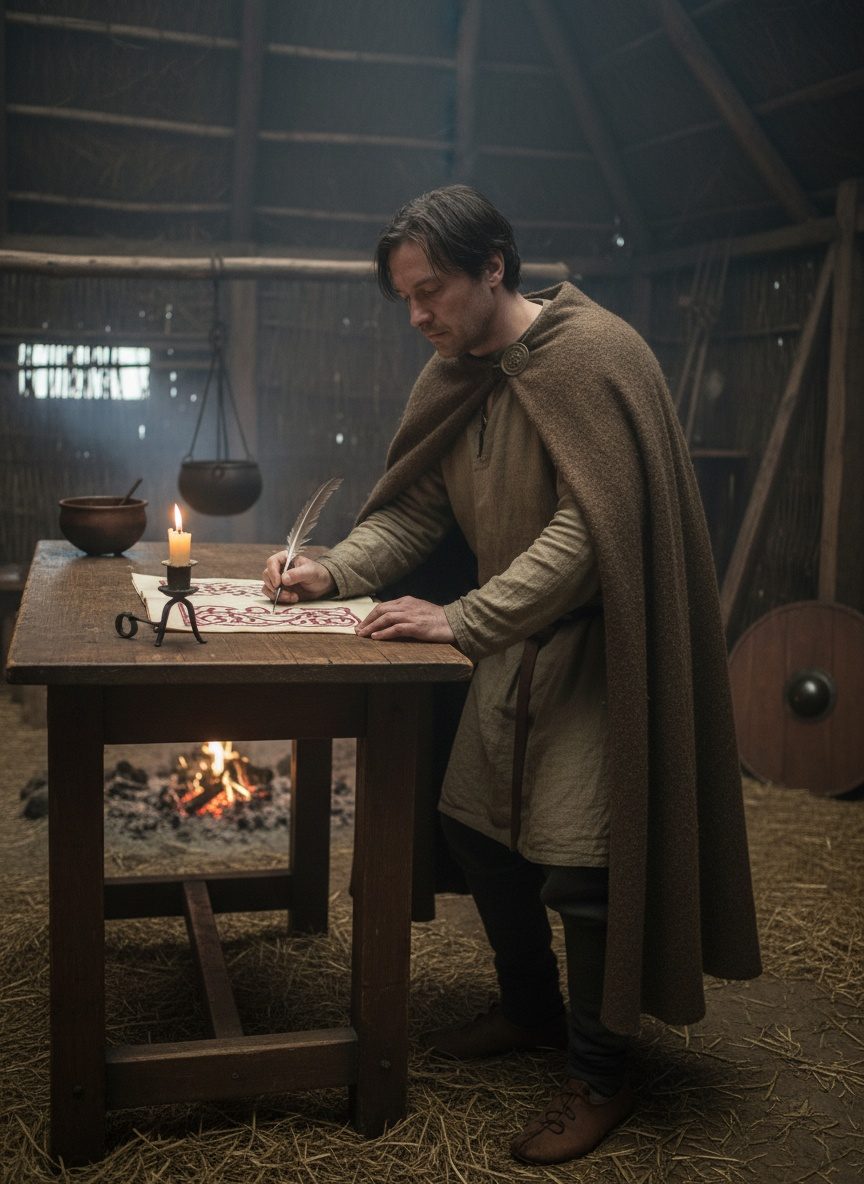
The dampness clawed at his bones, and the peat-smoke from the hearth stung his eyes, but he refused to be deterred. With numbed fingers, he clutched the fragile parchment, its surface a sea of squirming Latin letters awaiting his translation. Outside, the wind howled through the reeds of the Somerset marshes, a reminder of the chaotic world that had driven him, Alfred of Wessex, to this tiny refuge. Others might moan of despair; he chose instead to write hope into the world.
The Marsh King
In a time when kingdoms rose and fell with the thunder of swords, Alfred found himself a king with neither throne nor army. The year was 878 AD, and the Viking scourge had swept across England like a plague. The fierce Norse invaders surged through the land, and even the once-mighty kingdom of Wessex crumbled under their relentless advance. It seemed as though the light of Saxon England was flickering, about to be snuffed out by the shadow of foreign conquest.
But deep within the marshes of Somerset, Alfred, barely more than a handful of loyal men at his side, plotted. His subjects called him the unwanted marsh king, yet they didn’t understand the gift of the marshes—how the landscape itself had become his ally. It was here, amidst the mist and the mud, that Alfred rekindled the embers of a defiant hope. In this forgotten corner of England, he turned not to his sword, but to his pen.
The Power of Words
Though he had been driven from his lands, Alfred knew that the war against the Vikings was not solely one of physical conflict. An idea, a faith, could prove just as powerful as an entire army. His true battleground was the hearts and minds of his people, and to win there, he would arm them with knowledge that had long been cloaked in mystery.
Read next: The Day a Saxon King Knelt and Washed a Leper's Feet
Alfred understood Latin with some difficulty, the language of the Church and the law, a code locked away from the common folk he now hid among. So, in that marsh-land dwelling, with the world crumbling around him, Alfred began translating sacred texts and ancient wisdom into the Anglo-Saxon tongue. These were not mere words on a page; they were lifelines, a bridge over ignorance intended for hungry minds.
The Manuscript Mission
It was amidst the shifting tides of worry and relentless determination that Alfred embarked on his most ambitious project. He sought to make the word of God accessible not to the scribes in the churches, but to the ploughmen tilling the fields, the craftsmen at their forges. In one of the many dark moments, hunched over a table, he turned God's words into a language they could understand, whispering them into English.
Such a task might seem the burden of a lesser man than a king. Yet, to Alfred, each sentence was a shield, each paragraph a fortification for his people's spirits. By translating spiritual texts, he was not merely creating literature; he was crafting a new foundation for Saxon culture, where the nourishment of the mind was as vital as the might of the sword.
Victory from the Ashes
The marshes were filled with tales of hope kindling like small fires in the fog. Alfred's men spoke of their king with a reverence that bordered on myth. Here was a ruler who refused to succumb to the cold despair that might tremble the hardest heart. While other rulers raised armies, Alfred raised awareness, and in this quiet defiance, he birthed a revolution.
As the veil of the storm-clouds parted and the struggle to reclaim Wessex began in earnest, Alfred’s translated words had already gained power and prepared the way. When the Viking threat finally receded, it was not merely a victory of steel and strategy, but of an enlightened populace, roused to rally with their king by the words he had given them.
A Legacy Inked in Time
When daylight finally cast its glow back upon the reclaimed lands of Wessex, the manuscripts served as enduring symbols of a kingdom reborn. Alfred had transformed adversity into opportunity, the intangible gift of knowledge more potent than any weapon. This quiet translation, wrought from despair, sowed stronger roots for the English spirit than the mightiest of armies ever could.
Alfred's decision to translate those sacred texts laid the cornerstone for the cultural and intellectual revival of England, heralding an era where literature began to thrive, illuminating minds long shrouded in darkness. As he turned the pages of his life into legend, he not only secured his legacy as Alfred the Great but also as the ultimate warrior of word, safeguarding his people long after the swords were sheathed.
Perhaps it is this tale of resilience, carved into history, that reminds us why Alfred remains cherished. It is a lesson that even when stripped of kingdom, throne, and earthly power, one can still wield the formidable power of an idea, inked onto pages, to change the course of history and the lives of those it touches.