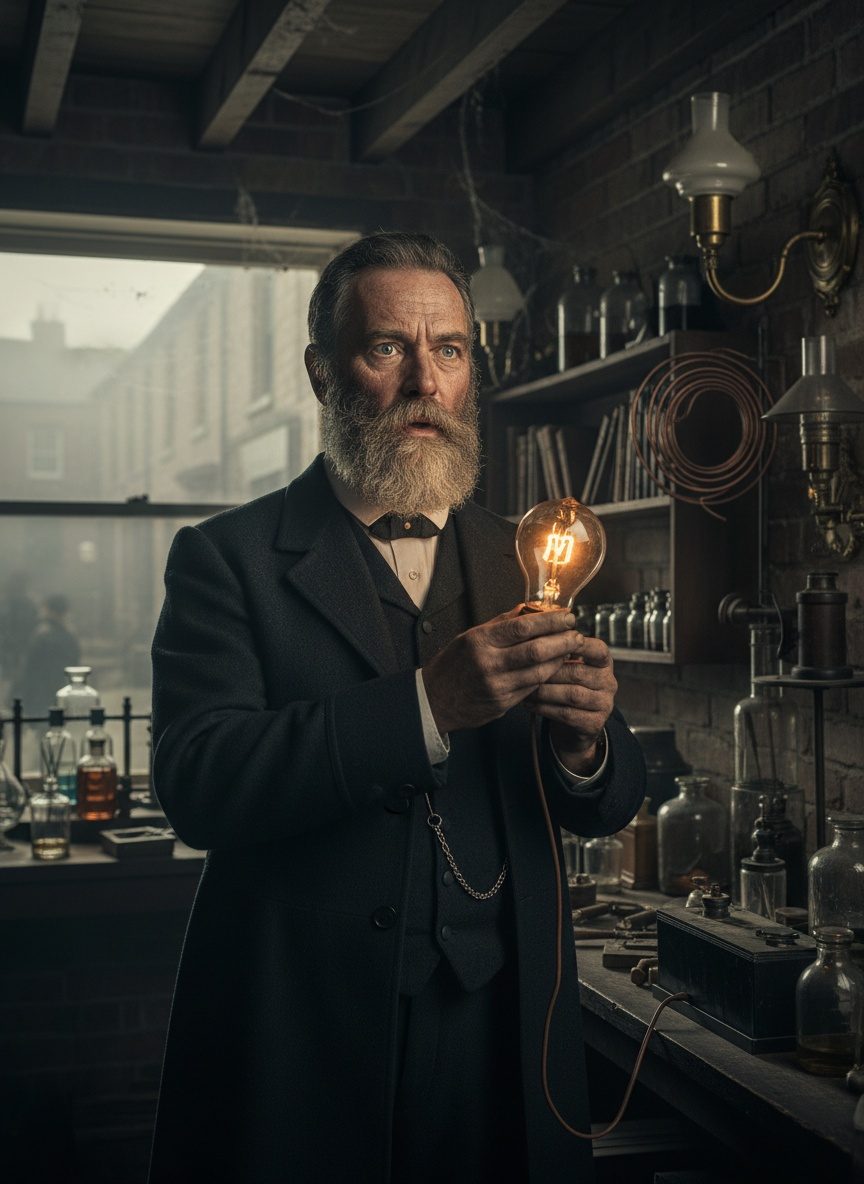
As dense clouds slid over the winter sky of Newcastle-upon-Tyne on a chilly evening in December 1878, a quiet chemist carefully twisted together two wires in his dimly lit workshop. The room was filled with the musty scent of chemical experiments and the faint hum of anticipation as Joseph Wilson Swan prepared to breathe life into his dream. When the connection was made, the bulb unexpectedly blazed to life, shattering the gloom with a steady, golden glow. The world of Victorian Britain was, for a moment, illuminated not just by light but by the promise of the future — and it had all begun with one man's relentless pursuit in the north of England.
The Eternal Experimenter
Joseph Wilson Swan was born in 1828 in Sunderland, and from a young age, he was captivated by the pursuit of knowledge. His curiosity led him to an apprenticeship at a local pharmacy, where he immersed himself in the study of chemistry. What may have seemed mundane work to others was, for Swan, an invitation to explore the boundaries of possibility. By 1848, Swan had relocated to Newcastle, where he joined with a small photographic company and later opened his inventions workshop. It was here that he first encountered the challenge of electric light — a challenge that would consume him for the next thirty years.
Swan's quest for electric illumination was no fanciful endeavor. It was a steadfast belief that the prevailing gas lighting, with its smoky, dim ambiance, could be replaced by something far more revolutionary. The chemist meticulously focused on identifying suitable materials for a filament that would conduct electricity and emit light without burning out too quickly. After countless trials and failures, didn’t just stumble upon the carbonized paper filament; he labored for years through frustrations and triumphs to arrive at a filament that could withstand the heat required to shine.
The Fiery Glow of Revolution
Finally, in December 1878, within the confines of his Newcastle workshop, Swan connected the carbon filament to an electrical supply. The moment wasn't marked by fanfare or trumpets; it was Swan in his solitude, the anticipation subtler yet no less powerful than the fiery light that suddenly lit the room. The bulb glowed warmly, beautifully — and above all, consistently — an invention seemingly brought to life with an air so magical it defied its simplicity.
Read next: The Day a Victorian Nurse Walked Into a Fever Ward Alone
By being the first to demonstrate a working electric light in that seminal winter night, Joseph Swan had effectively taken one step beyond the contemporary understanding of light, paving the way for the electrification of Britain and ultimately, the world. Astonishingly, Swan’s successful demonstration in November 1878 meant he had predated Thomas Edison’s famed lighting of Menlo Park by almost a year. It wasn’t about being the first, however. Swan’s aim was loftier: to fundamentally transform societal norms, and in this small room filled with vintage apparatus, the future had flickered to life for the first time.
The Unsung Hero of Innovation
While Edison has long been celebrated as the archetype of invention, Swan’s contributions reveal a rich tapestry of discovery often relegated to historical footnotes. After all, Edison himself acknowledged Swan's pioneering work. Accolades might have been sparse during his life, but Swan was no stranger to official recognition. In 1881, he was elected a Fellow of the Royal Society, slipping praise for his endeavors from science’s upper echelons. Later, his collaboration with Edison would manifest in the formation of the Edison & Swan Electric Light Company in 1883, sparking a new era in which electric lighting began to flicker and then blaze across Britain.
Swan's legacy, however, involves more: his filament process was used to great effect in X-ray tubes, and his experiments in photography led to the invention of bromide paper, revolutionizing photographic printing. Despite these achievements, recognition beyond academic circles was curiously muted compared to his illustrious counterparts.
Lighting Up the World
What Swan’s revolutionary illumination offered was nothing short of a new chapter in humanity's relationship with light. It allowed society to extend productivity into the night, irrevocably altering work patterns and social structures. Homes, factories, and streets were transformed. The pallor of gas lamps gave way to the spark and flicker of electric bulbs that breathed vigor into urban nights.
Yet, it was not just the practicality of Swan's invention that left an indelible mark; it was the symbol it became of Victorian ingenuity and perseverance. It showcased how a solitary man, inspired by nothing more significant than the dim twilight and endless curiosity, could light a path forward, blazing trails for future technologies to follow.
The Legacy of Illumination
Today, electric light may seem mundane, its ubiquity often causing us to overlook its profound impact. But Swan’s achievement holds timely relevance. In an age where technology evolves at breakneck speeds, his story reminds us that innovation is often born out of patience, perseverance, and a stubborn refusal to abandon the improbable.
Swan’s hard-won achievement serves as a luminous beacon — imploring today’s inventors and dreamers to connect the wires of imagination with the currents of truth, and in doing so, light up the shadows of the unknown. His story, often overlooked and under-told, illuminates not just the dark but the depths of human potential — a testament for all ages to never bask blindly in the glow of prevailing wisdom.