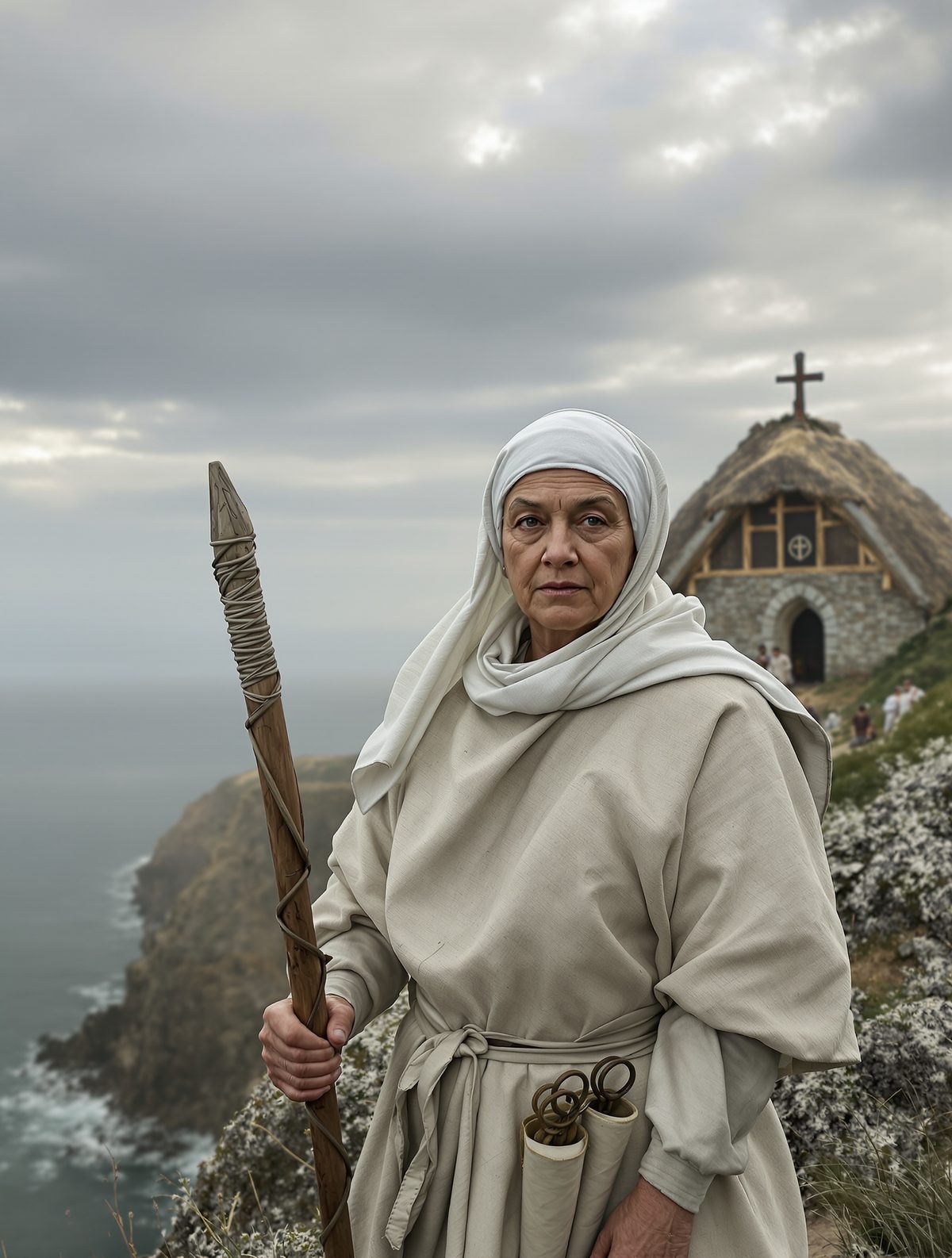
As the brisk sea winds howl against the ancient cliffs of Yorkshire, their song carries tales of a time long past, where a Saxon princess ignited a flame of learning and leadership that would burn brightly across England.
The Vision on the Headland
In the year 657 AD, atop the rugged headland overlooking the North Sea, a vision took shape, one that would redefine the spiritual and intellectual landscape of Anglo-Saxon England. It was here that Hild of Whitby, a noblewoman of royal blood, founded a community like none before. The stark beauty of the setting—with its vast vistas and endless horizons—was matched only by the pioneering spirit of its founder. Daughter of Prince Hereric of Deira, and great-niece to King Edwin of Northumbria, Hild took her place as a formidable force in her own right.
Beneath her stewardship, her abbey became a beacon of enlightenment in a turbulent age. The abbey at Whitby was not merely a religious sanctuary. It was an epicenter of knowledge where both sacred and worldly wisdom flourished. Hild’s ability to marry the ecclesial with the educational drew in those who would become the luminaries of their time. Astonishingly, no fewer than five students who studied at Whitby were elevated to bishoprics.
The Unsung Bard
Among the most remarkable figures to emerge from Whitby was a humble cowherd named Caedmon. Until his encounter with Hild's vibrant community, Caedmon was an unremarkable man, known more for his shyness than any talent. However, thanks to a dream—some say divinely inspired—Caedmon discovered his ability to craft verses that turned sacred stories into song. Encouraged by Hild, his poems would set the foundations for what we now recognize as English literature. Caedmon's hymn is considered the first piece of English poetry, a forgotten cornerstone of the literary tradition that coursed through medieval England.
Read next: The Day a Saxon Abbot Walked Into a Slave Market Alone
Hild's encouragement of Caedmon signified her extraordinary knack for recognizing and nurturing potential, regardless of status or background. She possessed that rare ability to see what others could not, illuminating the untapped reservoirs of talent that lay within her community.
The Counsel of Kings
The reputation of Whitby Abbey—and Hild's sage counsel—shot across the kingdom like an arrow. Kings and nobles from all corners of England sought her advice, regarding her as a paragon of wisdom and diplomacy. So respected was she that kings entrusted their sons to her guardianship, confident that at Whitby they would receive the finest education of both heart and mind. Hild’s influence was far-reaching; it was said that none who crossed her path left unchanged.
One of her most notable accomplishments came during the Synod of Whitby in 664 AD, a gathering pivotal in aligning the English Church with Roman practices. Her diplomatic skill ensured a smooth transition during this contentious theological dispute, demonstrating her unparalleled ability to navigate the intricacies of power and faith.
The Scholarly Sanctuary
At the heart of Whitby's success were the values of learning and piety that Hild intertwined seamlessly. The curriculum was progressive for its time, embracing subjects that ranged from theology and philosophy to poetry and history. The abbey became a crucible where ideas were exchanged freely, moulding minds capable of envisioning a future beyond the familiar feuds of rival kingdoms.
This remarkable institution operated with a sense of equality uncommon in its era; women and men were educated under the same roof, reflecting Hild's own belief in the inherent dignity and potential of every individual. Many may not know that this practice of inclusivity at Whitby condemned the rigid societal norms of the time, making it almost revolutionary.
The Enduring Legacy
Hild of Whitby passed in 680 AD, yet the flame she lit continued to illuminate the dark ages long after her demise. Her abbey emerged as a model for others throughout England and beyond. Her life was a testimony to her indomitable spirit and profound impact—a legacy where belief in educating the mind and soul thrived within the austere walls of Whitby Abbey.
Today, when we look upon the ruins of Whitby Abbey, silhouetted against the Yorkshire sky, we are reminded of the enduring power of vision and education. In a time when the world often valorized might over mind, Hild's story is a vivid reminder of the transformative power of knowledge and enlightenment. Her legacy prompts us to consider the potential resting within all of us to craft change, just as she did on those windswept headlands more than a millennium ago.
The fire Hild sparked at Whitby still illuminates the path forward—a testament to the timeless power of education and creativity to shape the future.