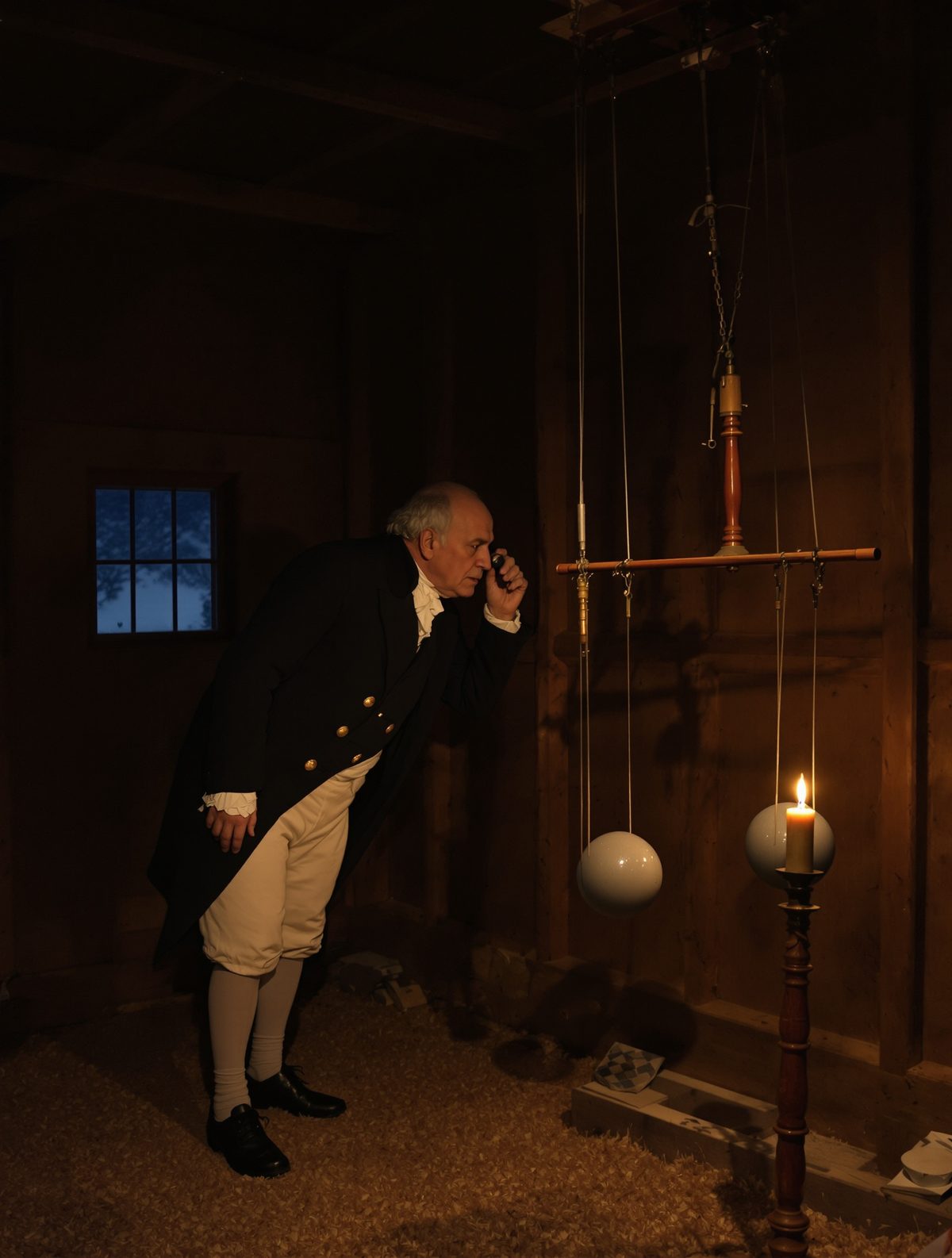
June 1797. The quiet, leafy suburb of Clapham, South London, bore witness to an event so significant that it would change the way humanity understood its place in the universe. Within the confines of a modest garden shed, a reclusive gentleman emerged from his solitude to carry out a feat that defied the imagination of his peers. Henry Cavendish, a man known as much for his ghost-like presence as his prodigious intellect, succeeded where many only dreamed — he weighed the entire planet Earth.
The Phantom of Clapham
Henry Cavendish, born in 1731, was an enigmatic figure even among the eccentric geniuses of the Georgian era. Unquestionably one of the wealthiest men in England, Cavendish was the heir to fortunes from both his father and his noble grandfather, the Duke of Devonshire. Yet, his wealth rarely translated to societal visibility or luxury. Instead, Cavendish lived like a phantom, communicating with his servants through written notes and avoiding eye contact at all costs. He was known to arrive at dinner parties only to stand silently by the fireplace, his thoughts worlds apart.
Despite his socially withdrawn demeanor, Cavendish was a towering figure in the scientific community, celebrated for his groundbreaking experiments in chemistry and physics. He was, in many ways, a self-sufficient institution of scientific inquiry, preferring his laboratory to any lively salon.
Constructing a Universe in a Shed
A dedicated observer, Henry Cavendish was obsessed with measurement and precision. In 1797, he embarked on an experiment that would eventually be remembered as "The Cavendish Experiment." It was an undertaking that demanded both his intellect and introverted nature — the weighing of the Earth.
Read next: The Day a Miner's Son Gave the World Safe Light
Using a simple wooden shed as his workshop, Cavendish constructed a device so intricate it stood as one of the most precise instruments of his age. This contraption, known as a torsion balance, comprised lead spheres suspended from a wire, which would measure the faint gravitational attraction between masses. The concept was rooted in Isaac Newton's law of gravitation, yet no one before had employed it to measure Earth's mass.
Imagine, if you will, the dimly lit shed illuminated by a single lantern. There, Cavendish, in solitude, made minute adjustments, peering through his telescope to avoid disturbing the apparatus. His meticulousness bordered on the obsessive; any vibration, even the gentle tap of his foot, could disturb the experiment's fragility.
A Sea of Numbers and a Calculated World
By documenting the deflection of the wire and the consequent movement of the spheres, Cavendish could calculate the force of gravitational attraction. From this, using well-known values of density and volume, he determined Earth's mass. The number, strikingly close to modern values, was 5.972 × 1024 kg — practically the same figure modern science agrees upon.
One must not forget that this was achieved in a world before digital technology, without sophisticated computing power. Cavendish conducted countless trials, letting the spheres sway rhythmically until they reached equilibrium, a process taking weeks or months to ensure accuracy. Without fanfare or acclaim, he produced a result that solved one of nature's profound mysteries.
The Echoes of Silence
Many contemporaries had no inkling of Cavendish's monumental accomplishment. Ever modest and self-effacing, he published his findings in an understated manner, under the technical title "Experiments to Determine the Density of the Earth." The paper was devoid of grandeur or extravagance, much like Cavendish himself, who cared solely for the pursuit of truth. It wasn't until decades later that his "weighing the world" became acknowledged for the scientific tour de force it was.
An astonishing fact about Henry Cavendish's life is that he left reams of unpublished notes that, upon their later study, revealed methods and insights that were far ahead of his time, prefiguring discoveries attributed to future scientists.
Legacy of the Lonesome Genius
So, why does the life and work of Henry Cavendish matter today? In a world driven by technological connectivity, Cavendish's journey reminds us of the power of solitary exploration and the relentless pursuit of knowledge for its own sake. His weighing of the Earth was not just a testament to his genius but an enduring message that the Universe's deepest secrets can be unraveled even by those who work in silence.
Henry Cavendish's solitary genius soared amidst the whispering winds of Clapham's leafy suburbs. His life and achievements suggest that innovation doesn't always reside in the loud, bustling hubs of society but often in the quietness within, where thought is unshackled by the pressures of social convention.
We remember Cavendish not just for weighing the Earth but for demonstrating that the pursuit of knowledge is as infinite as the universe, and as profound as a solitary evening beneath the stars.