He was a servant, not a free man. But Joseph Knight dared to challenge the very foundation of Scottish laws protecting slavery's authority.
The Chains of Empire
In the thriving colonial heart of the British Empire, Jamaica stood vibrant with the labor of enslaved Africans. Among them was Joseph Knight, torn from his homeland and shackled to the sugarcane fields. Jamaica was a place where the line between survival and despair was as thin as a plantation owner's whip. Knight's journey to Scotland began when John Wedderburn, a Scottish plantation owner, decided to bring him back as part of his household. In 1769, Knight was transported across the Atlantic, trading the hot, humid climes of the Caribbean for the comparatively brisk Scottish air.
For many at the time, Scotland's own landscape symbolized freedom, but for Knight, the 'freedom' experienced was mere rhetoric. His labor continued in the Wedderburn household, no longer beneath the glaring sun, but under subtler, yet no less oppressive, social circumstances. While Jamaica bound Knight with the chains of legality, Scotland suggested the possibility of a new life—a concept Knight tenaciously pursued.
The Rule of Law Meets Humanity
In Edinburgh, the capital of Scotland, legal mores were evolving. Enlightenment ideas whispered promises of liberty and equality, echoing across cobblestones into the ears of thinkers and judges. However, the law still bore signs of its past, complicated and cobbled together from Roman precedents and medieval common law.
Read next: The Day a Scots Minister Walked Into a Plague Town Alone
When Joseph Knight took his case to the Court of Session in 1778, he invoked a pre-existing, yet seldom adjudicated Scottish tradition that valued the air of freedom. Knight asserted that once he stood on Scottish soil, he ceased to be property. He was aided by a groundswell of support, including abolitionists keen on hammering away at the institution of slavery, and they seized upon this chance for a grand legal challenge.
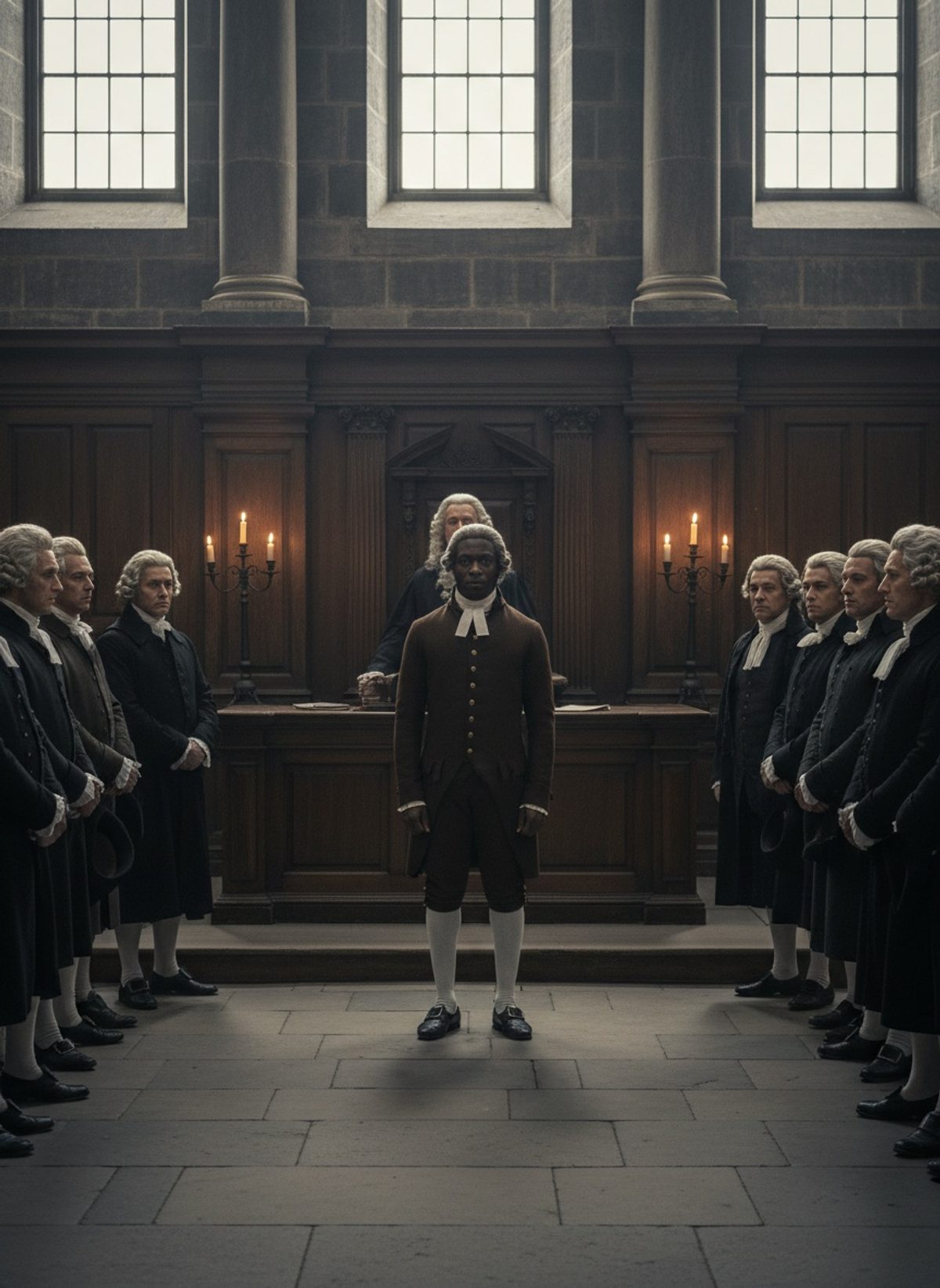
The scene in the courtroom was intense. All eyes were on Lord Kames, an influential figure in Scottish jurisprudence and an Enlightenment philosopher in his own right. The question was deceptively simple: could a man be considered property on Scottish soil? Kames’s ruling not only had national implications but was a moral litmus test for an entire society.
Knight's Fight for Freedom
Knight's battle bore the weight of history. His determination unfurled in courtroom debates as legal minds untangled centuries of legislative matrices entangled with societal norms. For the first time, the personal story of one man stood poised to reshape Scottish legislative identity.
Lord Kames declared that slavery was not recognized by the law of Scotland. The court ruled that regardless of his origin as a slave, no man could be a slave once he stepped onto Scottish soil. This decision marked a sweeping shift in Scottish history. Although rooted in one case, Knight's victory was symbolic for the enslaved people everywhere, heralding a philosophical shift towards the recognition of human rights.
The Impact of a Single Ruling
The reverberations from the Court of Session's decision extended far beyond Joseph Knight. While the ruling did not immediately end the British Empire's reliance on slavery, it established a precedent in Scottish law that defied the dehumanizing notion of humans as property—a precursor fortress against the oncoming tides of abolition.
Scotland’s legal quagmire had turned into fertile ground for planting seeds of abolition. While many of Scotland’s wealthiest families had benefitted extensively from the slave trade, the country was now on a path that would increasingly oppose such practices. Throughout Britain and the world, the case of Joseph Knight would become a beacon, an invocation for justice.
A Legacy Carved in Courage
Joseph Knight’s fight in a quiet Edinburgh courtroom illustrated the power of an individual's quest for justice to ignite society-wide change. His stance, alongside Lord Kames’s pivotal ruling, provided a framework for challenging legal norms that had long protected slavery. The courage found in Knight’s circumstances illuminated the harsh realities of an empire built on the backs of the enslaved, urging a re-evaluation of what freedom and rights truly meant in a modern society.
In the endless annals of history, where empires rise and fall, the day Joseph Knight walked into and left that court was a reminder that laws, no matter how embedded they seem, are human creations—and as such, they can be unmade and remade. A reminder that it often takes just one courageous act to initiate profound change. In a Scotland seeking to reconcile its ideals with its practices, Knight’s defiance and the court's verdict remain a vital tale of justice, freedom, and the power narrative holds in shaping a nation's future.