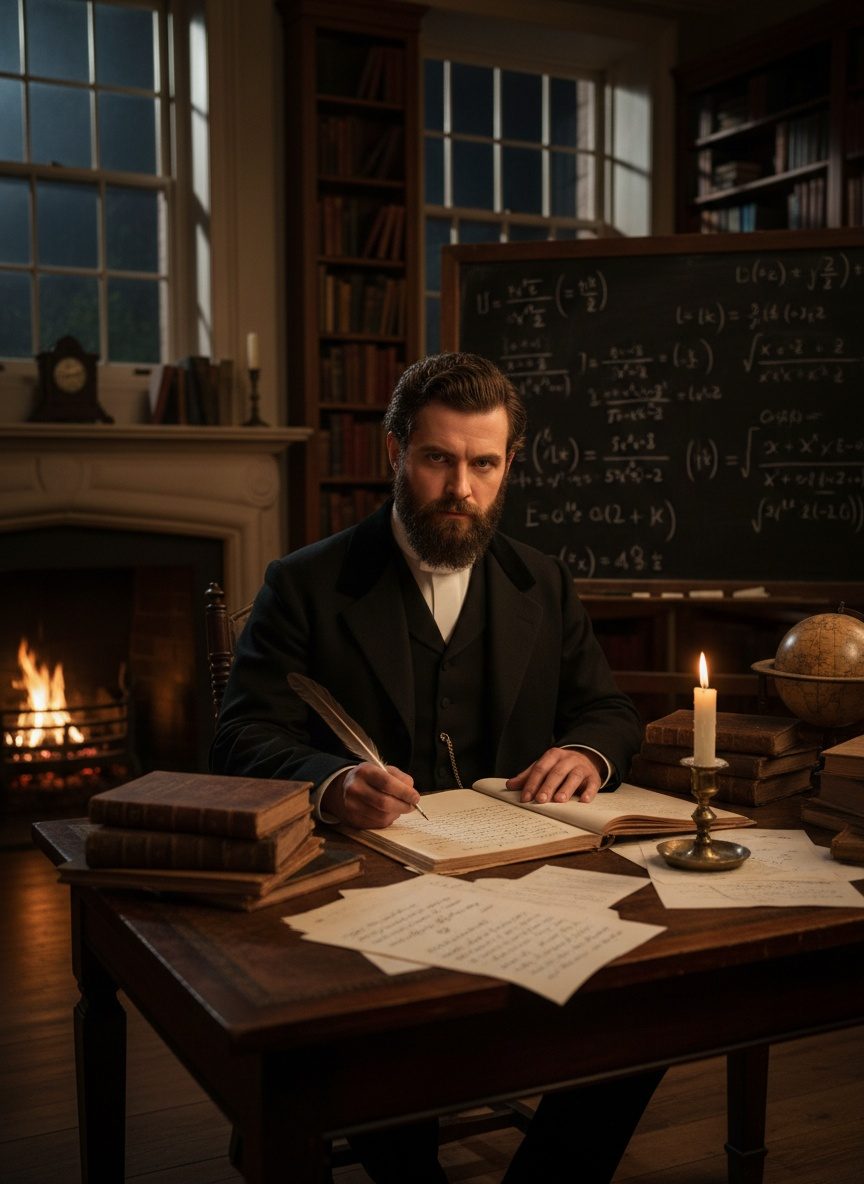
He was a Scottish clerk, nestled quietly in the heart of Victorian Edinburgh. Yet James Clerk Maxwell wielded a pen with the power to illuminate the universe.
The Quiet Scotsman in the Age of Steam
In the bustling epoch of the Victorian Era, the Industrial Revolution roared through cities, transforming landscapes with smoke and steel. Amidst the clamor of innovation, a solitary figure in Edinburgh, far removed from the clanking machinery of modern contraptions, sat hunched over a desk. James Clerk Maxwell, a man blessed with a mind as vast as the universe he pondered, had found his stage not in factories or laboratories, but in the quietude of thought.
Born into a world buzzing with mechanical wonders, Maxwell's genius wasn't forged in the flaming fires of industry, but rather in the serene elegance of abstract reasoning. In 1859, mere numbers on a page began to whisper truths that no instrument of the day could capture. While others built engines of steam and structures of iron, Maxwell constructed bridges of understanding, connecting the invisible forces of nature with humanity's endless curiosity.
The Equations That Spoke Volumes
Maxwell’s remarkable journey was marked by an unwavering belief in the power of mathematics. At a time when physical experiments defined scientific discovery, he sought to unravel the mysteries of the universe with the elegance of equations. Without the trappings of a grand laboratory or a cacophony of assistants, Maxwell relied solely on the language of mathematics to speak to the cosmos.
Read next: The Day a Miner's Son Gave the World Safe Light
The waves of light, electric sparks, and magnetic dances became part of a single symphony under his pen. In their simplest form, Maxwell's equations unified electricity, magnetism, and light into a single theoretical framework. The Victorian era may have marveled at the tangible feats of iron and steam, but Maxwell's abstract tapestry was the loom of future realities we could yet only imagine. He proved that light itself is an electromagnetic wave, a flash of insight sparking the inception of every radio signal and wireless communication of the modern world.
A Pivotal Moment in History
Consider the scene: an ordinary room in Edinburgh, its air filled not with the acrid scent of chemicals or the rasp of machinery, but with the soft rustle of paper and the gentle scratch of quill on parchment. It was here, in 1865, that Maxwell's quivering pen inscribed the four elegant equations that would forever change our perception of reality. These weren’t mere scribbles; they were declarations that lit up the obscured corridors of scientific understanding.
Maxwell's revelation was initially cloaked in the complex garb of mathematical formalism, perhaps incomprehensible to many of his contemporaries. But within those mathematical lines lay the fundamental truth about the universe, a unification of phenomena that underpinned everything from the gentle flicker of a candle flame to the titanic forces driving the stars.
The Legacy of Light
Maxwell's work was revolutionary, a silent but profound thunder that ignited the imagination of future scientists. Albert Einstein would later assert that the theory of relativity stood on Maxwell’s shoulders, keeping Maxwell’s portrait hung on his study wall in homage. Such was the impact that a humble Scotsman’s equations had on those who sought to grasp the nature of light, space, and time itself.
The significance of Maxwell’s achievement in a world now animated by electromagnetic technology is immeasurable. As our devices pulse with data carried by invisible waves, it is easy to overlook the mathematical roots that gave rise to our digital reality. Maxwell’s triumph in 1859 was the quiet dawn of an era, woven not in steel or stone, but in the elegant fabric of understanding — a testament to the power of human cognition and creativity.
This tale reveals how innovation sometimes emerges not from thunderous invention but from silent introspection. Maxwell’s equations are a beacon, shedding light on how the pursuit of knowledge through quiet dedication can yield discoveries that illuminate the path forward for all of humanity. The waves he envisioned ripple through time, an echo of that contemplative Victorian moment that continues to resonate in our electrified age.