The Day a Sick Young Man Decoded the Language of the Stars
A Starry Obsession in the Chill of York
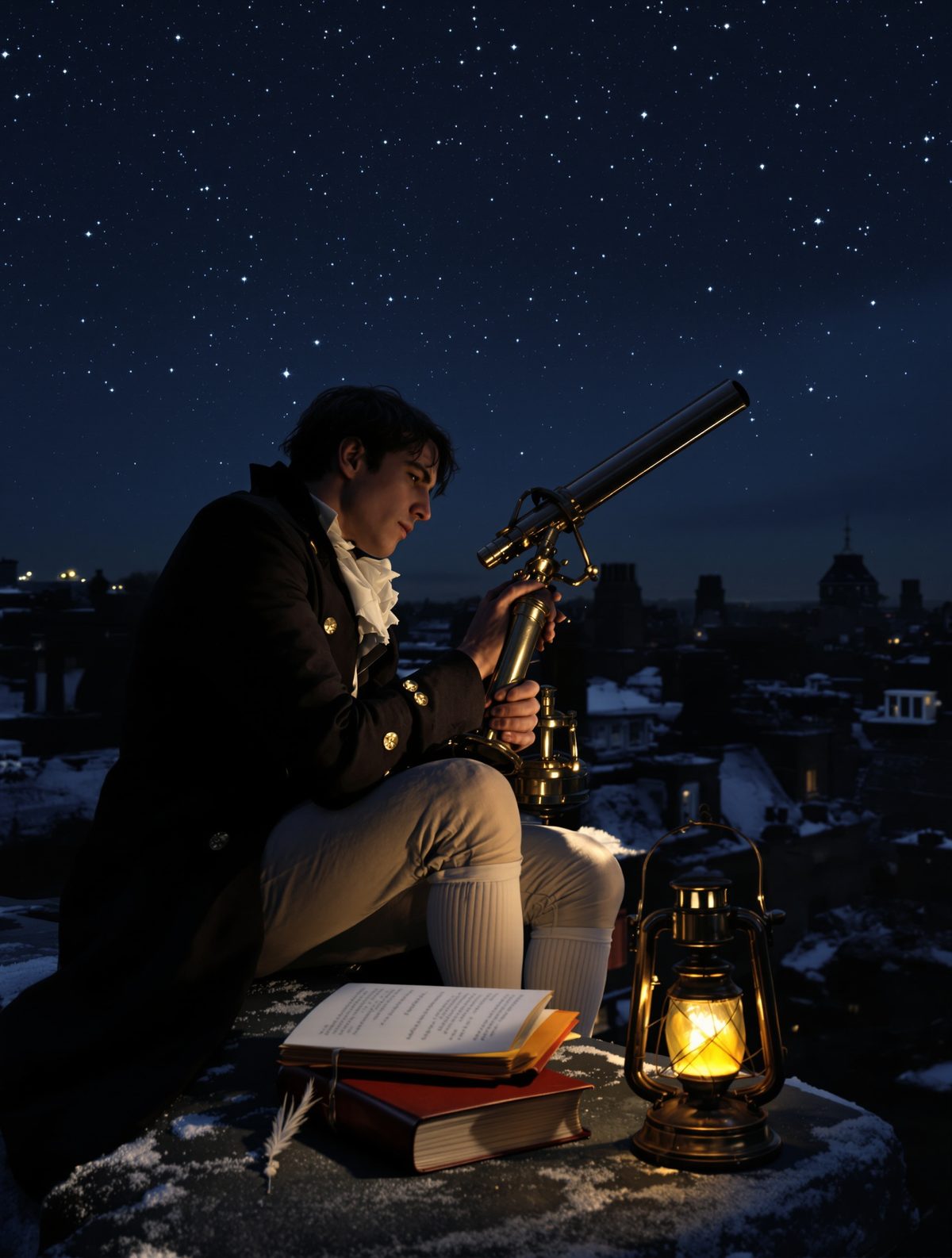
It was on one of those icy evenings of the winter of 1782, when most folks in the north of England huddled around their hearths for warmth, that a young man made history under the starlit skies of York. Wrapped against the biting cold, the frail figure settled before his telescope in a small garden, his breath forming mist in the February air, frost clinging to the woollen curves of his cap. This was no ordinary observer of the heavens—it was the 24-year-old John Goodricke, battling illness, hearing silence, and marked by time’s fleeting nature.
Goodricke’s determination in the face of his physical limitations was as extraordinary as the skies he studied. Though unable to hear the clatter of society or the whistling wind, he felt a profound connection with the stars above. That particular winter, his telescope was fixed intently on a celestial enigma—a star that defied the eternal constancy once assumed of heavenly lights. Despite being given only months to live, Goodricke was not inclined to surrender the mystery of Algol, a star that seemed to change its brightness in a surreptitious dance. Little did the world know, this quiet, sickly lad would soon alter humanity's understanding of the cosmos.
The Unlikely Astronomer
To appreciate Goodricke’s contribution, it’s essential to delve into the unlikely circumstances that shaped him. Born in 1764, John Goodricke was a child of privilege but also adversity. His father, Henry Goodricke, descended from a long line of baronets, while his mother, Levina, hailed from a cosmopolitan Dutch family. An illness during infancy rendered John deaf, a condition that shaped his isolation from the bustling world and directed his gaze upwards, away from words unspoken and unanswered into the silent dialogue of the stars.
Read next: The Day a Miner's Son Gave the World Safe Light
Edinburgh was the stage of Goodricke’s early education, but it was in a Yorkshire school, led by a teacher adept in mathematics and astronomy, that his budding interest found nurture. The curriculum, suited to navigating a celestial globe, ignited in young John not just a passion but purpose. It was there he learned of methods that medieval astrologers could only have dreamed of and began to consider questions about the skies most had never thought to ask.
The Mystery of Algol Unraveled
The peculiar star that had held Goodricke’s attention for those frozen nights was Beta Persei, more romantically known as Algol, the Demon Star. Previous astronomers had noted its mysterious dimming, a phenomenon recorded as far back as 1667 by the Italian astronomer Geminiano Montanari. Yet, the mechanism behind Algol’s seemingly capricious behavior eluded explanation. To the scientific community, it was a perplexing riddle. To Goodricke, it was a challenge for his analytical mind.
Through systematic observation, which involved noting the star’s brightness every clear night—its periodic mysterious dip piqued Goodricke's curiosity—he hypothesized that the variations were not inherent to Algol itself but rather due to the presence of another body moving around it. This was an astonishingly advanced theory of its time, suggesting a binary star system where one star periodically eclipses the other. He dared to claim that Algol wasn’t a solitary entity but a paired system dancing an orbit that would reveal the secrets of the universe.
The First Steps in Understanding Stellar Pulsation
In May 1783, his observations, noted meticulously under the candle’s flicker in the midst of numbing cold, were presented to the Royal Society—not by Goodricke himself, for he never indulged in self-promotion, but by his mentor and fellow astronomer, Edward Pigott. Despite the unconventional path of recognition, the society awarded Goodricke with the Copley Medal in 1783, the institution’s most distinguished acknowledgment of scientific achievement, recognizing the precision and insight of his work.
Goodricke’s findings amounted to the first known discovery of a variable star’s behavior through regular and predictable changes, sowing seeds for the future field of variable star astronomy. His work paved the way for future astronomers to explore the astonishing diversity of the universe’s astronomical bodies, leading to insights into the lifespans and structures of stars. Though he himself would not live to witness the blossoming of his work—Goodricke passed away tragically young at 21—his legacy started the unravelling of celestial mysteries.
A Deaf Astronomer’s Lasting Impact on Modern Science
Imagine now, the world within which Goodricke worked: no advanced equipment or powerful computers for modeling celestial events, merely a telescope, handcrafted tables of data, and a mind able to pick clues from the coded language of the universe. Today, in an era abundant with technological advantage, our comprehension of stellar life cycles, distances, and phenomena owes an immense debt to the groundwork laid by this remarkable Georgian mind.
While funds and conspiracies of inertia often stifle talent, Goodricke’s story, punctuated by brevity but packed with innovation, is a reminder of the boundless capacity for achievement inherent in human curiosity and perseverance, regardless of physical limitations or societal expectations.
Why John Goodricke Matters Today
In a world that sometimes marginalizes those who are different, Goodricke’s life and work stand as a testament to what can be accomplished with quiet courage and a relentless quest for knowledge. His ability to communicate the language of the stars from a small garden in York hasn’t just changed how we look above but has assuredly influenced how we must look within society itself—crafting the notion that disability is neither a barrier nor a determinant of capability.
The stars do more than just illuminate the night sky. They tell stories, and in decoding their language, John Goodricke crafted a narrative that still resonates today: a narrative of resilience, intellect, and above all, the unyielding willingness to peer into the uncharted realms of possibility, one cold night after another.
And so, as you find yourself looking skyward on a crisp evening, remember the tale of John Goodricke, the sick young man who, as much an observer as the telescopic lens through which he peered, illuminated the world with his singular brilliance.