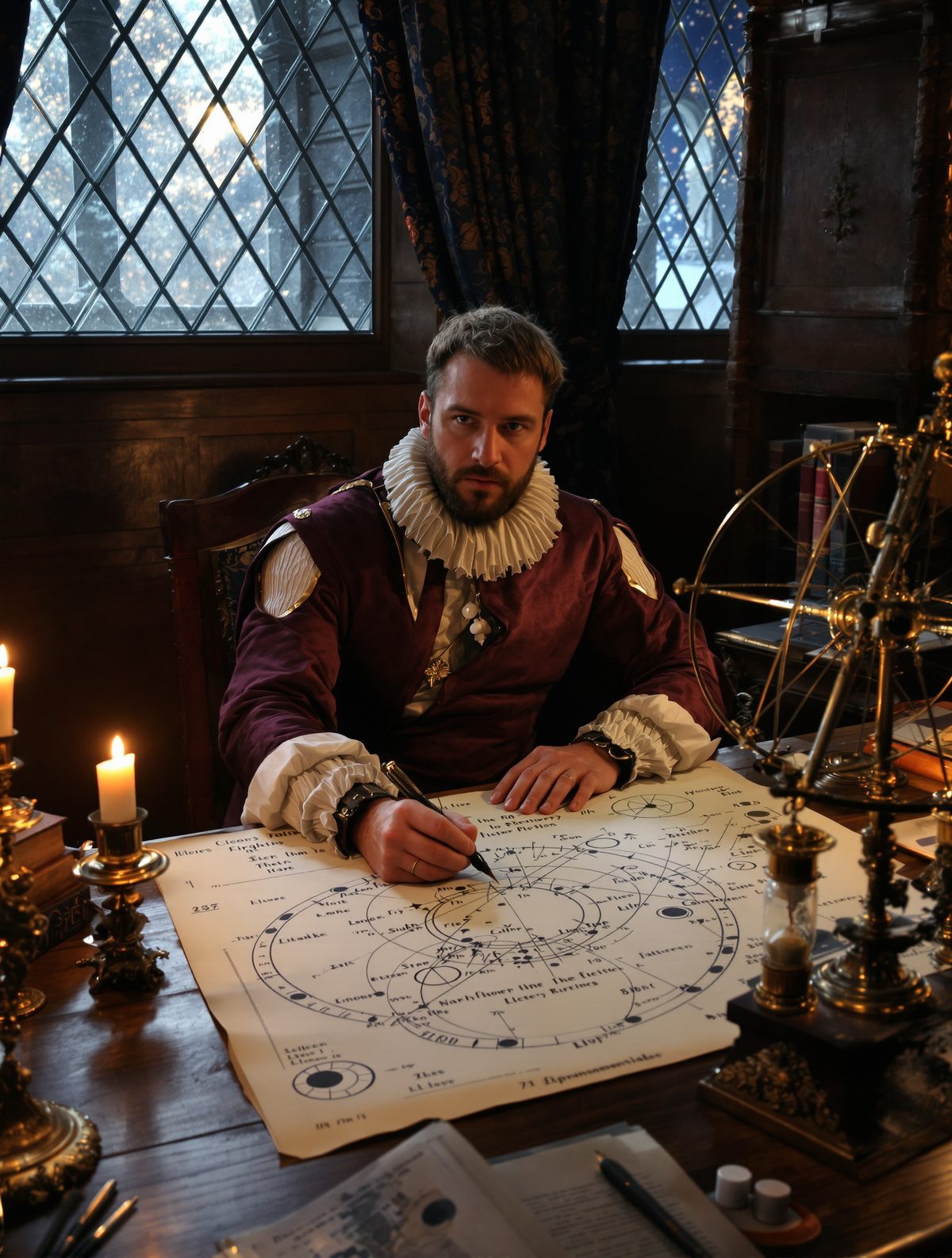
For most of 1576, the sky's daily turns were a dance of divine order for the common folk of England, its twinkling stars as immutable as the pages of the Good Book. But within the shadowed walls of this celestial theatre, one man, Thomas Digges, prepared to stage a production as audacious as it was heretical. Digges was no ordinary astronomer; he was a pioneer, unswayed by the prohibitions of the church, driven by a profound thirst for knowledge. His work would ripple across the pages of history, unraveling the tightly held notions of the heavens.
The Unlikely Heir
Born in 1546 in the bustling parish of St. Botolph’s, Aldgate, London, Thomas Digges was thrust from a young age into a world that danced between the dim flickers of mathematical genius and the pervasive shadows of religious dogma. His father, Leonard Digges, was an established mathematician and surveyor, whose own ambitions were cut short by a mysterious death when Thomas was just thirteen. Despite this early tragedy, Leonard left behind an unfinished work that would become the seed from which Thomas’s celestial revelations would bloom.
With an ambitious heart and a mind crafted through the finest teachings of both mathematics and astronomy, Thomas was the rightful heir to his father’s intellectual throne. Yet, he was not satisfied with merely completing his father’s notes. He was determined to redefine them, to question the unquestionable, and in doing so, set the Mercury of enlightenment teetering precariously on the scales of an uncharted cosmos.
A World Without Edges
In an era where geometric perfection was likened to divine harmony, the notion of an infinite universe was unthinkable, even heretical. In 1576, when Thomas published his revolutionary translation of Copernicus's *De revolutionibus orbium coelestium*, his additions shocked the world. He did not just interpret Copernicus; he opened the book wide. Where Copernicus had alluded to a heliocentric universe without claiming infinity, Digges went further, proposing a cosmology with no borders — a boundless expanse, teeming with an unending cascade of stars.
Read next: The Day a Stuart King Walked Calmly to His Own Execution
The Perfit Description of the Caelestiall Orbes, Digges's treatise, dared to shatter the celestial spheres intact since Aristotle. He proposed that the stars stretched infinitely beyond the solar system, like islands scattered across a never-ending archipelago. It was as though someone within the cloistered scholastic darkness had struck a match, illuminating a universe where divine providence might reside in infinite space, rather than tightly-bound celestial curves.
Fighting the Firmament
With parchment and ink as his sword and shield, Digges mounted a largely solitary battle against ecclesiastical tradition. The Church's interpretation of Scripture proclaimed a finite cosmos created by divine decree, with heavenly bodies spinning in crystalline spheres. To them, the periphery of creation was a fixed set of concentric circles, each enclosing the known planets, and beyond them, the divine realm.
By suggesting that the universe extended infinitely, Digges effectively rendered those celestial spheres redundant, boldly challenging not only scientific paradigms but theological ones too. It was a defiance that could court excommunication — or worse.
The English Printing Revolution
At a time when the written word had the power to shift societies, Digges's assertions found a voice within the burgeoning realm of English print. Unlike earlier works that were largely the domain of Latin, and thus the educated elite, Digges ensured that his astronomical musings reached the broader English public in their mother tongue when he published The Perfit Description.
His work mirrored England’s rising intellectual independence, a small but significant step on the path to loosen its scholarly reliance on continental Europe. This wasn’t just a scientific milestone; it was also emblematic of a cultural awakening — an assertion that British thought could utterly transform the way humanity perceived its place in the cosmos.
Legacy of a Cosmic Visionary
Although Thomas Digges may not be as widely celebrated today as Copernicus or Galileo, his contributions set the stage for future astronomical discoveries. His radical assertion of an infinite universe would pave the way for thinkers like Giordano Bruno and Isaac Newton, who would further challenge and eventually reshape the understanding of the heavens.
In the current age, where black holes and dark matter fill our imaginations and our physics textbooks, Digges serves as a poignant reminder of the power of human curiosity — to question, to explore, and to redefine the very essence of reality. In a universe where knowledge should have no limits, Digges's work continues to inspire, demonstrating that progress often arises from those willing to defy the established and gaze beyond the confines that tradition imposes.
The Call to Look Up
As modern society contends with the bounds of its own knowledge and confronts the infinite unknowns of the universe, the legacy of Thomas Digges resonates more deeply than ever. His audacious leap into the uncharted dimensions of the cosmos encourages us not to simply accept the world as it is, but to explore what lies beyond — to push against the edges until they vanish into the infinite night.
On that day in 1576, when Thomas Digges pierced the celestial veil, he bequeathed a timeless command etched in the starlit tapestry of history: Look up, and ponder the infinite.