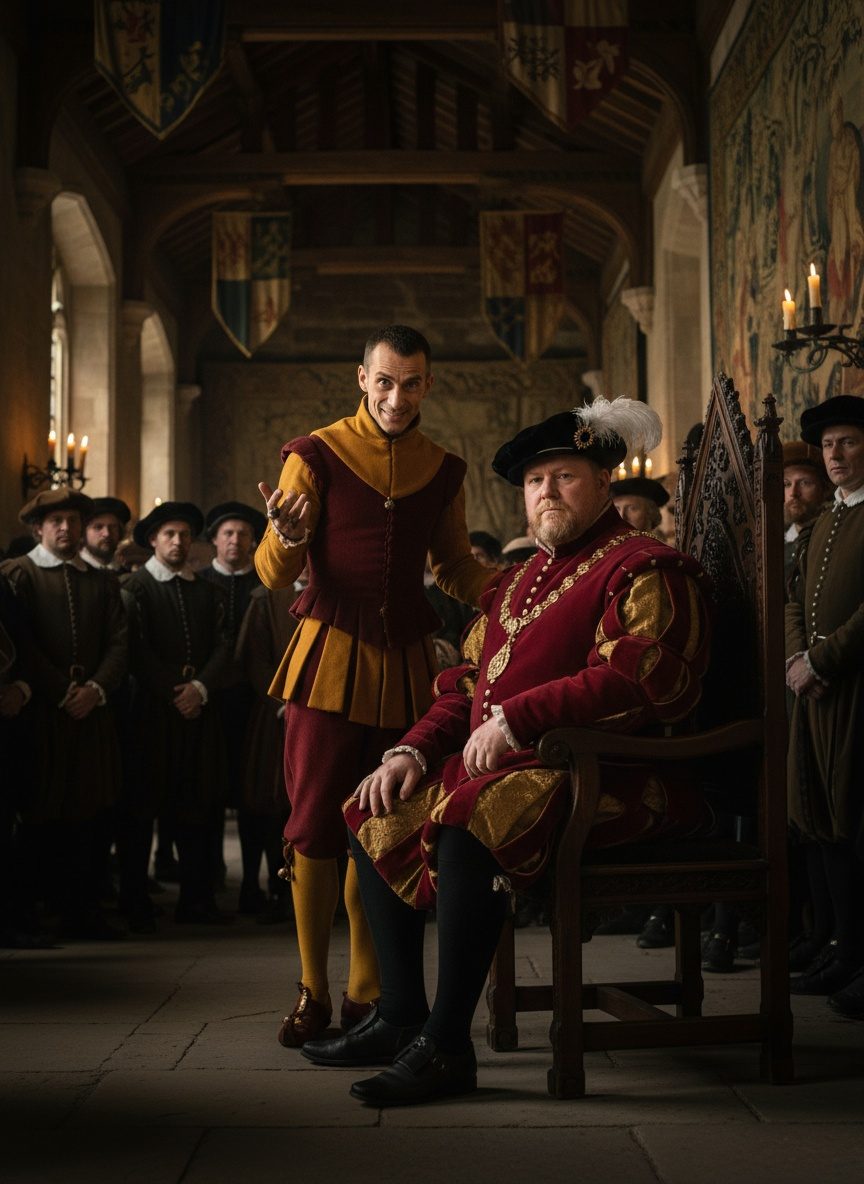
He wore a motley of the brightest colors. He held the power to soothe a king's rage with a single jest.
The Fool Who Spoke When Others Fled
In the grand halls of Tudor England, even the laughter held its breath. Few dared to disturb King Henry VIII's formidable temper. Courtiers, diplomats, and advisors lived and died according to the whims of this unpredictable monarch. Yet, among these wary souls, one man stood apart. His name was Will Somers, a man of slight build and mischievous wit. When the court was silent and courtiers slipped away to the shadows, Somers approached the throne with unwavering resolve. He held in his grasp not delicate scrolls or elaborate plans, but a jester's staff and a repertoire of sharp quips.
In a world where favors could shift with the wind and the wrong word could spell doom, Somers possessed a peculiar invulnerability. His tool of trade was humor, and his sanctuary, an intangible bond with the king he served. As those wiser in statecraft scurried away, Somers approached King Henry VIII fearlessly, undeterred by fury that could send heads rolling. He was no ordinary fool; he was a master of the delicate dance between jest and insult, using his art to deflect the king's ire and sow serenity where others sowed fear.
An Unlikely Friendship Forged in Humor
The story of Will Somers' acceptance into King Henry VIII’s court is shrouded in legend. A young man from Shropshire, he was not born into privilege, nor did he possess a pedigree that might open palace doors. Instead, the path to his royal appointment was paved with his ability to make others laugh, a skill more precious than royal blood in a tense court. Despite his humble origins, once Somers entered the court, he never looked back. His talents caught the attention of King Henry, who found an unexpected delight in the jester's wit.
Read next: The Day a Stuart King Walked Calmly to His Own Execution
With Somers, the king shared a relationship uncommon in those rigid structures of power; they laughed together. The bond was one of friendship, an anomaly in a world defined by hierarchy and duty. Somers’ humor cut through the layers of tension that often encroached upon courtly life. He had the licence to speak truths hidden beneath the veil of jests, reflecting the king's true nature back to him and, in so doing, reminding Henry of his own humanity.
The Court’s Delicate Juggling Act
As court fool, Will Somers occupied a unique space within the Tudor hierarchy. His role was not merely to entertain, but to distill the chaotic whirl of court politics into something palatable. Through his japes, Somers could address truths, subtly guiding the fluctuating sympathies of those in power. It was a position requiring finesse and fearlessness, an art of balance between humor and dangerous candor. With each jest, Somers walked a tightrope, maintaining his perch with a deftness that few could achieve.
His role in court was multifaceted, serving both as an entertainer and an unofficial advisor. Somers' insights were sought in moments when the traditional channels of counsel had been exhausted. In a court where every utterance carried weight and every misstep could have dire consequences, Somers’ freedom of speech was a precious anomaly. His humor acted as both salve and sword, easing tensions and piercing deceptions when required.
The Day a Jest Saved Lives
One infamous day in 1535, rolls of thunder echoed not from the skies above but from the very seat of English power. King Henry VIII, a towering figure known for mercurial shifts between honor and anger, had been provoked, his wrath threatening to consume anyone unfortunate enough to linger nearby. The courtiers had vanished, leaving a solemn space around the throne. It was an atmosphere ripe with tension and silence, broken only by the determined footfalls of Will Somers.
As he approached the throne, courtiers held their breath, fearing the consequences of a poorly timed jest. Yet, with a deftness born of experience and flair, Somers broke the air taut with anticipation. His jest erupted through the chamber as a beacon of levity, momentarily transforming a room steeped in anxiety into one of release. In that singular moment, Henry's fury was assuaged, dissipated amidst peals of royal laughter. England—a nation that often trembled at its sovereign’s unpredictable moods—found solace in the laughter of a king and the jovial courage of his fool.
A Legacy of Laughter That Ceased the Thunder
Though the title of court fool may seem diminutive, Will Somers’ legacy endures as a reminder of the power of humor in even the darkest of times. His tenure in the court of Henry VIII was a testament to the notion that laughter holds untapped strength, capable of bridging the gulf between ruler and ruled. To Henry, Somers was more than a jester; he was a companion who brought light to moments overshadowed by fear. To history, he stands as the last fool of England's grand courts, a man whose quick wit and audacity could calm storms that threatened to shake the realm to its core.
The tale of Will Somers is a testament to the unexpected power of humor within the folds of history. At its heart, it serves as a poignant reminder of the value of human connection amidst the complexities of life and governance. In the halls where treaties were brokered and penalties delivered, a simple jest bridged the gap between a sovereign and his subjects—an enduring legacy marking the fine line between jest and justice.