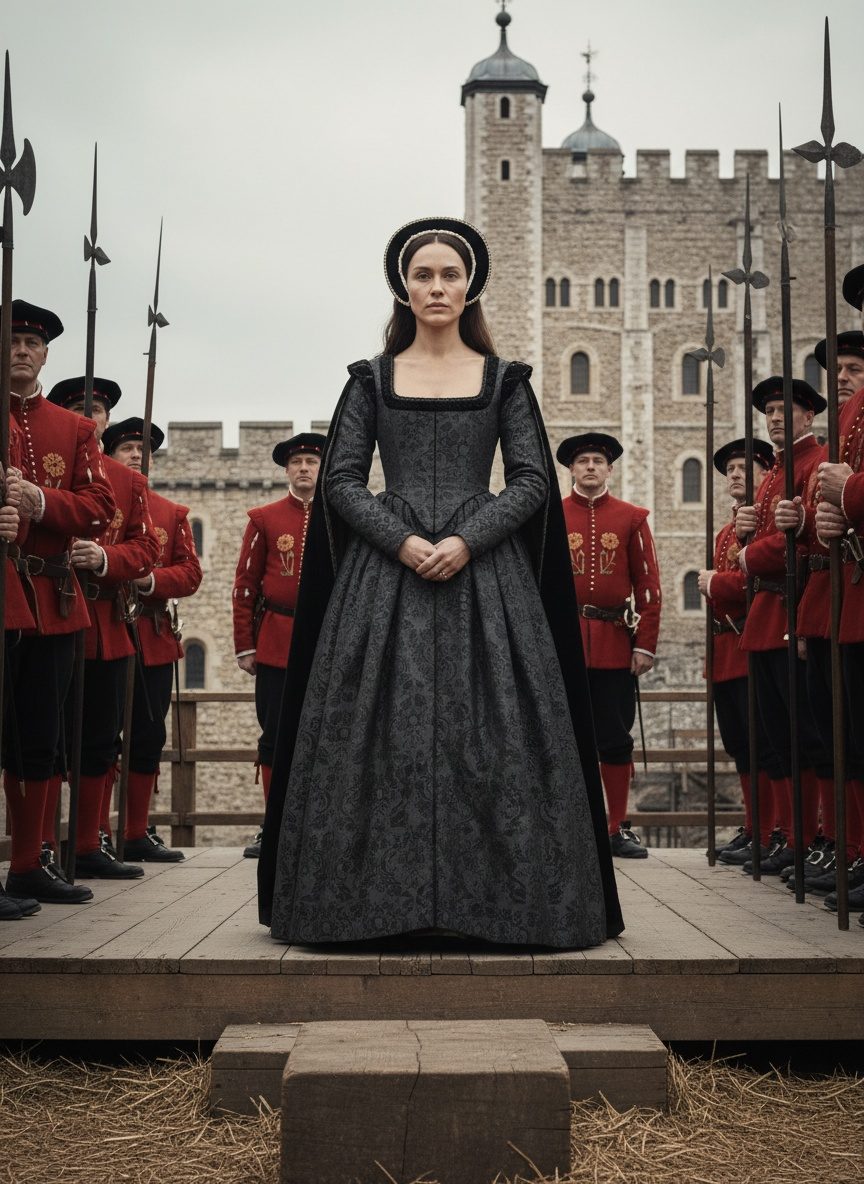
May 1536. A light fog clung to the edges of the Thames, mingling with the early morning chill, as if London itself were holding its breath. Within the daunting walls of the Tower of London, a delicate figure graced her final walk with a regal serenity that belied the tragedy of the day. Anne Boleyn, Henry VIII's enigmatic queen, stepped forward to meet her fate with a poise that would etch her memory into the annals of history.
A daughter of ambition, Anne had ascended to the dizzying heights of royalty from relatively humble beginnings. Her early years glistened with polished wit and an education uncommon for women of her time. She was a curiosity and a force, much like the relentless political currents of Tudor England that carried her to the forefront of history upon the infatuated gazes of a king.
The path to the scaffold had been as tumultuous as any love affair. Anne's initial presence at Henry's court as a lady-in-waiting captivated the king and kindled a flame that would redefine the religious landscape of a nation. Her refusal to be just another mistress spurred Henry VIII's dramatic break from the Catholic Church, a schism that saw the birth of the Church of England, forever changing the course of British history.
Anne's charm and intelligence, so dazzling at court, became her downfall when her womb could not produce a male heir. The birth of her daughter, Elizabeth, was not the triumph Henry had craved. Yet this child, overlooked by her father, would grow to become Elizabeth I, one of England's most formidable monarchs. The irony is not lost in the corridors of history.
Read next: The Day a Stuart King Walked Calmly to His Own Execution
By the spring of 1536, the tidal forces of court politics saw Anne ensnared in a web of conspiracy and betrayal. Charged with adultery, treason, and incest, her trial had been swift and decisive, though history casts doubt on the fairness of these proceedings. Politics once again had dictated her fate, with Henry eager to remarry in his quest for a male successor.
As Anne mounted the scaffold erected on Tower Green, her poise was that of one resigned, yet unbroken. The scene was set for a powerful final act in a life that had seen the grandeur and despair of the Tudor court. The role of executioner, steeped in the rituals of death, was one Anne faced with an unyielding composure.
The crowd, a grim assembly of curious onlookers, drew silent as she addressed them with the eloquence that had so often turned heads at court. Her words were a testament to her grace, acknowledging the laws of the land and expressing her willingness to meet her end. Unlike the shouts that had once filled the dance halls of Henry's court, now there was only the sound of her voice.
In a gesture that would perplex and humble, Anne handed a small purse to her executioner. This act of tipping him was not out of fear or desperation, but perhaps a stark reminder of her command over herself and her dignity, even in death. It is said she knelt, head held high, holding tightly to her pride and faith, a world away from the gilded thrones and whispered conspiracies she had once known.
Anne's serene smile as she knelt was more than defiance; it was recognition of a game well-played, an acknowledgment of the impermanence of power. Legend suggests that even the executioner was stirred by her bravery, and he executed the task with expert precision, ensuring her end came swiftly with a single stroke.
The head that once wore a crown now rolled into the annals of history, sparking tales of a queen who defied the times in life and death. Anne's fall, a mixture of personal tragedy and political machination, remains a potent reminder of the volatile nature of power. Her daughter would embody this balance of strength and vulnerability, shaping an era as Gloriana, resisting those who claimed the crown by bloodlines only.
Anne Boleyn's story matters not only because it showcases the interplay of personal ambition and political upheaval but because it highlights the enduring human spirit. Her life and untimely death continue to captivate the imagination, inviting reflection on both the perils and poignancies of living at the heart of a court where fortunes were made and lost in the shadows of a sovereign's favor. The resilient legacy she left behind, embodied in her daughter Elizabeth, is a testament to the indomitable fierceness of women scorned yet destined to change the world in unexpected ways. The memory of Anne Boleyn remains a haunting, illuminating legend of Tudor England, a narrative forever captured beyond the King's reach, above the Tower's stones.