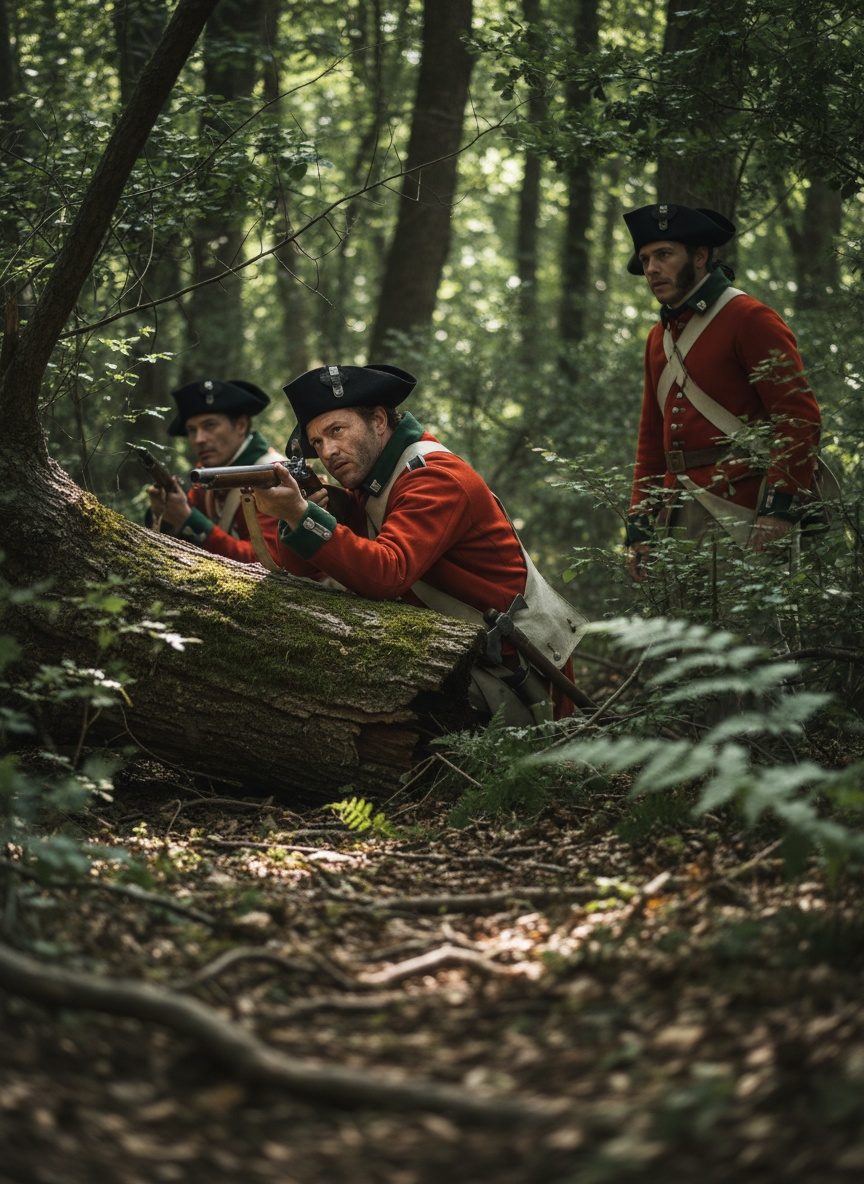
The Pennsylvania woods were thick with the hum of cicadas, their persistent drone mingling with the occasional call of a distant bird. The towering trees, ancient sentinels of a forgotten world, threw long shadows under the relentless summer sun. It was a forest of secrets and shadows, and it hid more than just wildlife beneath its dense canopy. In the summer of 1755, it became the site of a cataclysmic event that would reshape not only those who stood among its tangled underbrush but the very fabric of military history.
This was to be the defining summer for Major General Edward Braddock and his regiment. They marched with colors held high, in perfect order, confident in the strength of British arms. Yet, as they ventured deeper into the forest, they would confront an enemy not just of flesh and blood, but of terrain and tactics unlike anything encountered before.
The Ambushed Army
Braddock's forces moved with the precision of a parade. Trained in the traditional European style of warfare, they were a striking spectacle of red coats and gleaming bayonets. Their boots thudded rhythmically on the soil, the sound swallowed by the oppressive stillness of the Pennsylvania forest. It was a march of assurance, perhaps of arrogance, into unknown territory fraught with unseen dangers.
This was the North American interior, a world far removed from the orderly battlefields of Europe. As Braddock's troops advanced, concealed eyes followed their every step. Battles in this terrain were not won by the clash of brightly clad regiments but by those who mastered stealth and surprise. French and Native American combatants knew this forest as a second skin, their warfare as much a product of nature as of strategy. The British were walking into a trap.
Read next: The Day a Baronet Stood Up in Court and Freed His Slaves
Without warning, the forest erupted. Muskets cracked and arrows whistled, originating from an enemy that seemed to materialize from the very shadows. The air turned acrid with smoke, the ordered ranks of Braddock's regiment dissolving into chaos. Panic spread like wildfire, communication faltered, and suddenly, flanks proud with regimental history found themselves exposed and vulnerable. Ignoring the British belief that valor lay in standing one's ground, the French-Indian forces dissolved into the forest after each strike, leaving ghosts to battle flesh.
Many who stood with Braddock that day never stood again. The traditional tactics that had won so many battles in Europe failed utterly in the rugged forests of America. Those survivors who staggered back to safety bore tales that stripped away the veneer of British invincibility and demanded a stark reevaluation of warfare itself.
Rebirth of a Modern Army
The shock of Braddock's defeat in the woods went beyond the immediate military loss. What emerged from the devastation was a realization that would revolutionize the British military. This enemy—and this land—required a new strategy. Slowly, the military minds of Britain began to grasp that victory would not be handed to well-drilled redcoats, but to soldiers who could adapt and innovate in the harsh realities of unfamiliar territory.
From this necessity, a new breed of soldier began to take shape. The disciplined formalities of Braddock's army gave way to more flexible, resourceful fighting units capable of independent action and rapid adaptation. These new soldiers traded their bright red coats for the greens and browns of their environment, learning to blend into the landscape as seamlessly as their adversaries.
The transformation was gradual yet decisively effective. Leaders who could think independently and soldiers who navigated using not just compasses but their instincts began to redefine British military approaches. Skirmish lines replaced rigid formations, and guerrilla tactics learned from the enemy were integrated into the British lexicon of war. It was evolution borne from necessity, creating soldiers who could outmaneuver and outfight even the most elusive foes.
With their newfound prowess, these reformed regiments unleashed a formidable force upon their adversaries. They adapted not only to the forests of America but also far beyond, carrying the lessons of adaptability and innovation across continents and conflicts, proving decisive in theaters around the globe.
The Battle's Enduring Legacy
More than merely a tale of defeat and reformation, Braddock's fateful expedition into the forests of Pennsylvania offers a study of human tenacity and adaptability. It serves as a haunting reminder of the price of overconfidence and the value of humility in the face of nature's challenges. The lessons learned amongst the brambles and tall trees laid the groundwork for what would become one of the world's most effective fighting forces.
While the immediate aftermath of the ambush was one of devastation, it catalyzed a series of transformations that would ripple through the fabric of the British military. Soldiers and strategists alike began to embrace innovation, versatility, and a deeper understanding of their battlegrounds. The seeds of modern military doctrines were sown on that bloody green canvas, flowering on battlefields across continents.
This story reminds us that true strength often emerges from adversity, that the capacity to adapt to our surroundings is a powerful tool, and that sometimes, the harshest lessons learned in the shadows of failure become the very foundations on which future triumphs are built. The ghosts of Pennsylvania do not speak of avoidance but of evolution, urging us to see change not as a threat but as an opportunity to become something greater than history ever imagined.