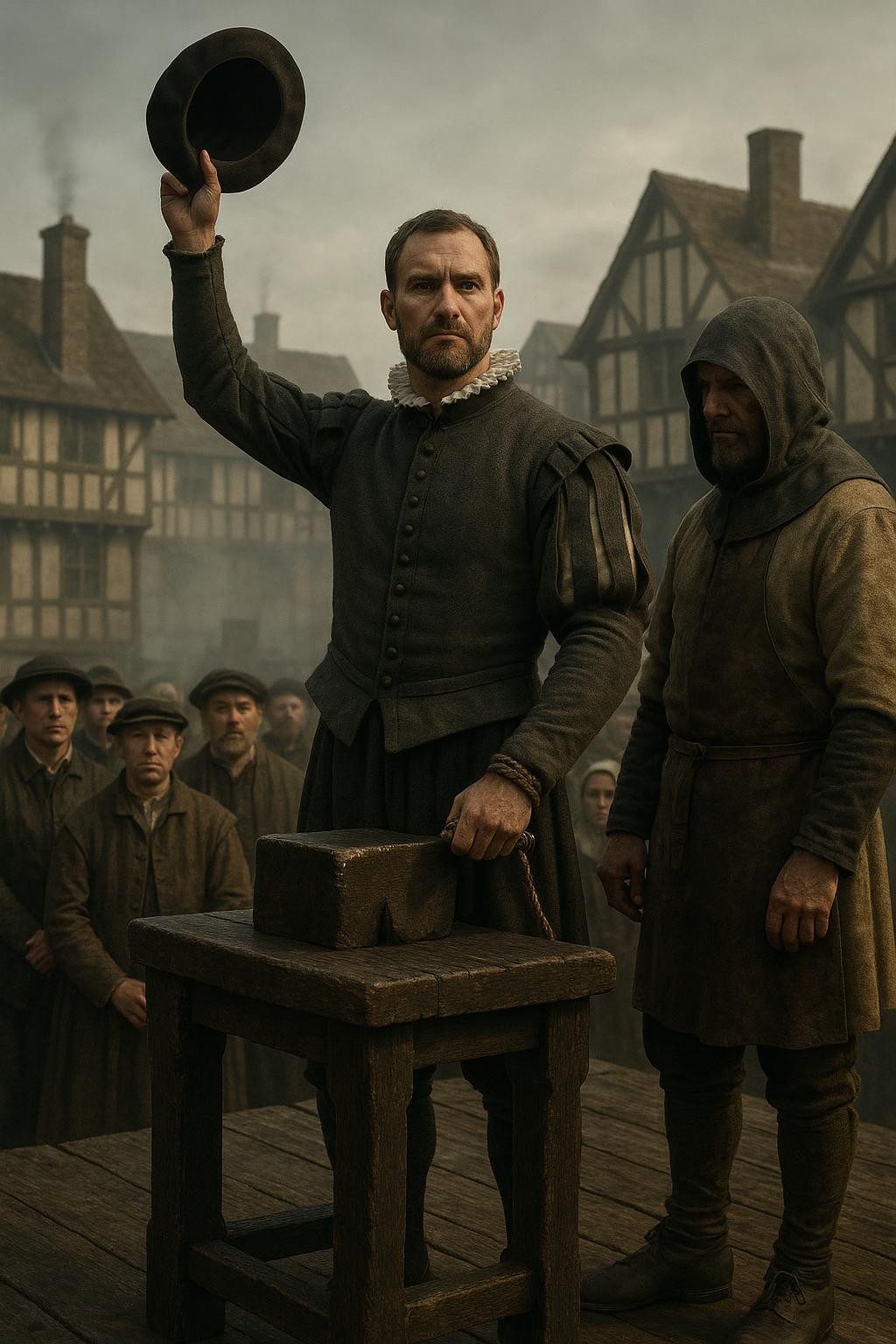
October 3, 1581. The autumn air nipped sharp against the warmth of the crowded marketplace.
The Pamphlet That Challenged a Monarchy
In the late 16th century, England stirred under the reign of Queen Elizabeth I. The realm, though graced with prosperity, was a battleground of religious convictions. The tension between Protestant reformers and steadfast Catholics simmered beneath the surface of Elizabethan politics. Within this charged atmosphere, a printed piece of rebellion emerged—one that tested the limits of free expression under a monarch renowned for her strength and discernment.
The pamphlet in question was penned by John Stubbs, a Protestant lawyer from Norfolk. Its inflammatory content would soon embroil him in controversy. The Queen, known for her sharp wit and political acumen, was considering matrimony with François, Duke of Anjou, a French Catholic. Such a union, to the English Protestant mind, signaled the potential return of Catholic oppression and a weakening of Protestant England.
Stubbs, aligning with Protestant fears, decided to take his grievances to the press. His pamphlet, boldly entitled The Discoverie of a Gaping Gulf, Whereunto England is Like to be Swallowed by another French Marriage, laid bare his apprehensions. With searing language, he argued that the marriage would compromise England's religious integrity and political independence. More than mere criticism, his words were seen as incitement against the Queen's authority—an unforgivable transgression in a time when monarchs ruled by divine right.
Read next: The Day a Stuart King Walked Calmly to His Own Execution
When the pamphlet reached Elizabeth's court, it was met with a storm of fury. The content was deemed seditious, and the punishment was severe. This was no mere slap on the wrist; Stubbs was to be made an example of. Queen Elizabeth, with a calculated balance of justice and deterrence, decreed a sentence reminiscent of medieval brutality. For his audacity to challenge the crown, he would lose his right hand — the very instrument of his dissent.
A Scaffold, a Cleaver, and a Solemn Salute
On the appointed day, the town square brimmed with anticipation. Crowds gathered, craning their necks to witness the spectacle of punishment that was as much a lesson in obedience as it was a macabre public event. The air buzzed with whispers, tinged with both dread and intrigue. Amongst the throng stood John Stubbs, resolute in his fate.
The scaffold was a stark tableau of Tudor justice. Stubbs ascended with a somber dignity. His expression, calm and unwavering, conveyed a defiance deeper than words. His composure did not falter as the executioner stepped forward, cleaver in hand. With a single stroke, Stubbs's right hand was severed from his body—an act as swift as it was savage.
The crowd gasped, a mix of horror and fascination playing on their faces. Bloodied but unyielding, Stubbs collected himself. In an extraordinary gesture of quiet defiance, he lifted his remaining hand, grasped his hat, and placed it confidently upon his head. Silence enveloped the square, broken only by the rustle of wind through the trees. Stubbs said nothing more. His act, wordless yet profound, echoed across the square—a testament to the quiet courage of a man stripped of his hand but not his dignity.
The amputation was meant to silence him, yet in that moment, Stubbs communicated more than an entire pamphlet of words. It was a demonstration that even when the hand is silenced, the spirit and its convictions remain unbroken. What he lacked in physical form, he retained in moral fortitude—a precarious balance of duty and dissent.
Unseen Threads of Resistance
The repercussions of Stubbs’s act of defiance rippled through the fabric of Elizabethan society. In a monarchy where questioning the sovereign was akin to treason, Stubbs’s punishment signified an extreme boundary between governance and persuasion. Those present would carry the memory of his bravery, the captain of his soul, beyond the scaffold.
Queen Elizabeth's decision to forgo a marriage with the Duke of Anjou ended the immediate panic sparked by Stubbs's pamphlet. Whether influenced by the public outcry or her own political strategizing, the union never came to pass. Stubbs's sacrifice, though personally catastrophic, mirrored the silent protests of many who desired a voice in their rulers' decisions.
Stubbs’s story, an undercurrent in the grand chronicles of Tudor England, serves as a reminder of the perilous dance between power and the press—one that resonates even today. His hand became a symbol of the risks inherent in challenging authority, an unspoken warning etched into the annals of history. As history turns its gaze upon such stories left untold, the echoes of Stubbs's defiance glimpse timeless struggles for expression and freedom.
The tale of John Stubbs is seared with pain yet edged with resilience. It reminds us how personal sacrifice can ripple through the ages, carving silent pathways of resistance. Against the backdrop of power, his defiance evokes a question that lingers in the minds of those who remember: What hand might we lift in solemn salute to speak when words are not enough?