The air in the Gloucestershire countryside was crisp that morning, the promise of summer weaving softly through the late spring chill. Fields dotted with vibrant wildflowers swayed lazily in the burgeoning warmth, while dairy cows lumbered languidly, placidly minding their business on the rolling greens. Birds chirped inquisitively from their leafing perches, their bright notes punctuating the serene landscape. In this sun-dappled world, a thick anticipation hung the air, built upon the soft rustle of grass underfoot—a moment that, unbeknownst to most then present, was about to forever change the course of human history.
The Whisper of a Theory: Observations from the Cowshed
It was in this tranquil Gloucestershire setting that Edward Jenner, a dedicated country doctor, stood contemplating a bold and transformative idea. Jenner, possessing a calm, determined manner honed by years among the rural population, was silently staking a bet against a devil that plagued humanity—the relentless scourge of smallpox. His thoughts were spurred by the observation he had made over countless conversations with local dairymaids. These young women, robust and ruddy from their laborious work, carried a secret: despite close contact with the deadly pox, they emerged unscathed, touched only by the milder, sister affliction, cowpox.
For years, Jenner pondered the tales exchanged in the flickering shadows of hearths or the bustling dairy stalls. A farmer's wisdom held in casual conversations—that those who caught cowpox never succumbed to smallpox—spoke to his keen scientific mind. It was an insight that flickered like a candle in the darkness of medical understanding, promising a new path grounded not in divine will or fate but in empirical observation.
The Moment of Reckoning: A Bold Experiment
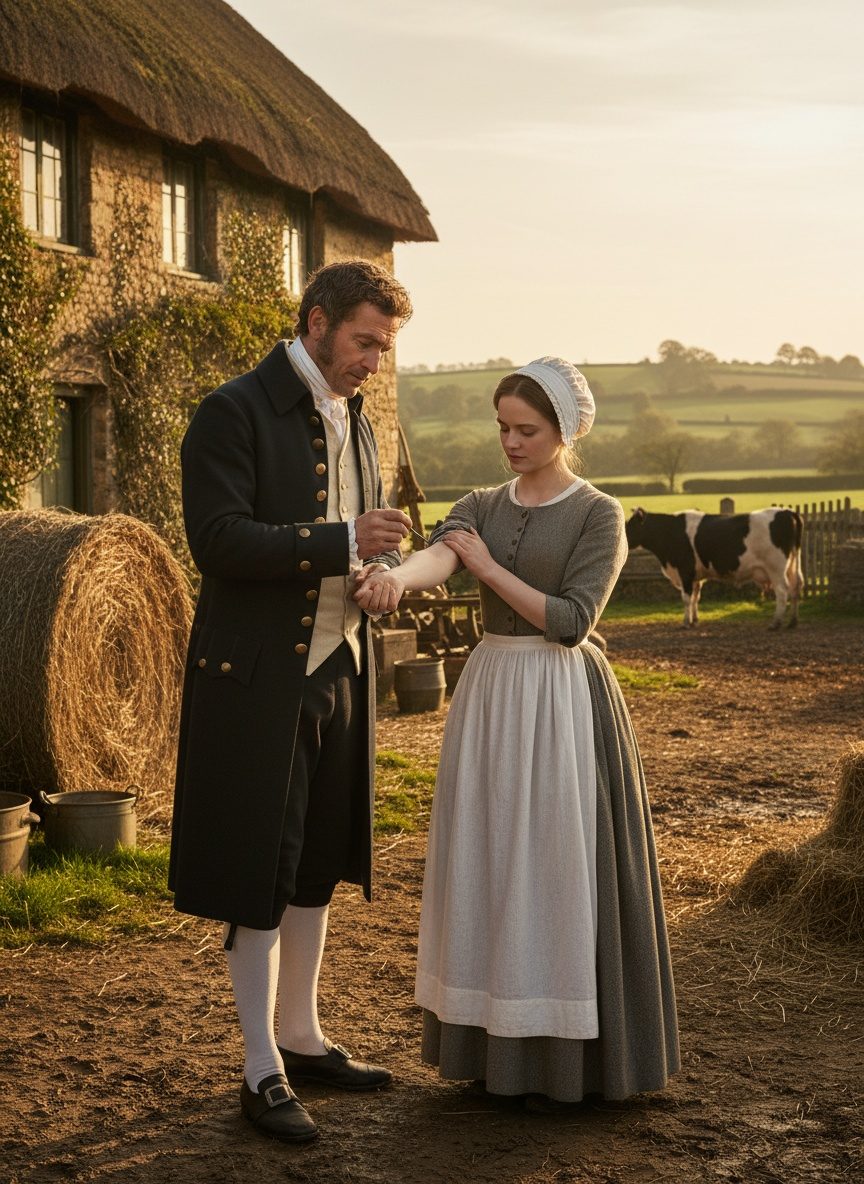
On a May day in 1796, the rural quietude was broken by the weight of intent. Jenner gathered the apparatus of his little experiment: a sharpened lancet, a vial, and a determined resolve. He approached Sarah Nelmes, a dairymaid who bore the innocuous pockmarks of cowpox, the benign herald of his theory. With reverence and precision, Jenner carefully took pus from the lesions on Sarah's hand, an act imbued with more risk than most dared contemplate. It represented not only his conviction in an unproven idea but also the hope of a shield against one of humanity's deadliest adversaries.
Read next: The Day a Baronet Stood Up in Court and Freed His Slaves
The subject of his test was James Phipps, the young son of Jenner's trusted gardener, willingly offered up for the cause. It was an act of trust solidified in the bond between doctor and villagers—an unspoken pact forged in service and tempered by collective need. The pressure of centuries past, where the cries of smallpox's victims reverberated through time, bore down as he made the fateful incision, introducing cowpox into the boy.
Against the Odds: The Triumph of Cowpox
Weeks passed, suspended in anticipation. Jenner watched, waited, and documented Phipps’s progress with an eye both clinical and fatherly. The boy developed a mild fever, and small blisters appeared, though he remained otherwise unfazed. Jenner, while hopeful, knew the ultimate test lay before him. Proving immunity meant exposing James to smallpox itself—a gambit unthinkable to some, revolutionary to others.
In due time, the controlled exposure came, as much a scientific procedure as it was a leap of faith. James demonstrated no symptom of smallpox—a miracle wrought not through divine intervention but through the manifest ingenuity of human discovery. Jenner's hypothesis had held firm, marking the beginning of an era where mankind would wield the power to stand against the brutal force of disease.
Carriages of Doubt: A World Suspicious Yet Intrigued
Despite evidence and meticulous documentation, the scientific realm was not immediately persuaded. Skepticism permeated academia as peers and practitioners were slow to embrace a notion lacking extensive scholarly validation. Yet, the practice of vaccination began to spread quietly at first, a tendril of optimism threading through skeptical streets and dedicated lecture halls.
The gravity of Jenner’s work continued to unfold as word traveled beyond the boundaries of Britain, reaching the Americas and eventually the globe. People, yearning for relief from the oppressive shadow of smallpox, began to accept the merits of his revolutionary procedure. In time, esteemed institutions would rally behind Jenner's pioneering spirit, establishing vaccination as a cornerstone of public health.
Beyond the Gloucestershire Fields: A Legacy Unshackled
The quiet field in Gloucestershire may now be history's footnote, yet its echoes resound loudly across centuries. Edward Jenner's work transcended the pastoral silence to unfurl an era of immunization, saving untold millions in its wake. His audacious blend of observation and experimentation not only liberated humanity from smallpox’s reign but sparked a broader revolution in medicine, ushering in an age bold enough to unearth cures from the seemingly mundane.
Particularly poignant in today's context, Jenner's quaint gamble in a country village exemplifies how innovation often arises from simplicity and persistence rather than grandeur or acclaim. As we continue to delve deeper into the mysteries of disease and health, the spirit of that pivotal May day resides at the heart of scientific discovery, reminding us of the enduring power rooted in courage and curiosity.