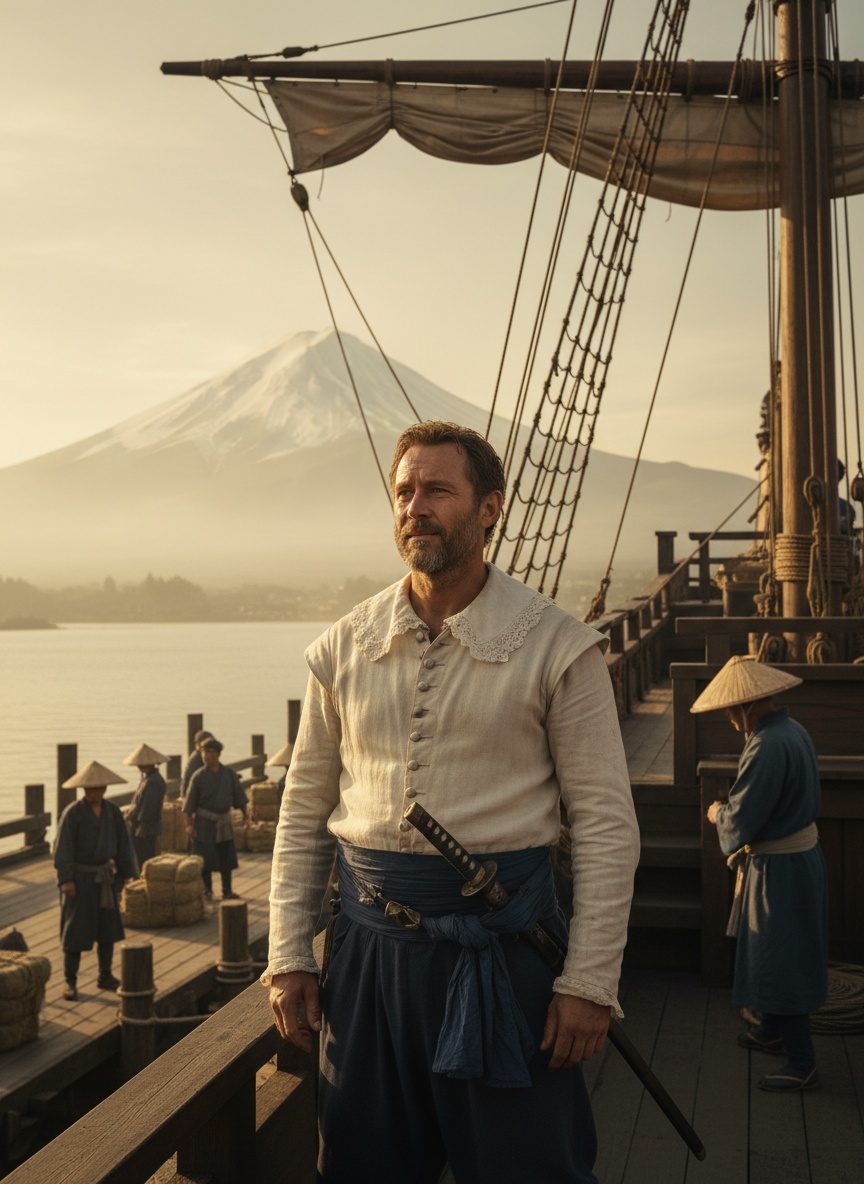
Most people have never heard of William Adams. They would be astonished if they had.
In 1611, eleven years since vanishing into the enigmatic world of Japan, a letter from Adams arrived in England, sparking intrigue and bafflement. The tale unfolded in those pages was nothing short of extraordinary. Once a humble navigator from Gillingham, Adams had embarked on an expedition that led him to a fate few could have imagined—becoming the first Englishman to earn the title of samurai.
The English armada, captained by curiosity and greed, had set sail in pursuit of the riches of the East, Adams among its numbers. However, his voyage would not unfold as planned. Journeying aboard the Dutch vessel De Liefde around the Cape of Good Hope, Adams found himself thrust not into glory but into turmoil. The seas battered them with tempestuous might, disease ravaged the crew, and death became a frequent caller. And yet, this tribulation was but a precursor to his turbulent path ahead.
By the time De Liefde finally limped into the harbour of Usuki in Japan, the crew had been whittled down to a skeletal shadow of its original strength. They did not receive the warm welcome they might have hoped for. Instead, suspicion met the foreigners' eyes. Japan in the early 17th century was no open port for outsiders; it was an insular realm keenly guarding its sovereignty. Adams was seized and imprisoned, subjected to rigorous scrutiny. Once his intentions were deemed devoid of malice, however, a surprising benefactor took an interest in the foreign sailor.
Read next: The Day Britain Voted to Keep a King — and Lost Him Anyway
Tokugawa Ieyasu, the shrewd and pragmatic shogun, recognized the potential nestled in Adams’s skills. Unlike his compatriots intent on monopolizing trade, Adams had sailed on a journey borne more of exploration than exploitation. Ieyasu saw promise in his nautical knowledge, and in a unique twist, Adams found himself advising one of the most powerful men in Japan. His expertise in European navigation and shipbuilding soon transformed him from a curiosity to a prized advisor, appreciated for his insight in an empire only just beginning to glance across its horizons.
The transformations Adams underwent during his Japanese odyssey defied common expectation. He crafted two Western-style ships, unlocking maritime advances that intrigued the shogun and altered Japan's naval capabilities. What's more, he found his place within a society that was markedly different from his own. The ritualistic ethos, the honour-bound culture — these elements permeated Adams's new life, and in understanding them, he began to transcend his foreignness.
Being bestowed the rank of samurai, a status achieved by no other Westerner, William Adams embraced the martial code of Bushido. His life was embedded among the rigid etiquettes and clan loyalties of feudal Japan, a realm where warriors were celebrated and feared, defined by their unwavering dedication to their lords. This status was not merely a ceremonial token; it signified a deep and respected integration into the cultural tapestry of Japan. Despite the chance of returning to England waning with the passing years, Adams found himself not only surviving but thriving.
Yet, there remained a pull, an echo of a life left behind. And so, he wrote. Pen met paper, letters entwined with longing crossed oceans to reach the proud isle of England. They spoke not merely of his exploits but painted vivid tapestries of Japan's landscape — its mountainous vistas, bustling market streets, and wooden shoals of wonders such as cherry blossoms — visions of an exotic land unopened to English minds. But more strikingly, these missives carried the weight of one man's transformation, the shedding of the sailor, and the forging of the samurai.
Adams's writings jolted the imaginations of his countrymen. Here was a witness to the closed-off empire, to a rich and varied world beyond the known reaches of European maps. For England, on the cusp of its own expansions over the seas, his accounts were invaluable. They provided a glimpse into a nation of contrasts—of refined artistry, of philosophical introspection, and of rigid social order woven together by the delicate, unyielding strands of the samurai code.
As this tale unfurled from ink and parchment, it flickered a shadow of destiny across England's own ambitious path—a reminder of what lay not just beyond the horizon but within the hearts of those daring enough to traverse it. William Adams became an emblem of transformation and adaptation, illustrating that the frontiers defining us often blur in the face of curiosity and openness. He embodied the essence of a bridge between worlds, forging new paths where once waters divided.
Though centuries have passed, the story of William Adams remains vibrant in its relevance. It captures the intrinsic human spirit that persists in exploring and understanding all beyond, especially when barriers stand firm. His narrative invites reflection on the nuances of cultural exchange amid globalization—the recognition that while borders separate us, knowledge and understanding can bridge even the widest oceans. Thus, while his name may not linger in the annals alongside the crown and sword, the day a Tudor sailor brought back the echoes of Japan has never ceased to ripple through history's tide.