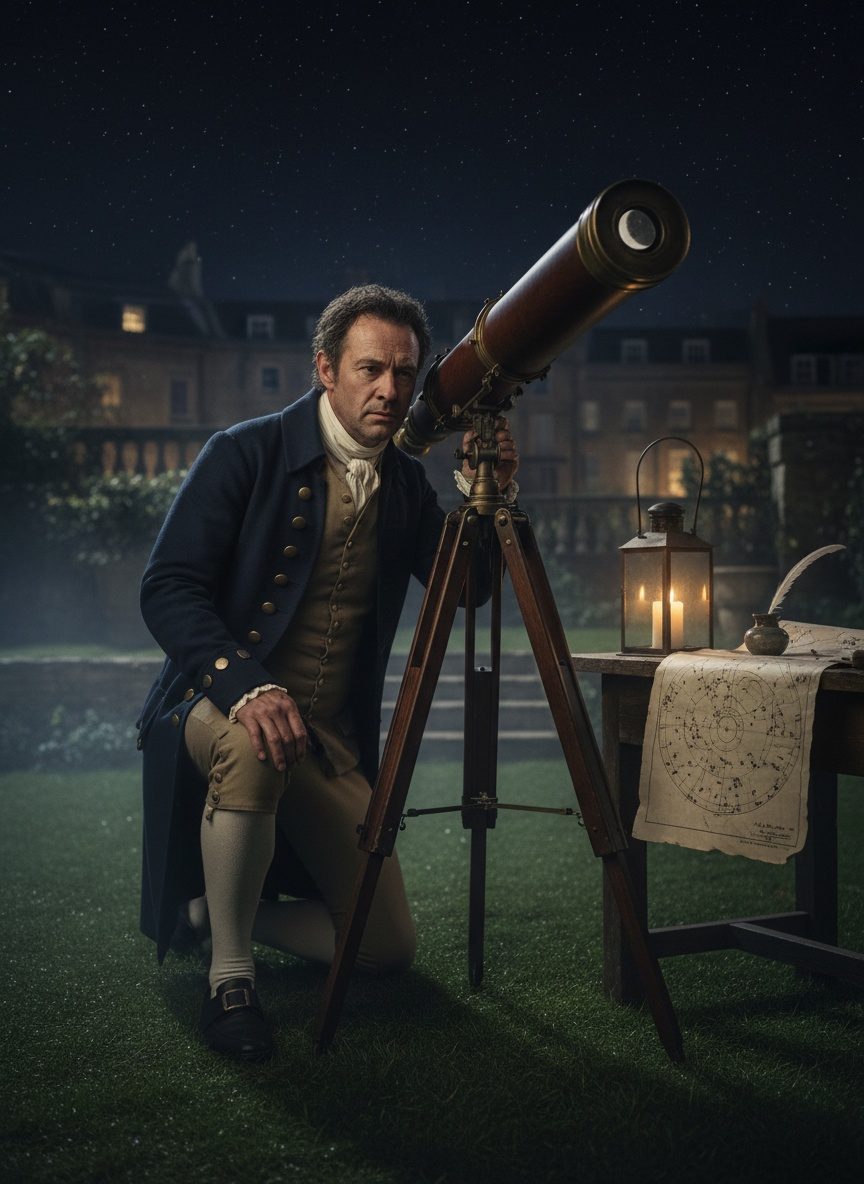
The chill of the March night settled into the bones as William Herschel leaned closer to his telescope, his breath clouding slightly in the freezing air. He was alone in his garden in Bath, only the faint rustle of night creatures keeping him company. He squinted through the eyepiece, drawn irresistibly to the light of an object moving against the black velvet of the sky. It wasn’t a star; its path was peculiar, hinting at motion unseen in the heavens. His heart raced with a possibility almost too large to comprehend.
As his fingers adjusted the telescope’s gears with the precision born of countless hours of practice, Herschel’s thoughts traveled back to the journey that had brought him here. A Hanoverian musician by trade, he had arrived in England decades earlier, immersing himself in the world of concertos and sonatas. Yet, beneath the harmonious strains of music, another melody had called to him from the cosmos—a fascination with the stars that refused to be silenced. Without formal training, the self-taught astronomer pursued this passion with the same zeal he showed in his music, crafting his own telescopes, grinding and polishing mirrors with the care of an artist painting his masterpiece.
This dedication transformed his home into both a workshop and an observatory. Candlelit evenings were spent bent over reams of paper, scribbling calculations, tracking celestial bodies as they wheeled across the sky. Astronomy offered a mystery at every glance and Herschel was determined to unravel its secrets. His instruments, painstakingly constructed with materials brought to life through his hands, were the finest in England, some even said, the world. As Herschel trained his telescope once more on the mysterious object, he was not aware that this night was to change the course of his life—and that of the scientific community—forever.
It was March 1781. Stars had been cataloged and studied for millennia, yet the idea of discovering a new planet, one never before identified in all the annals of human observation was staggering. The ancient astronomy was about familiarity, a slow dance of known players—Mercury, Venus, Mars, Jupiter, and Saturn—against a cosmic backdrop. To catch a rogue actor crashing this celestial ball was almost unthinkable. But there it was, in plain sight, teasingly elusive until Herschel’s diligent studies illuminated its path.
Read next: The Day a Deaf Man Gave the World Its First Electric Motor
Herschel’s initial belief was that the object was a comet, but the fixed, planetary course it took betrayed a steadier orbit. Conversely, a star would not exhibit this movement. Herschel diligently cataloged its position night after night, enlisting mathematics to divine its orbit and elevate the guesswork into certainty. Slowly the reality dawned—he was observing a planet, a discovery no individual had made before. The sphere moved with a majestic slowness, its sedate progression through the heavens offering no immediate fanfare, yet its implications were momentous.
The news spread with unpredictable speed, igniting excitement within astronomical circles far and wide. Herschel’s findings were soon corroborated by other astronomers, their telescopes pointing in unison towards the new world lingering beyond the familiar boundaries of Saturn. With the discovery confirmed, debate stirred over the planet’s naming. Herschel himself modestly proposed Georgium Sidus in honor of King George III, a gesture of diplomacy and gratitude. But internationally, the mythological lineage of celestial naming prevailed, and ultimately, it claimed its place as Uranus, after the ancient Greek deity of the sky.
As the news morphed from professional recognition to public wonder, the world grappled with how much larger the universe now seemed—a universe suddenly deeper, richer, and teeming with potential. The implications rippled beyond science; indeed, an entire epoch now bore witness that the known cosmos still held secrets, stoking dreams of exploration and discovery amid the burgeoning Age of Enlightenment’s questing spirit.
Though Herschel returned his focus to music, his contributions to astronomy were indelible, surpassing this singular discovery. His telescopes pierced the veil of the skies, uncovering binary stars, nebulae, and deep space phenomena that continued to expand humanity’s cosmic narrative. Herschel’s garden, once simply a retreat, transformed into a launchpad from which humanity soared into unknown frontiers.
Reflecting upon this night from the vantage of contemporary exploration, one can’t help but ponder the spirit that drove William Herschel—an insatiable curiosity married to a relentless pursuit. As telescopes probe deeper today and machines traverse cosmic expanses, Herschel’s journey reminds us of the formidable power resting within those who dare to look anew at the universe, to find worlds hidden in plain sight. His discovery was not just about finding a new planet; it signified uncharted possibilities, an ever-expanding boundary of human knowledge poised against an infinite sky.