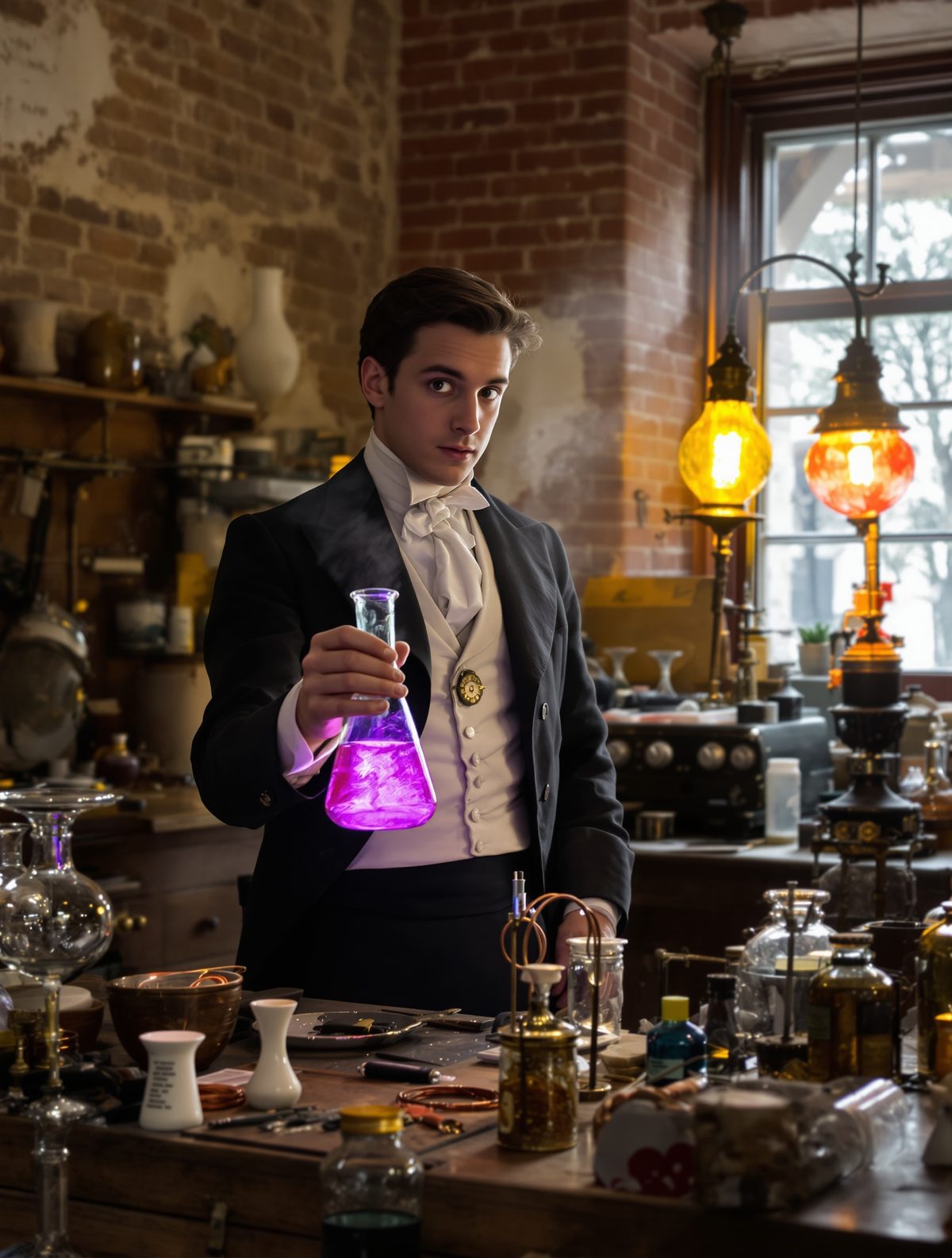
In the heart of bustling London, amid the cacophony of horse-drawn carriages and gas-lit streets, an extraordinary event unfolded. It was spring of 1856, and in a modest, makeshift laboratory within the bedroom of a young chemist, history was waiting to happen. The sulphurous tang of chemicals filled the air, interspersed with the anxious excitement of an 18-year-old student who was about to gift the world a discovery that would change not only the color palette of ladies' dresses but also save millions of lives.
The Teenage Chemist with Grand Aspirations
Meet William Henry Perkin, the young man at the center of this narrative. Born in 1838 in the vibrant neighborhood of Shadwell, London, Perkin was the youngest of seven children. His father, a carpenter and refuse collector, had aspirations for Perkin to enter the Ministry. Yet, from an early age, Perkin was captivated by the mysteries of chemistry. At 14, he was admitted to the Royal College of Chemistry, where his mentor, the illustrious August Wilhelm von Hofmann, became a significant influence.
During one of the Easter vacations from college, a fateful experiment began in Perkin's ramshackle home lab. His task was monumental: synthesize quinine, a miraculous malaria treatment, from aniline, a chemical compound derived from coal tar. Malaria, a rampant and deadly disease, had plagued both soldiers and citizens alike, and Perkin was ardently motivated by the idea of benefiting humanity. However, the process was fraught with challenges, not least because aniline was infamously fickle and unpredictable.
Mauve: A Purple Accident
As Perkin labored away, his Bunsen burners transforming the room into a realm of trial and alchemical shifts, the results were not as expected. Instead of quinine, Perkin’s flask was left with a residue that was a striking, vivid purple. Initially perceiving it as yet another failure in a sequence of missteps, Perkin was about to discard this residue when a serendipitous suggestion by a close friend prompted him to pursue the purple matter further.
Read next: The Day a Widow's Son Lit Up the Victorian Night
Through a series of systematic experiments, Perkin found that this royal hue did not fade when applied to silk, a revelation in an age reliant on natural yet often inferior dyes. Astonished by its staying power and brilliance, Perkin had inadvertently created the world's first synthetic dye. Fascinated and cognizant of its commercial potential, the youthful chemist promptly patented it in August 1856, christening it ‘mauveine’. The world of fashion was reshaped almost overnight, as purples previously reserved for royalty became accessible to the middle class.
From Curtains to Catwalks
Perkin’s discovery reverberated far beyond the confines of fashion. Mauveine ignited a wave known as the “mauve mania,” where the vibrant shade was ubiquitous on the streets of Britain and beyond. Even Queen Victoria herself wore a mauveine gown to the Royal Exhibition of 1862, a fact that forever sealed the dye’s status as a symbol of prestige and innovation.
The dye industry, almost non-existent before Perkin's breakthrough, flourished into an international enterprise. By the time Perkin was 18, he was already the architect of a thriving business, spurring economic change and shifting societal norms. Factories sprouted up, spearheading the development of synthetic dyes that added new dimensions to industries far beyond textiles—the coloration of wallpapers, books, and even the military uniform of British and French officers during the Franco-Prussian War.
The Dye that Fought Disease
What many do not realize, however, is that Perkin’s accidental invention laid the groundwork for chemical advancements that would have osculate influences over the field of medicine itself. By the late 19th century, dyes derived from coal tar had profoundly advanced the fields of antiseptic medicine and pharmaceuticals. Paul Ehrlich, awarded the Nobel Prize for his work on antibacterial agents, could trace his methodologies back to practices borne from Perkin’s mauveine production.
The synthetic dye industry catalyzed the investigation into bacteriology and pathology, leading to the formulation of drugs like methylene blue and eventually paving the way for the discovery of penicillin. Perkin's purple accident indirectly contributed to breakthroughs that would combat diseases globally, boosting a spiraling movement towards improved health and longevity for millions.
A Legacy of Color and Chemistry
Though William Henry Perkin did not ultimately develop a quinine substitute, the dye he created when he was barely out of his teenage years revolutionized the world in unexpected ways. His legacy extends beyond the realm of fashion and consumerism; it represents the ingenious potential of serendipity and curiosity in scientific endeavors. The Victorians appreciated the aesthetic perk of Perkin’s discovery, yet his mauveine marked the dawn of a synthetic chemical industry that radiates through modern medicine and technology.
Today, as we find ourselves still combating diseases and seeking innovative solutions, the story of Perkin's purple stain reminds us of the power of accidental discovery and perseverance. Mauve was more than a color—it became a symbol of innovation, a reminder that sometimes the path to solving world problems might start with youthful curiosity, a burst of unexpected color, and the courage to venture beyond failed ideas.