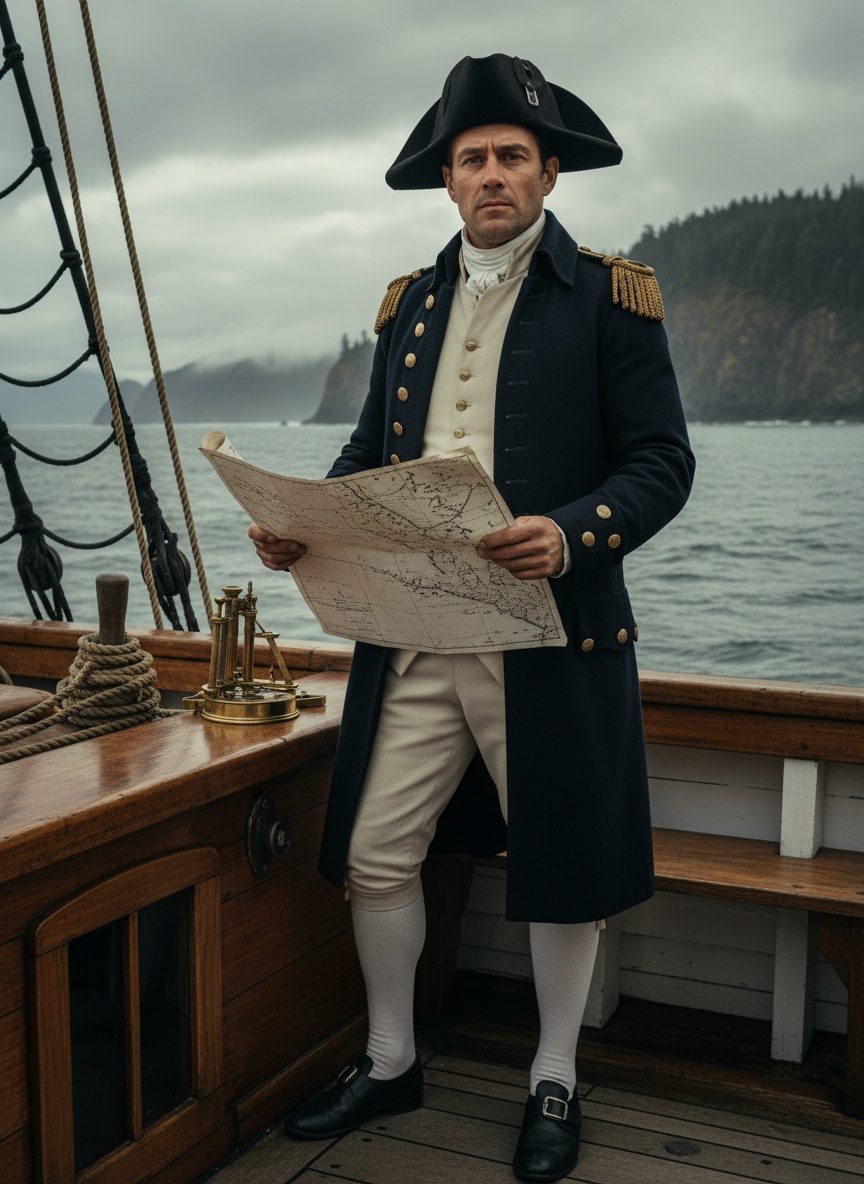
He was twenty-three years old. He was already a veteran of the legendary Captain Cook's voyages.
The Ambitious Voyage Begins
In the spring of 1791, an ambitious endeavor took shape as George Vancouver set sail from the British Isles. Commissioned by the Royal Navy, he was tasked with one of the most challenging mapping expeditions of the time. Vancouver was to chart every nook and cranny of the Pacific Northwest coast, a region boasting treacherous waters, dense fog, and shifting islands. His mission was no mere naval routine; it was a Herculean effort to gain a comprehensive mastery over largely unknown territories.
The journey spanned four arduous years and 65,000 miles—at a time when the Pacific Ocean was a vast, enigmatic expanse often cloaked in myth and speculation. Many regions of its coastlines had never been scrutinized with such intent, let alone depicted in detailed maps. Yet the determined crew, under Vancouver’s precise command, returned not only with their lives intact but also with contributions that would redefine navigation for years to come.
Through Fog and Ice
As Vancouver’s ships threaded through the maze of the Pacific Northwest, the crew found themselves engulfed in the infamous fogs that cloaked the coastlines. The daily rituals of navigating ice-packed waters and unpredictable weather patterns became a testament to their resilience. Despite these natural adversities, Vancouver distinguished himself with his methodical approach to mapping, refusing to allow any inlet or bay to remain uncharted.
Read next: The Day a Baronet Stood Up in Court and Freed His Slaves
The precision with which Vancouver and his crew carried out their surveys was unprecedented. They mapped 1,700 disjointed miles with exacting detail. His charts, a blend of artistry and scientific rigor, documented the jagged coastlines and daunting archipelagos with an accuracy that astounded his contemporaries.
The Decision That Changed the Voyage
A pivotal moment unfolded when Vancouver chose to sidestep the maritime scourge that had claimed countless seafaring lives before: scurvy. Through careful ration planning and a steadfast commitment to hygiene and diet, not a single member of his crew succumbed to the disease. This health-conscious strategy not only preserved the well-being of his sailors but also ensured that no momentum was lost in their surveying mission.
An unwavering dedication to discipline kept morale in high spirits, fostering a sense of unity and purpose despite the occasional tempests outside. It also allowed Vancouver to focus on his task at hand without the worry of a demoralized or debilitated crew haunting him. This foresight proved instrumental in the expedition’s success.
Creating a Nautical Masterpiece
The resulting maps from Vancouver’s voyage were nothing short of revolutionary. They became invaluable assets in the navigational world, influencing maritime maps well into the 19th century. The charts set a new standard for accuracy, used by explorers and naval officers who followed. Such was their precision that many charts remained in practical use for a century after the voyage, a testament to the meticulous work carried out by Vancouver and his team on their wooden decks and inking tables.
Vancouver’s cartographic skills were paired with astute observations of the rich ecology he encountered. His records included notes on the coastal fauna and indigenous peoples, offering a glimpse into the diverse world unseen by European eyes. Vancouver’s maps were not just navigational tools; they became crucial documents in the study of exploration and natural history.
The Hidden Depths of Legacy
Upon his return to Britain, George Vancouver was both celebrated and, like many visionaries, sometimes overlooked. Yet his legacy is enduring, for he opened up vast stretches of the Pacific for trade, exploration, and scientific inquiry. Vancouver’s maps did not merely demystify coastlines—they peeled away the veil over the Pacific’s monumental scale and beauty.
In an era defined by maritime exploits and scientific awakenings, Vancouver stands apart as a figure who navigated beyond known frontiers with foresight and precision. As we reflect on his accomplishments, his story is a potent reminder of how detailed knowledge and methodical inquiry can illuminate the darkest stretches of our world. It’s a testament to the human spirit that dares to chart not just territories, but the profound depths of understanding itself.