The evening air in Gateshead was thick with the lingering mist, as if the River Tyne had stretched an inquisitive hand over the town. Streetlamps flickered dimly, gasping light into the shadows that loomed around the terraced houses. Inside one of these modest dwellings, a different kind of illumination was about to chase away the darkness, one that promised not just to brighten the room but to transform the very world. This was no grand theatre, yet the drama of invention was about to unfold, as Joseph Swan prepared to ignite the first practical electric light bulb.
A Humble Setting for a Grand Idea
Gateshead, a town that clutches the banks of the Tyne, was not known as a cradle for innovation. Its streets echoed the gritty endeavours of the working class, its skyline punctuated by the smokestacks of industry. But it was here, amid the clatter of progress and the hum of steam, where Joseph Swan—a self-taught chemist with a mind as restless as the river—set about creating light itself.
Born in 1828, Swan found his inspiration not in the hallowed halls of academia but in the bustling workshops and laboratories of his own design. Trading the textbooks for trial and error, he took on a challenge that eluded even the brightest minds of his time. While others saw limitations in the fragility of carbon, Swan saw potential. In his modest home laboratory, bare-footed floors became the canvas for a revolution.
The Light Before Edison
In a world where improvisation met innovation, Swan’s journey toward illumination was one of perseverance. Using the most ordinary of materials—a cotton thread treated and carbonized—he crafted a filament that would resist incandescence. Encased within a vacuum-sealed glass bulb, Swan’s creation was more than metalwork and glassblowing. It was a glimpse into the future.
Read next: The Day a Victorian Doctor Defied His City to Save the Poor
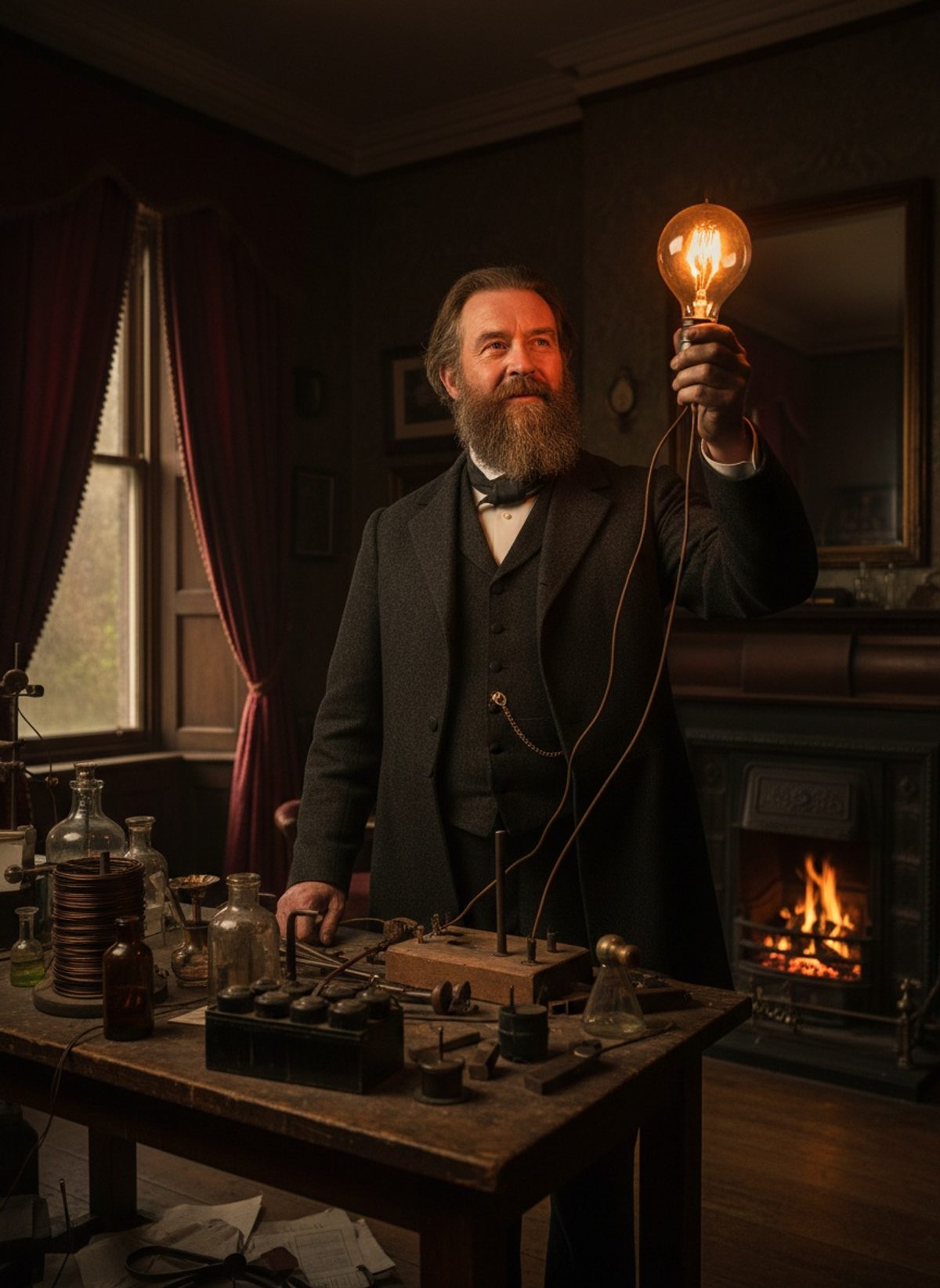
On one fateful evening in 1878, Swan held the bulb aloft against the sullen backdrop of Gateshead’s night. Electricity coursed through the filament, which glowed steadily, bathing the room in a warm, golden light that seemed to draw the shadows into itself. It was a moment that transcended the confines of that little terraced house, promising a different kind of dawn that put Britain ahead in the race to light the world.
Innovation Without Accolades
Compared to Edison’s later celebrations, Swan’s achievement flew under the radar of historical acclaim, yet he was indisputably a pioneer. His design secured the first British patent for an incandescent bulb, a testament to his ingenuity and vision. Unlike the well-funded ventures of Thomas Edison across the Atlantic, Swan’s triumph was one crafted from the simplest of means and funded by the determination of his spirit.
When Edison would later file his own patent, lights lit up on both sides of the ocean, but the heart of that glow traced back to the banks of the Tyne. Swan’s practical electric light bulb manifested in the corridors of history as the bearer of civilisation, leading Britain toward an electrically lit future long before the world marvelled at Manhattan’s brilliant skyline.
The Embers of Change
Joseph Swan’s journey did not end in the quiet rooms of his home. His light spread, finding purchase in places of learning and industry. Electric light powered by Swan’s technology graced the halls of Newcastle’s Literary and Philosophical Society, and illuminated lecture halls where ideas exchanged hands like currency. His contribution paved the path for electroluminescence across England, putting the nation at the forefront of modernity.
Yet it was Swan’s ability to see beyond the darkness that illuminated the uncharted paths of the human spirit. In the guttering glow of a gas lamp, he saw a new way forward, one that inspired countless dreamers to look beyond the limits drawn by circumstance and imagine the world not as it is, but as it could be. Swan, a widow's son from Gateshead, heralded a new era.
As we stand today beneath the glare of artificial lights that outshine even the stars, let us remember the night in Gateshead when one man's flickering invention set the stage for the electric world. In yielding darkness to luminescence, Joseph Swan didn't merely light a bulb; he lit the way forward, reminding us that from the humblest of nooks, the brightest of revolutions can begin.