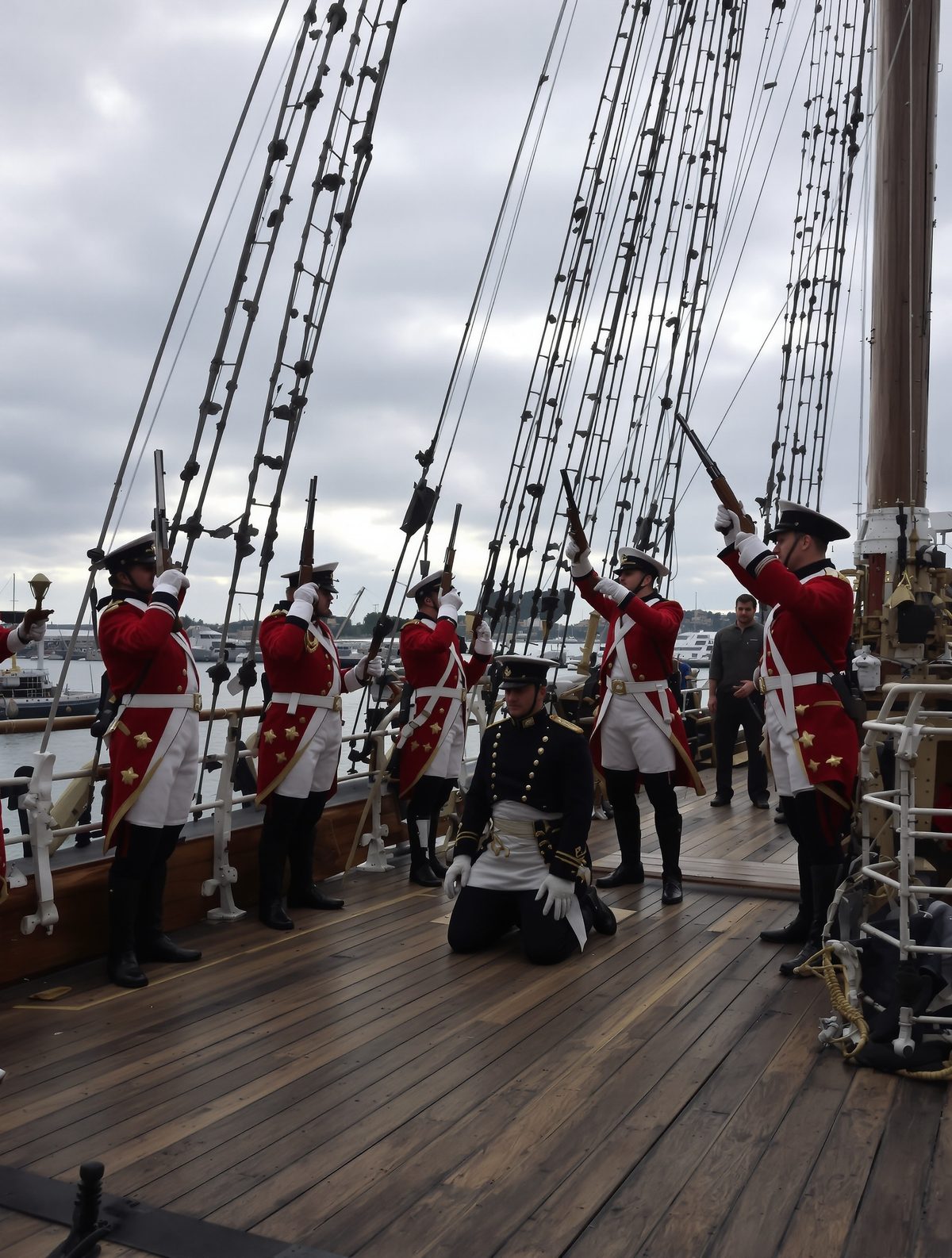
The musket balls struck with a thunderous crack, their echo rolling across Portsmouth harbour on that grey March morning in 1757. Six marines lowered their smoking weapons as Admiral John Byng crumpled to the deck of HMS Monarch, a silk handkerchief still clutched in his hand—his final signal to the firing squad. Blood pooled on the same quarterdeck where countless naval heroes had once stood triumphant. But Byng was no hero. He was the first and only British admiral ever executed by his own navy, shot for the unforgivable sin of prudence in the face of enemy fire.
The man bleeding out on the wooden planks had once been the toast of London society, son of Viscount Torrington and heir to one of Britain's most distinguished naval dynasties. Yet here he lay, condemned not for treason or corruption, but for something far more damning in the eyes of Georgian Britain: showing discretion when the nation demanded valour, even unto death.
The Doomed Mission to Minorca
Six months earlier, in September 1756, Admiral Byng had received orders that would seal his fate. The Seven Years' War—that first truly global conflict—was erupting across Europe, and French forces under the Duke of Richelieu were besieging the British garrison at Fort St. Philip on the island of Minorca. This Mediterranean stronghold was crucial to British naval supremacy, a fortress that commanded the sea lanes and protected British interests from Gibraltar to Naples.
Byng's mission seemed straightforward: sail to Minorca with a fleet of thirteen ships, relieve the besieged garrison, and send the French packing. What could go wrong? Everything, as it turned out. The Admiralty, in their infinite wisdom, had given Byng a collection of vessels that belonged more in a maritime museum than a battle line. Several ships were so riddled with rot they leaked like sieves, their cannon crews untrained and their supplies woefully inadequate.
Read next: The Night the British Ate the President's Dinner
The admiral himself was hardly brimming with confidence. At fifty-two, John Byng was a competent but uninspiring officer who had spent more time navigating London's political waters than enemy broadsides. He possessed the fatal flaw of seeing problems too clearly—a dangerous trait in an age when British admirals were expected to attack first and worry about practicalities later.
When Prudence Meets Pride
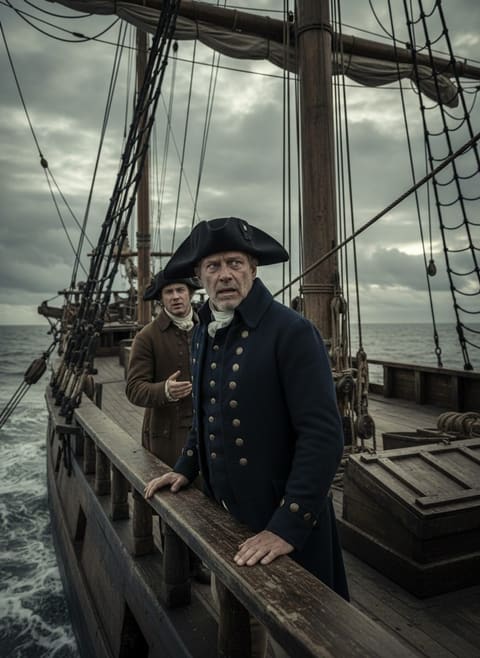
On 20 May 1756, Byng's ramshackle fleet encountered the French squadron under Admiral Roland-Michel Barrin de La Galissonière off the coast of Minorca. What followed was less a battle than a cautious ballet of sailing ships, each fleet manoeuvring for advantage while cannon roared across the blue Mediterranean waters.
The engagement began promisingly enough for the British. Following naval tradition, both fleets formed lines of battle, with ships arranged like floating fortresses ready to pound each other into submission. But as the morning wore on, it became clear that Byng's vessels were outgunned and outmanoeuvred. French gunnery proved devastatingly accurate, while several British ships struggled to maintain formation.
Here's where Admiral Byng made his fatal decision. Seeing his van ships taking heavy damage and recognizing that his fleet was in no condition for a prolonged engagement, he ordered a withdrawal. His reasoning was sound from a tactical perspective: preserve the fleet, return to Gibraltar for repairs, and fight another day when the odds were more favourable. It was the kind of prudent decision that might have earned praise in peacetime manoeuvres.
But this wasn't peacetime, and the British public was in no mood for prudence. News of Minorca's fall reached London like a thunderbolt. The island, with its 2,800 British defenders, had surrendered to the French after Byng's withdrawal. Public outrage was immediate and volcanic. Here was Britain's mighty Royal Navy—the wooden walls that protected the realm—retreating before a bunch of Frenchmen!
A Scapegoat for National Humiliation
The Duke of Newcastle's government, already teetering on the edge of collapse, desperately needed someone to blame. Admiral Byng, arriving back in Portsmouth to jeers and threats from angry crowds, found himself the perfect sacrificial lamb. The newspapers, those early masters of public fury, branded him a coward and worse. Pamphlets appeared on London streets depicting him as a French puppet, while coffee houses buzzed with tales of his alleged treachery.
The court-martial began in December 1756 aboard HMS St George in Portsmouth harbour. The proceedings were a masterpiece of legal theatre, with the Admiralty determined to find guilt and Byng's defenders fighting a hopeless battle against public opinion. The charges were damning: failing to do his utmost to take or destroy enemy ships, and neglecting to relieve the garrison of St Philip's Fort.
Under the Articles of War—particularly the infamous Article XII—any officer who showed cowardice or failed to engage the enemy with full vigour faced mandatory execution. There was no middle ground, no option for lesser punishment. The law was as inflexible as it was harsh, designed in an era when British naval supremacy depended on officers preferring death to dishonour.
The court-martial lasted weeks, with witness after witness dissecting every moment of that fateful day off Minorca. Byng's own testimony revealed a man trapped between impossible orders and inadequate resources, but the legal machinery ground on remorselessly. On 27 January 1757, the verdict came down: guilty of neglecting his duty, sentenced to death.
The Admiral's Final Hours
Even as the sentence was pronounced, many believed it would never be carried out. Surely King George II would show mercy? Surely the government would commute the sentence to dismissal or imprisonment? Petition after petition arrived at court, including pleas from Byng's fellow officers who recognized they might face similar impossible situations.
But the king, furious at the loss of Minorca and under immense political pressure, refused to intervene. The message was clear: British admirals fight or die, with no third option permitted. On 14 March 1757, Byng was informed that his execution would proceed at dawn.
Read next: The Day a One-Eyed Admiral Sailed Into the Line of Fire
The condemned admiral spent his final night writing letters and settling his affairs with remarkable composure. Contemporary accounts describe a man who had found peace with his fate, understanding that he was dying not for his tactical decisions but for the larger sins of a system that demanded impossible victories with inadequate means.
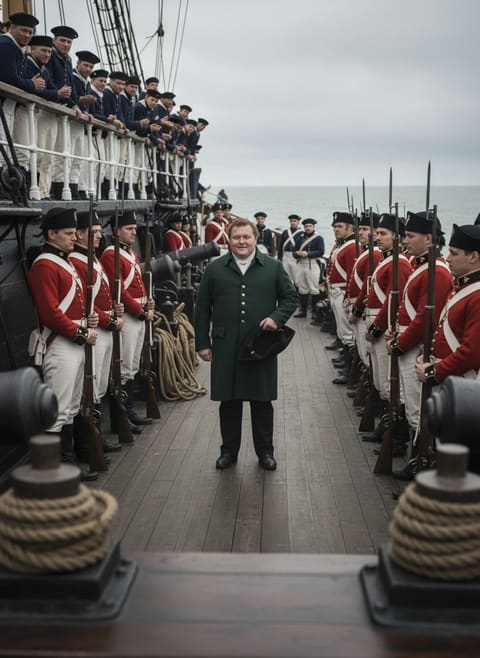
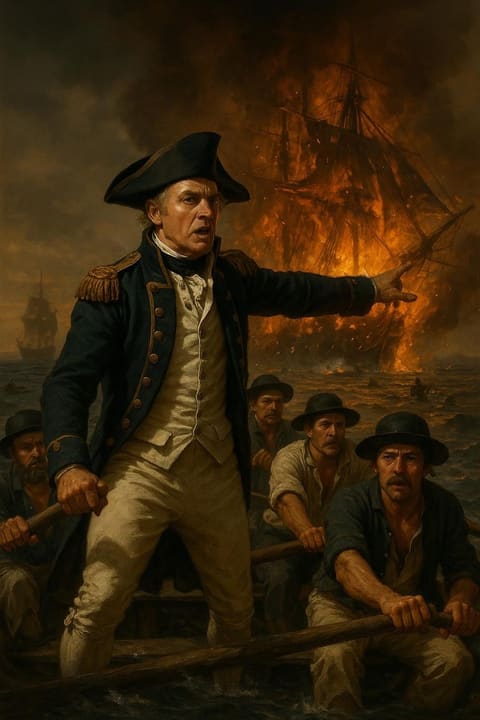
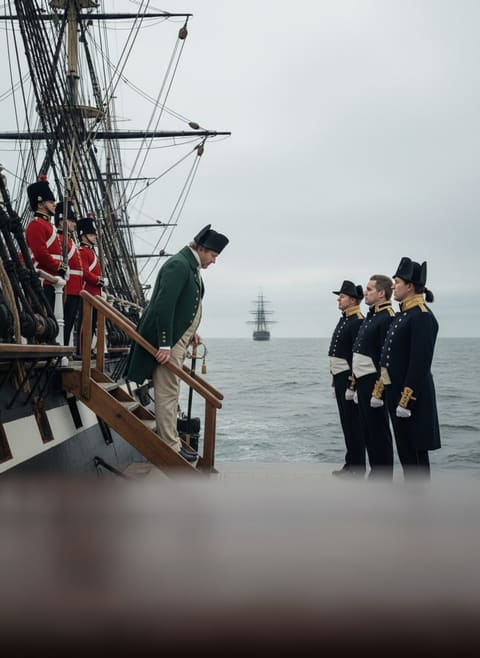
As dawn broke grey and cold over Portsmouth harbour, Byng was rowed out to HMS Monarch for the final act. He had requested to die on the quarterdeck rather than be hanged like a common criminal—a small dignity granted to his rank. Six marines from his own service stood ready, their muskets loaded with ball and powder. Byng knelt on a cushion, blindfolded himself with his own handkerchief, and dropped it as the agreed signal.
The Price of Making Examples
The volley that killed John Byng echoed far beyond Portsmouth harbour. Voltaire, that master of savage wit, immortalized the execution in Candide with his famous observation that the English find it advisable to kill an admiral from time to time "to encourage the others." The French philosopher understood what many of his contemporaries missed: Byng's death was theatre, a bloody performance designed to terrorize future commanders into desperate bravery.
Did it work? The evidence is mixed. British naval officers certainly became more aggressive, sometimes recklessly so, in the decades following Byng's execution. The fear of facing his fate drove commanders to extraordinary acts of courage—and occasionally to spectacular disasters when prudence might have served better than valour.
Today, Admiral Byng's story reads like a cautionary tale about the dangers of political scapegoating and inflexible military justice. His execution solved nothing—Minorca remained in French hands until the war's end—while destroying a competent officer whose only real crime was failing to perform miracles with inadequate resources.
Perhaps most tragically, Byng's death reflected the broader callousness of Georgian society, where individual lives were expendable in service of national pride. The same mindset that cheered his execution would later send thousands of soldiers into hopeless charges and naval ratings into disease-ridden ships, all in pursuit of glory that rarely justified its human cost.
In our own age of instant judgment and viral outrage, Admiral Byng's fate feels uncomfortably relevant. We may no longer execute our scapegoats, but we still demand them when things go wrong, still prefer simple blame to complex understanding. The musket balls that killed John Byng on that March morning carry a lesson that transcends naval history: sometimes the most dangerous enemy of justice is our own hunger for someone, anyone, to pay the price for failure.