On a crisp October morning in 1725, Allan Ramsay stood before his small shop on Edinburgh's High Street, clutching a hand-painted sign that would spark Scotland's first literary revolution. The words were simple enough: "Books lent out for a groat or less." But in a city where the Presbyterian Kirk held sway over nearly every aspect of daily life, these seven words amounted to a declaration of war against the moral guardians who believed that novels were nothing short of Satan's own curriculum.
What happened next would transform how ordinary Scots accessed knowledge, entertainment, and ideas—though not without a fight that would rage in pulpits, parlours, and public houses across Edinburgh for years to come.
A Poet's Dangerous Dream
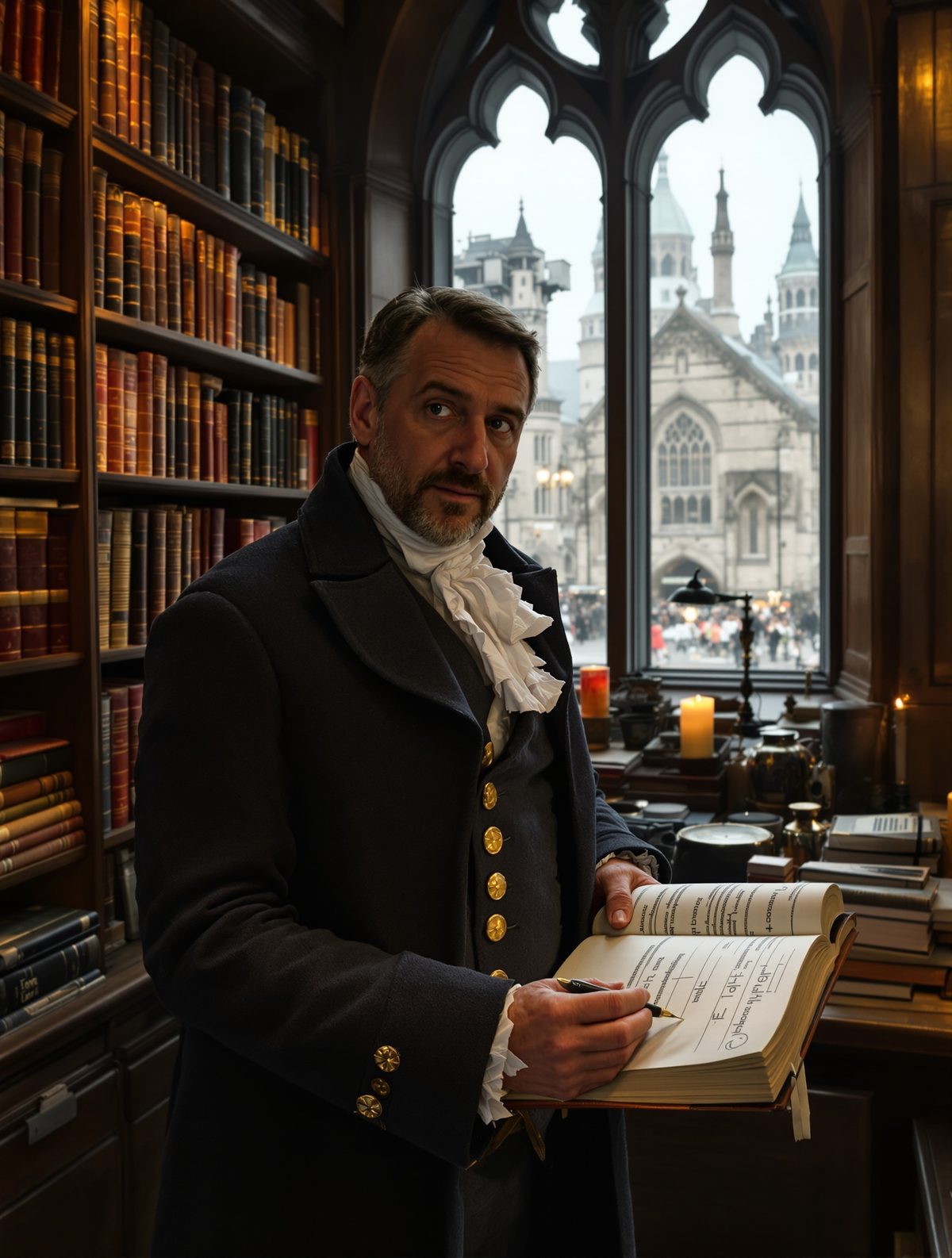
Allan Ramsay was no stranger to controversy. The wig-maker turned poet had already earned the Kirk's disapproval with his earthy verses and his attempts to revive Scottish vernacular poetry. But his latest venture—establishing Scotland's first circulating library—was perhaps his boldest gambit yet.
The idea had been percolating since his visit to London earlier that year, where he'd witnessed the success of commercial lending libraries. These establishments, barely two decades old in England, represented a radical democratisation of reading. For the price of a few pence, ordinary citizens could access books that would otherwise cost several weeks' wages to purchase outright.
Read next: The Day a Scots Weaver's Son Freed the Kirk From a King
Ramsay's library occupied the ground floor of his shop in the Luckenbooths, those ramshackle wooden structures that clung to the side of St. Giles Cathedral like literary barnacles. His initial collection was modest—perhaps 200 volumes—but it included works that would have made Edinburgh's ministers apoplectic had they known the full scope of what lurked on those shelves.
Among the more respectable histories and religious texts, Ramsay had smuggled in copies of novels by Aphra Behn, Daniel Defoe's scandalous Moll Flanders, and even some French romances that had been translated into English. These were the books that the Presbyterian establishment considered moral poison—stories that might corrupt the minds of impressionable readers with their tales of passion, adventure, and worldly concerns.
The Kirk's Holy War Against Fiction
To understand the explosive reaction to Ramsay's library, one must appreciate the stranglehold that the Church of Scotland maintained over intellectual life in early 18th-century Edinburgh. The Kirk Session—the local church court—regularly investigated and punished everything from adultery to dancing, and they viewed fiction as a particularly insidious threat to public morality.
The Reverend Robert Wodrow, a prominent church historian, captured the prevailing attitude when he thundered from his pulpit: "These vile books tend to corrupt the minds of young people and fill them with a romantic notion of the world." The ministers weren't entirely wrong in their assessment of fiction's power—novels did offer alternative ways of seeing the world, questioning authority, and imagining different possibilities for one's life.
Within weeks of the library's opening, the Kirk Session of Edinburgh began investigating complaints about Ramsay's venture. They were particularly incensed by reports that young women were frequenting the establishment, borrowing novels that might "inflame their passions" and distract them from their domestic duties.
The church's campaign against the library took multiple forms. Ministers denounced it from their pulpits, warning parishioners that reading novels was tantamount to inviting the devil into their homes. They pressured landlords to refuse to rent space to similar ventures and attempted to convince the Edinburgh Town Council to revoke Ramsay's license.
Secret Readers and Clandestine Collections
But the Kirk's opposition only seemed to fuel public curiosity. Edinburgh's residents, long starved of entertainment and intellectual stimulation beyond sermons and religious tracts, flocked to Ramsay's library with an enthusiasm that surprised even the poet himself.
The lending records, fragments of which survive in the National Library of Scotland, reveal fascinating patterns of literary consumption. Servants would borrow books on behalf of their employers' wives and daughters, creating a layer of plausible deniability. Young men studying at the University of Edinburgh discovered that novels offered a welcome escape from their prescribed diet of Latin, theology, and natural philosophy.
Perhaps most remarkably, a significant portion of Ramsay's customers were women—a fact that sent shockwaves through Edinburgh's patriarchal establishment. In an era when female literacy was actively discouraged by many, these women were not only reading but choosing their own reading material. They gravitated toward novels like Eliza Haywood's Love in Excess and the anonymous Secret History of Queen Zarah—works that depicted women as complex individuals with their own desires and agency.
The library's popularity necessitated an expansion within six months. By spring 1726, Ramsay had acquired over 400 volumes and was employing an assistant to help manage the steady stream of borrowers. The subscription fee of threepence for eight days' borrowing proved so affordable that even moderately paid artisans could afford to maintain a regular reading habit.
Underground Networks and Literary Rebels
As pressure from the Kirk intensified, Ramsay's library became the hub of an underground literary network that stretched across Edinburgh and beyond. Customers developed elaborate systems for concealing their borrowed books, hiding novels inside prayer books or wrapping them in brown paper.
The most dedicated readers formed informal clubs, meeting in taverns and private homes to discuss the books they'd borrowed. These gatherings, often held in secret, represented something unprecedented in Scottish society—spaces where ordinary citizens could engage in literary criticism and debate without clerical oversight.
One particularly enterprising customer, a merchant named James MacPherson, began hand-copying popular novels to create his own lending collection in Leith. Similar operations sprouted in Glasgow and Aberdeen, creating a shadow network of book circulation that operated entirely outside official channels.
Read next: The Day a Highland Clan Turned a Massacre Into a Legend
The economic impact was equally significant. Ramsay's success inspired other entrepreneurs to test the waters with their own collections. By 1728, Edinburgh boasted four unofficial lending libraries, each specializing in different types of material and serving different social constituencies.
Victory Through Persistence
The turning point came in 1729 when several prominent Edinburgh lawyers and physicians publicly defended Ramsay's library as a valuable educational resource. Their intervention reflected a growing divide within Scotland's educated classes between traditional religious authorities and a new generation of Enlightenment-influenced thinkers.
The Kirk Session's case against the library gradually lost momentum as public opinion shifted. Even some ministers began to acknowledge privately that reading—even fictional reading—might not automatically lead to moral degradation. The library had simply become too popular and too embedded in Edinburgh's social fabric to suppress.
By 1730, Ramsay's lending library was no longer operating in the shadows. The poet had successfully normalized the concept of recreational reading, paving the way for the explosion of literacy and intellectual curiosity that would make Edinburgh a jewel of the Scottish Enlightenment.
The Legacy of Literary Liberation
Allan Ramsay's courage in opening Scotland's first lending library represents more than a quaint historical footnote—it marks a crucial moment in the democratisation of knowledge and the expansion of intellectual freedom. His small shop on the High Street became a beachhead in the battle between traditional authority and individual choice, between prescribed wisdom and personal exploration.
The success of his venture demonstrated that ordinary people possessed both the desire and the capacity for literary engagement when given the opportunity. Within a generation, Edinburgh would produce David Hume, Adam Smith, and Robert Burns—towering figures whose intellectual development was nourished by the culture of reading that Ramsay helped establish.
Today, as we debate the future of libraries and worry about declining literacy rates, Ramsay's story offers a powerful reminder of reading's transformative potential. His willingness to risk social ostracism and economic ruin for the simple principle that books should be accessible to all continues to resonate in our digital age, where the battle for intellectual freedom takes new forms but remains as vital as ever.