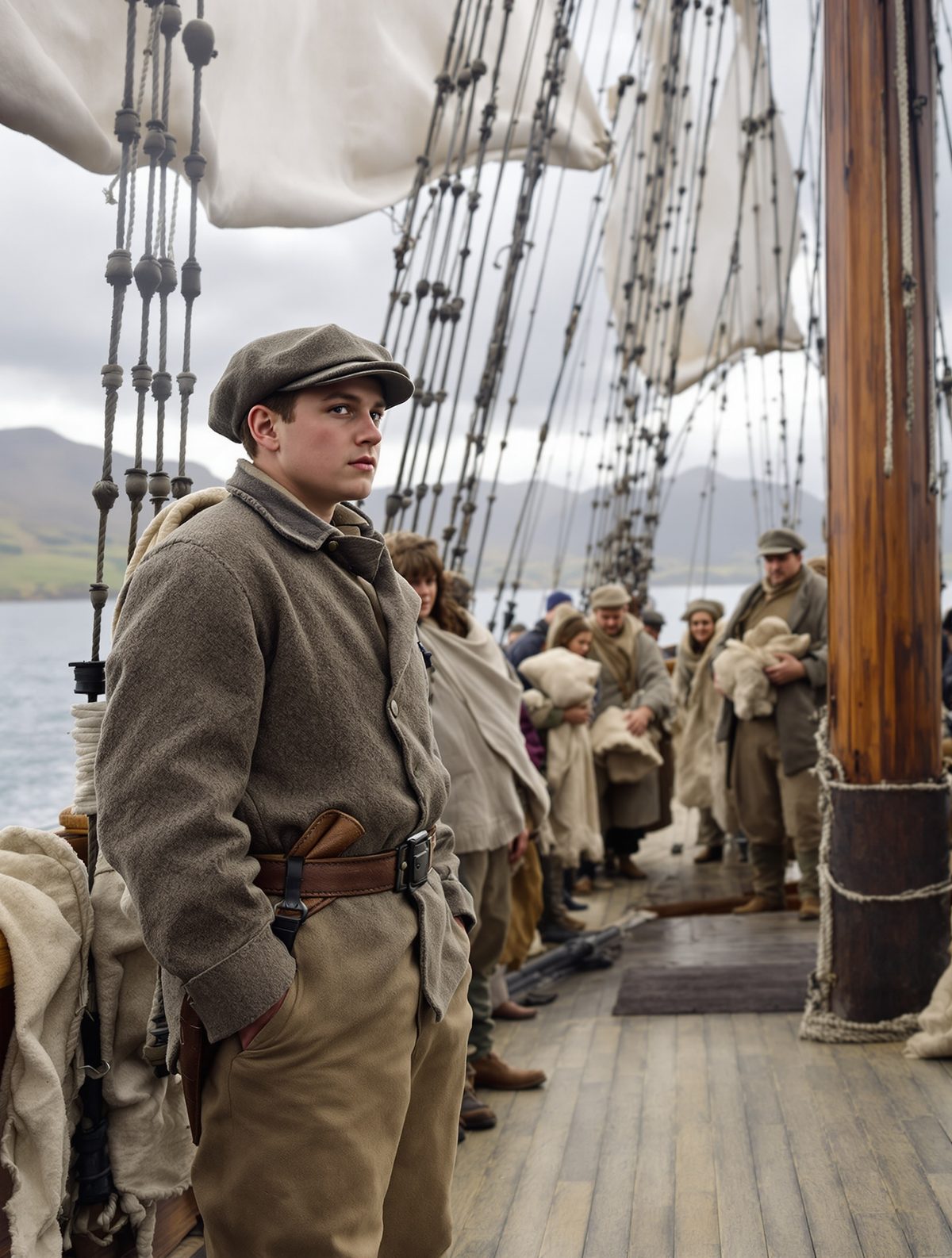
The stench of unwashed bodies and despair hung thick in the cramped steerage quarters of the Wiscasset as it creaked away from Glasgow's docks on May 17, 1848. Among the 450 souls packed below deck like cargo, a slight thirteen-year-old boy pressed his face against a grimy porthole, watching Scotland disappear into the grey Atlantic mist. Andrew Carnegie carried nothing of value—no money, no trade, no connections. His father William sat hunched nearby, a broken man whose hand-weaving business had been crushed by the relentless march of steam-powered machinery. But in the dim light, young Andrew's mother Margaret clutched her son's hand with iron determination. "We're going to be somebody in America," she whispered fiercely. "Mark my words, laddie."
She had no idea she was talking to the future richest man on Earth.
The Weaver's Son Who Lost Everything
To understand the magnitude of Carnegie's transformation, you must first grasp just how far his family had fallen. William Carnegie hadn't always been poor—in fact, he'd once been something of a local success story in Dunfermline, the ancient capital of Scotland. The town, dominated by the ruins of its medieval abbey where Robert the Bruce lay buried, had thrived for centuries on its linen trade. William owned four handlooms and employed several apprentices, weaving the fine damask tablecloths that graced the dining rooms of Edinburgh's elite.
But by the 1840s, the Industrial Revolution was devouring Scotland's traditional trades with mechanical precision. Steam-powered looms could produce in a day what took William a week, and at a fraction of the cost. Orders dried up. The apprentices drifted away. One by one, William sold his looms until only a single, silent frame remained in their cottage on Moodie Street—a monument to a dying way of life.
Read next: The Day a Scots Girl Thrust Her Arm Through a Door to Save a King
The family's descent into poverty was swift and merciless. They sold their furniture, then their extra clothes, then Margaret's few pieces of jewelry. Young Andrew watched his proud father shrink a little more each day, reduced to begging for occasional piecework that barely bought bread. But while William retreated into defeated silence, Margaret Carnegie blazed with defiant energy. She opened a small grocery shop in their front room and took in sewing work, her needle flying until her fingers bled. More importantly, she began writing letters—desperate, pleading letters to her sister in Pittsburgh, America.
The Mother's Impossible Gamble
Margaret Carnegie was not a woman who accepted defeat gracefully. Born Margaret Morrison, she came from a line of Scottish radicals who had battled landlords and preached revolution. Her own father had been imprisoned for his political activities, and she had inherited his burning conviction that the world owed no one anything—you had to seize your destiny with both hands.
When her sister Annie's reply finally arrived from across the Atlantic, it contained exactly what Margaret had prayed for: an invitation to come to America, and more crucially, the promise of twenty pounds to pay for passage. Twenty pounds—barely enough for the cheapest steerage tickets, with nothing left over for food, clothes, or hope of return. It was the kind of all-or-nothing gamble that could either save a family or doom them to starvation in a foreign land.
But Margaret never hesitated. On a cold morning in 1848, she marched her family to Glasgow's bustling docks, where the Wiscasset waited like a wooden ark amid the forest of masts and rigging. The scene was chaos—hundreds of Scottish families clutching their pathetic bundles, weeping goodbyes that might be forever, while sharp-eyed officials herded them toward the ships' dark holds. Andrew would later remember the moment he crossed the gangplank as "the most important step I ever took."
What he couldn't have known was that his mother had borrowed against their very last possession—their cottage—to scrape together a few extra shillings for the journey. If America failed them, there would be no Scotland to return to.
Fifty Days in Hell's Own Ship
The crossing of the Atlantic in 1848 was nothing like the comfortable passenger voyages of later decades. Steerage passengers were packed into airless compartments below the waterline, where diseases spread like wildfire and privacy was a forgotten luxury. Families hung blankets between their narrow bunks, creating a maze of makeshift rooms that reeked of sickness, unwashed humanity, and the ever-present smell of the ship's bilge.
Andrew and his younger brother Thomas slept on straw mattresses that quickly became infested with vermin. Their daily ration consisted of hardtack biscuits crawling with weevils, thin gruel, and water that tasted of rust and rot. When storms struck—and they struck often during that terrible crossing—passengers were battened below deck, where they endured hours of being thrown against bulkheads while seawater leaked through the groaning timbers.
But perhaps the most haunting detail of their journey was the sound that echoed through steerage each morning: the splash of bodies being committed to the sea. Disease claimed someone almost daily, particularly among the children and elderly. Andrew would later recall lying awake in his bunk, listening to the muffled prayers and the inevitable splash, wondering if his family would be next.
Yet even in this floating hell, Margaret Carnegie refused to let despair take hold. She organized the women to take turns caring for the sick, led evening prayers for the dead, and somehow found energy to teach her sons about the America that awaited them. "We're not running away," she would tell Andrew as the ship rolled through another endless night. "We're running toward something better."
America's Unexpected Embrace
When the Wiscasset finally limped into New York Harbor on July 14, 1848, Andrew Carnegie had his first glimpse of the country that would make him the richest man alive. But if he expected immediate transformation, he was quickly disappointed. The family's journey was far from over—they still faced a grueling 500-mile trip to Pittsburgh, traveling by canal boat and railroad through the mountains of Pennsylvania.
Pittsburgh in 1848 was a city being reborn in fire and smoke. The great steel mills that would make Carnegie's fortune were still decades away, but already the city pulsed with an energy that immigrant families could feel in their bones. This was a place where a man's accent mattered less than his willingness to work, where the old rules of class and breeding counted for nothing against raw ambition and clever thinking.
The Carnegies squeezed into a tiny apartment in Allegheny City, across the river from Pittsburgh proper, and immediately set about rebuilding their shattered lives. William found work in a textile mill, while Margaret returned to her sewing. But it was thirteen-year-old Andrew who would prove the family's salvation, landing his first job as a bobbin boy in the same mill where his father worked, earning $1.20 a week—barely enough to buy food, but enough to plant the seeds of an impossible dream.
What made Andrew different wasn't just his ambition—plenty of immigrant boys possessed that—but his almost supernatural ability to see opportunities that others missed. When he learned that the mill owner needed someone to tend his steam engine, Andrew volunteered, even though he'd never seen such a machine before. When he heard that telegraph operators were in demand, he taught himself Morse code by hanging around the local telegraph office. Each job led to another, each skill opened new doors.
The Reverse Midas Touch
By 1901, Andrew Carnegie had achieved something that would have seemed impossible to that sick, frightened boy on the Wiscasset: he had become the richest human being who had ever lived. His steel empire stretched across America, his fortune measured in hundreds of millions—in today's money, he would be worth over $300 billion, making him wealthier than Jeff Bezos, Elon Musk, and Bill Gates combined.
But here's where Carnegie's story takes a turn that still astonishes historians: having spent fifty years accumulating unimaginable wealth, he spent his final decades giving virtually all of it away. This wasn't the casual philanthropy of modern billionaires, donating a fraction of their wealth for tax benefits. Carnegie literally gave away 90% of his fortune during his lifetime, funding libraries, schools, and universities across the globe.
His most famous legacy became the Carnegie Libraries—2,509 of them built across the English-speaking world, including 660 in Britain alone. The boy who had arrived in America unable to afford a single book funded libraries from Scotland to South Africa, from small-town America to bustling Australian cities. He insisted on just one condition: each community had to promise to keep the library stocked and free forever.
Perhaps most remarkably, Carnegie never forgot Dunfermline, the Scottish town his family had fled in desperation. He returned in triumph to build not just a library, but an entire complex of public buildings, transforming the place that had once symbolized his family's failure into a monument to the possibilities of human transformation.
The Dream That Crossed an Ocean
Andrew Carnegie died in 1919, having given away $350 million in his lifetime—roughly $5 billion in today's money. But his real legacy wasn't measured in dollars or even in the thousands of buildings that bore his name. It was something far more powerful: proof that in the right place, at the right time, with the right combination of determination and opportunity, even the most impossible dreams could become reality.
Today, as millions of people around the world face their own desperate crossings—fleeing poverty, war, and hopelessness in search of something better—Carnegie's story resonates with fresh urgency. He reminds us that immigration isn't just about movement from one place to another; it's about the transformation that becomes possible when human potential meets genuine opportunity. That thirteen-year-old boy who stepped off the Wiscasset with nothing but his mother's fierce hope didn't just become rich—he became living proof that the distance between despair and possibility can be measured not in miles, but in the courage to take that first, uncertain step into the unknown.
And in an age when the gap between rich and poor seems insurmountable, perhaps Carnegie's greatest lesson isn't how he made his fortune, but what he did with it—using his success not to build monuments to himself, but to create opportunities for others to write their own impossible stories of transformation.