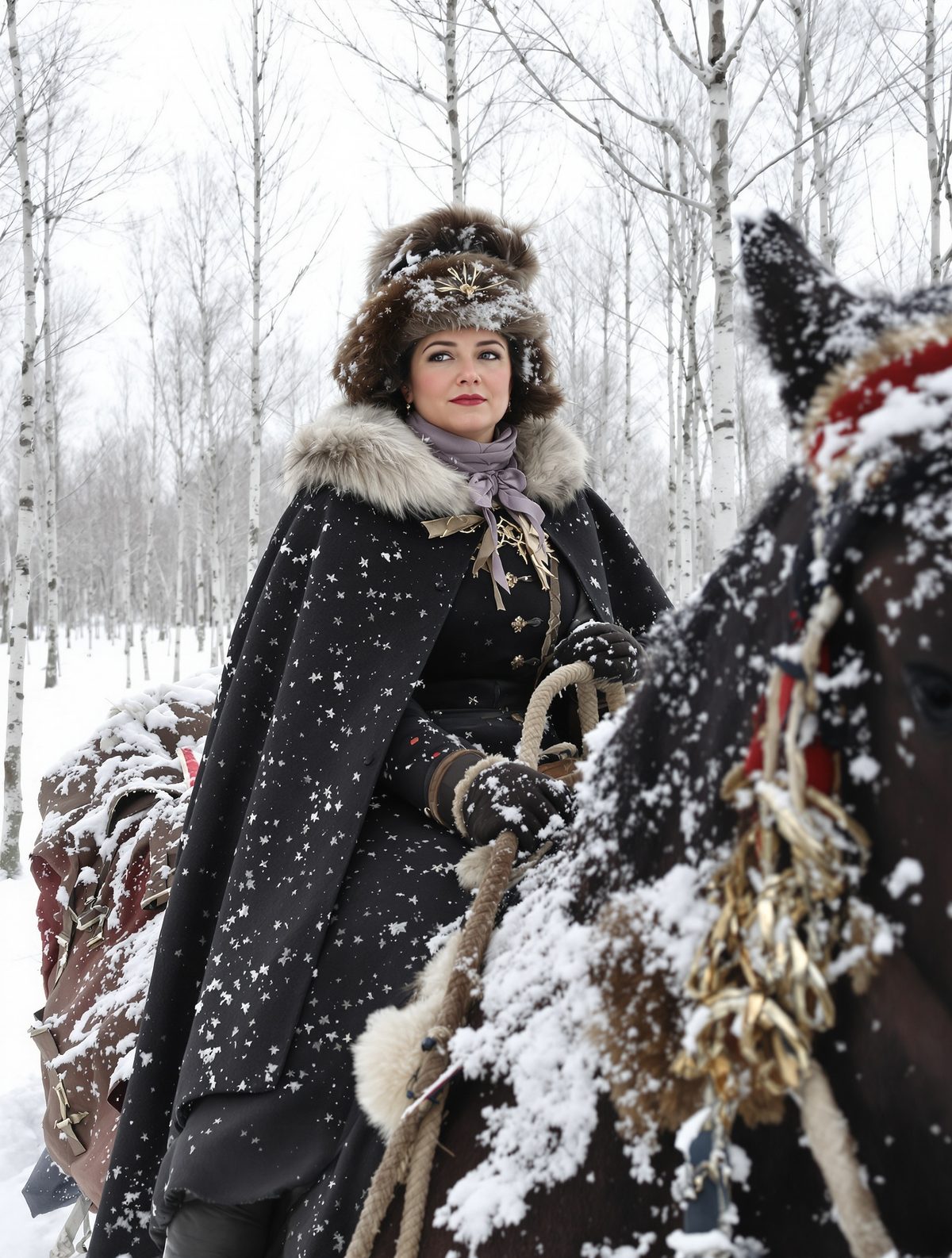
Picture this: a Victorian nurse sits astride a shaggy pony in the middle of nowhere, 4,000 miles from London. The Siberian wind cuts through her like a knife, and her tea has frozen solid in its cup. Wolves howl in the distance. Her hands are so numb she can barely grip the reins. Any sensible person would turn back.
But Kate Marsden wasn't sensible. She was magnificent.
In 1891, this extraordinary woman embarked on one of the most audacious medical missions in history. Armed with nothing but determination and a rumour about a miraculous herb, she rode alone into the Siberian wilderness—a journey that would take her 9,000 miles through some of the most unforgiving terrain on Earth. Her destination? A leper colony so remote that even hardened Russian convicts feared being sent there.
The Rumour That Started Everything
It began with a whisper in a Bulgarian military hospital during the Russo-Turkish War of 1877. Kate Marsden, then a young nurse tending wounded Russian soldiers, overheard a conversation that would change her life. A dying Cossack told her about a herb that grew in the remote forests of Siberia—a plant that could supposedly cure leprosy, one of humanity's most feared diseases.
Read next: The Day a London Printer Stood Trial and Freed the Press
Most people would have dismissed it as the ramblings of a fevered soldier. But Marsden had seen the ravages of leprosy firsthand during her nursing career, and the image of those suffering souls haunted her dreams. For over a decade, that whispered story gnawed at her consciousness until she could bear it no longer.
By 1890, the 28-year-old nurse had made up her mind. She would find this mysterious herb, even if it meant venturing into the frozen hell of Siberia. Her friends thought she'd lost her mind. Her family begged her to reconsider. The Royal Geographical Society—initially supportive—began having serious doubts about sponsoring what seemed like a suicide mission.
But Kate Marsden was already packing her bags.
Into the Frozen Wasteland
On 15 February 1891, Marsden stepped off a train in Moscow wearing a specially designed costume that would become legendary: a waterproof leather jacket, thick felt boots, and a fur-lined cap that made her look like a female Viking. She carried medical supplies, camping equipment, and enough determination to melt glaciers.
The journey from Moscow to Zlatoust was the easy part—a mere 900 miles by rail. But from there, she would travel by horse-drawn sledge across the Ural Mountains and into the vast emptiness of Siberia. The temperature regularly dropped to -40°F, cold enough to freeze spit before it hit the ground.
Her first shock came at the posting stations—ramshackle buildings that served as rest stops every 20-30 miles along the route. These weren't cosy country inns but barely habitable shacks filled with fleas, lice, and the overwhelming stench of unwashed bodies. The food was often rancid, the water frequently contaminated. Marsden learned to sleep sitting up, fully clothed, with her medical bag clutched to her chest.
But the real adventure began when she reached the town of Tyumen and switched from sledges to horseback. Here, 2,000 miles from civilisation, she mounted a sturdy Siberian pony and rode into legend.
Wolves, Bandits, and Blizzards
The Siberian taiga in 1891 was as close to the edge of the world as any human could venture. For weeks, Marsden rode through endless forests of pine and birch, accompanied only by a rotating cast of local guides who spoke no English and regarded her with a mixture of awe and bewilderment.
The wolves came at night. Marsden wrote in her journal about lying in her tent, listening to their haunting calls echo through the darkness, knowing that only a thin layer of canvas separated her from creatures that could tear her apart. Her guides built massive fires and took turns standing watch, but everyone knew that if a hungry pack decided to attack, there would be little they could do.
Bandits posed an even greater threat. The region was crawling with escaped convicts and desperate men who would kill for a pair of boots, let alone the valuable medical supplies Marsden carried. On more than one occasion, her small party had to take lengthy detours to avoid areas where travellers had recently vanished without trace.
But perhaps the most dangerous enemy was the cold itself. Temperatures plunged so low that Marsden's breath froze in crystalline clouds, and her eyelashes became coated with ice. Her hands suffered from severe frostbite, and she later wrote about the agony of trying to write in her journal with fingers so numb she could barely hold a pen.
The worst moment came during a three-day blizzard when visibility dropped to zero and the temperature fell to -50°F. Marsden and her guides were forced to dig a snow cave and huddle together for warmth, sharing body heat with their horses to survive. For 72 hours, they existed on frozen bread and melted snow, not knowing if they would live to see another sunrise.
The Lepers of Yakutsk
After three months of hell on earth, Marsden finally reached her destination: Yakutsk, a town so remote it made the North Pole seem accessible. Here, in wooden huts scattered throughout the surrounding forests, lived approximately 1,000 lepers—men, women, and children cast out by society and left to die in unimaginable squalor.
What Marsden found defied description. Families huddled in windowless shacks with no medical care, no sanitation, and barely enough food to survive. Children with the telltale signs of early leprosy played in the dirt while their parents slowly rotted away. The smell was overwhelming—a mixture of gangrene, human waste, and despair.
But Marsden had not come this far to be defeated by horror. She rolled up her sleeves and got to work, treating wounds, distributing medicine, and most importantly, searching for the mysterious herb that had brought her here.
Working with local guides, she combed the surrounding forests, collecting specimens and questioning anyone who might have knowledge of traditional remedies. For weeks, she found nothing but frustration. Then, deep in an ancient grove of birch trees, she discovered it: a plant the locals called "kusso"—a species of flowering shrub that seemed to possess remarkable healing properties.
The Discovery That Changed Everything
The herb Marsden found wasn't the miracle cure she had hoped for—leprosy would continue to plague humanity until the development of modern antibiotics. But her botanical samples, carefully preserved and documented, provided valuable insights that contributed to later medical advances. More importantly, her detailed reports about the conditions in Siberian leper colonies sparked international outrage and led to significant improvements in care for leprosy sufferers worldwide.
Perhaps most remarkably, Marsden didn't stop with discovery. She spent the remainder of 1891 establishing a hospital in Yakutsk, training local caregivers, and setting up supply lines to ensure continued medical support. When she finally began her return journey in late autumn, she left behind the foundation of a healthcare system that would serve the region for decades.
The trip back to civilisation was, if anything, even more harrowing than her outward journey. Winter had set in with a vengeance, and Marsden battled through blizzards so severe that she often couldn't see her horse's head. Her guides got lost repeatedly, and food ran so low that they were reduced to eating leather and tree bark.
By the time she reached Moscow in early 1892, Marsden had lost 40 pounds and aged a decade. Her hair had turned prematurely grey, her hands were permanently scarred by frostbite, and she walked with a limp from a fall that had nearly killed her. But she was triumphant. She had ridden 9,000 miles through hell and lived to tell the tale.
The Legacy of an Unlikely Hero
Kate Marsden returned to England as a celebrity, feted by the Royal Geographical Society and lauded in newspapers across the Empire. She wrote a bestselling book about her adventures, gave lectures to packed audiences, and raised enormous sums for leprosy research. Queen Victoria herself received Marsden in audience and declared her "a credit to British womanhood."
But like many true heroes, Marsden paid a heavy price for her achievement. The physical toll of her journey never fully healed, and she spent her later years in poor health, largely forgotten by a world that had moved on to new sensations. She died in 1931, aged 69, in relative obscurity.
Today, as we grapple with global health crises and debate the limits of human endurance, Kate Marsden's story resonates with fresh relevance. In an age when we can cross continents in hours and communicate instantly across oceans, her willingness to risk everything for strangers she had never met seems almost incomprehensible. Yet perhaps that's exactly why we need to remember her—as a reminder that extraordinary courage and compassion are not relics of the past, but timeless qualities that define our humanity at its finest.
Sometimes the greatest discoveries aren't made in laboratories or boardrooms, but in the frozen wilderness, by ordinary people willing to do extraordinary things. Kate Marsden proved that heroes don't always wear capes. Sometimes, they wear fur-lined caps and ride alone into the darkness, armed with nothing but hope and an unshakeable belief that every human life has value.