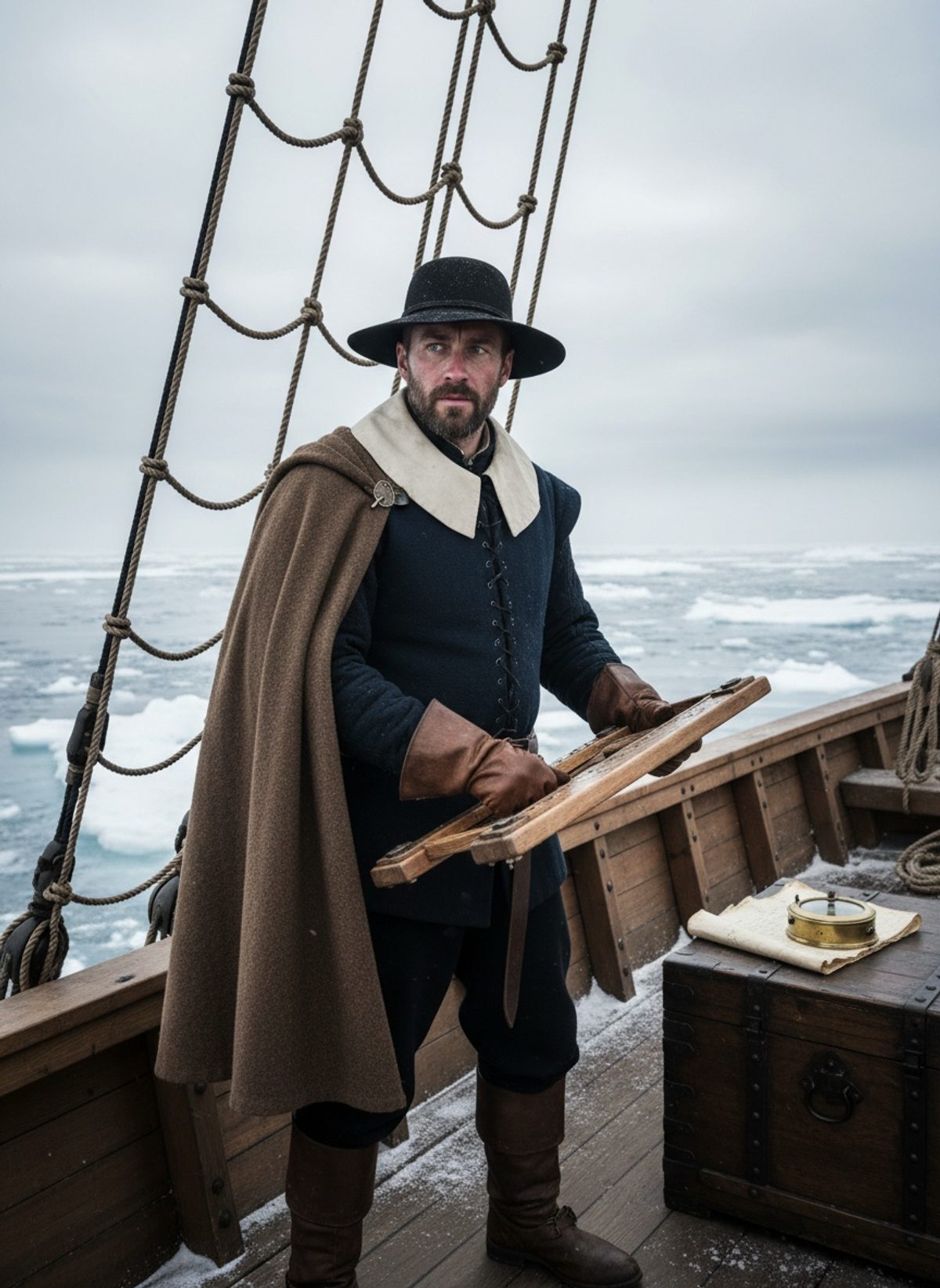
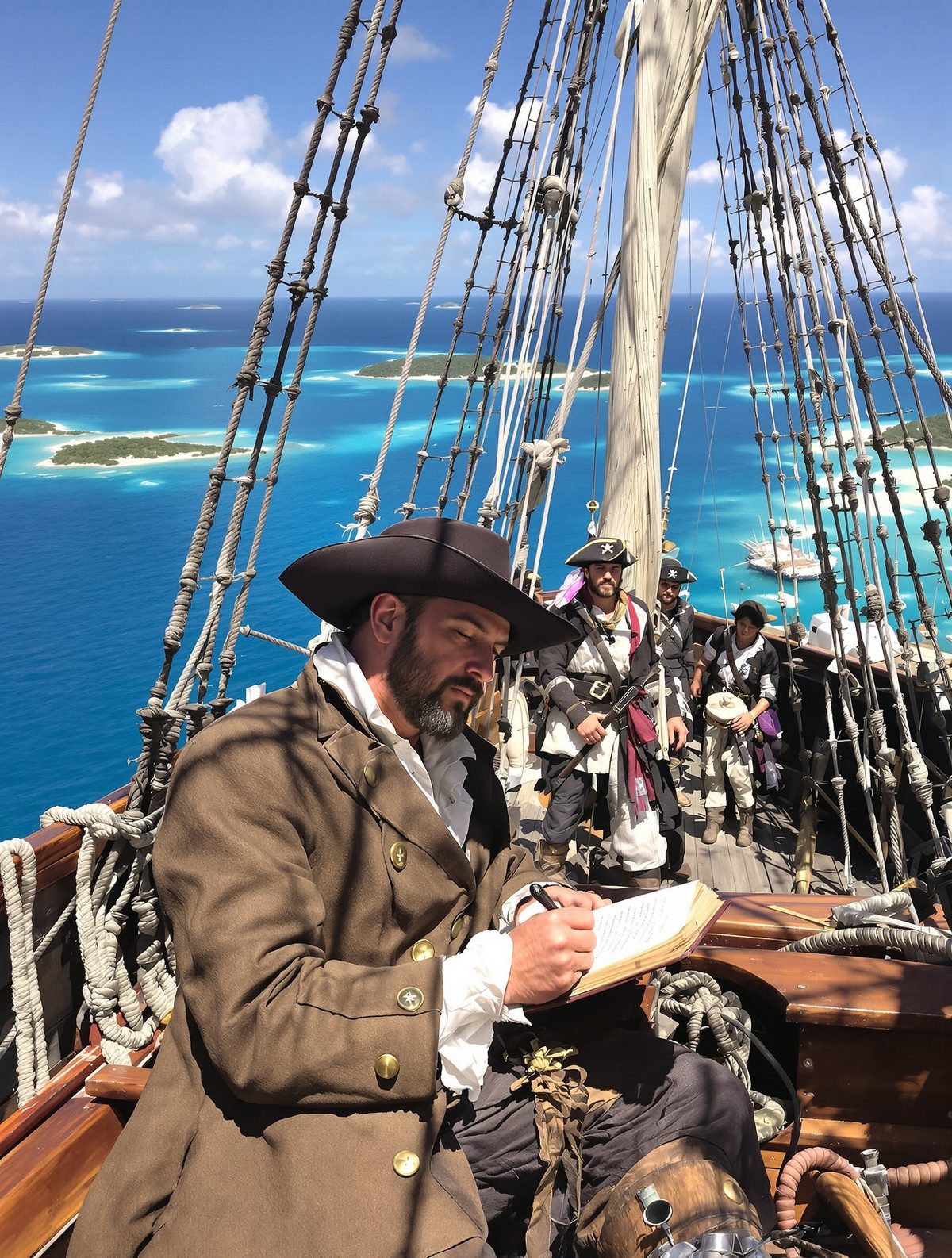
The morning mist clung to the Caribbean waters as Captain Bartholomew Sharp's crew prepared to board yet another Spanish treasure galleon. Cutlasses glinted in the dawn light, pistols were primed, and bloodthirsty shouts echoed across the waves. But one man aboard the pirate vessel Trinity paid little attention to the imminent violence. While his shipmates fantasized about chests of silver and doubloons, William Dampier clutched something far more precious to him—a leather-bound journal wrapped in oiled cloth, its pages already dense with observations that would change navigation forever.
This was no ordinary buccaneer. Dampier had joined Sharp's notorious crew not for plunder, but for passage to the most remote corners of the world. As cannons roared and ships burned around him, this quiet Somerset farmer's son was secretly conducting one of history's most ambitious scientific expeditions.
The Unlikely Pirate
When thirty-year-old William Dampier stepped aboard a pirate ship in 1679, he seemed an unlikely candidate for a life of maritime lawlessness. Born to tenant farmers in East Coker, Dampier had spent his youth managing a plantation in Jamaica—hardly the background of a swashbuckling adventurer. Yet beneath his unassuming exterior burned an insatiable curiosity about the natural world.
Dampier's transformation from plantation manager to pirate naturalist began with a chance encounter at a Jamaican tavern. Captain Bartholomew Sharp, fresh from raiding Spanish settlements along the Pacific coast, was recruiting crew members for an ambitious plan: to cross the Isthmus of Panama on foot and capture Spanish ships in the Pacific. For most men, this would have sounded like a death sentence. For Dampier, it represented an unprecedented opportunity to study the winds, currents, and creatures of uncharted waters.
Read next: The Day a Devon Captain Mapped the World's Last Shore
The decision to join Sharp's crew was calculated. European ships rarely ventured into Pacific waters, and legitimate expeditions to such remote regions were virtually impossible for a man of Dampier's modest means. Piracy, ironically, offered the only realistic path for conducting the kind of comprehensive oceanic research he envisioned. As he later wrote, he was "more desirous to see the world than to maintain myself comfortably."
The Journal That Defied the Odds
From the moment he stepped aboard, Dampier faced a unique challenge: how to conduct serious scientific observation while surrounded by men who would likely consider his activities suspicious at best, traitorous at worst. Pirates were notoriously paranoid about written records that might later be used as evidence against them. Yet Dampier somehow managed to maintain detailed daily observations throughout his voyage.
His method was ingenious. Rather than hiding his note-taking, he convinced his shipmates that his recordings were practical aids to navigation—which, in many ways, they were. While other crew members could barely read, Dampier's ability to predict weather patterns and identify safe harbors based on his careful observations of natural phenomena quickly made him invaluable. His journal became the ship's unofficial navigation guide.
To protect his precious notes from the elements, Dampier developed an elaborate preservation system. He wrapped his journal in multiple layers of oiled cloth, storing it inside a sealed bamboo tube that he fashioned himself. During storms and battles, he would tie this makeshift case to his body. The journal survived everything the Caribbean could throw at it: hurricanes that destroyed entire ships, naval battles that left the deck slick with blood, and tropical downpours that lasted for days.
Three Oceans, Twelve Years
What began as a single voyage with Captain Sharp evolved into an epic twelve-year odyssey that would take Dampier across three oceans. After parting ways with Sharp in 1681—partly due to disagreements over the captain's unnecessarily brutal methods—Dampier joined a succession of buccaneer crews, each voyage expanding his scientific database.
His journeys read like a catalog of the world's most dangerous waters. He sailed with Captain John Cook to the Galápagos Islands, where he became the first Englishman to document the giant tortoises and marine iguanas that would later inspire Darwin. He crossed the Pacific with Captain Swan, reaching Guam and the Philippines, meticulously recording wind patterns and ocean currents along routes no European scientist had ever traveled.
Perhaps most remarkably, in 1686, Dampier found himself marooned on the Nicobar Islands in the Indian Ocean after a dispute with his captain. Rather than despair, he used his three-month exile to conduct the most intensive biological survey the region had ever seen. His descriptions of monsoon patterns, tidal behaviors, and tropical species were so accurate that they remained the definitive scientific reference for the area well into the nineteenth century.
The Secret Science of Piracy
While his crewmates focused on immediate plunder, Dampier was conducting research that wouldn't be fully appreciated for decades. He was among the first to understand that ocean currents followed predictable patterns influenced by wind, temperature, and geography. His detailed observations of trade winds helped establish the scientific foundation for what would later become meteorology.
Dampier's biological observations were equally groundbreaking. He documented over 500 species of plants and animals previously unknown to European science, including the first detailed English descriptions of avocados, breadfruit, and chopsticks. His account of a "strange beast" with a pouch on its belly provided Europe's first scientific description of a kangaroo—nearly a century before Captain Cook's more famous encounter with Australian wildlife.
Perhaps most importantly, Dampier understood that successful navigation required comprehensive knowledge of local conditions. Where other navigators relied on crude maps and dead reckoning, Dampier developed techniques for reading the subtle signs that indicated proximity to land: changes in water color, distinctive bird species, floating vegetation, and cloud formations. These methods proved so effective that professional mariners would later pay substantial sums for copies of his notes.
Return of the Pirate Scientist
When Dampier finally returned to London in 1691, he carried more than just his journal. His clothes were in tatters, his skin was bronzed by tropical suns, and his hair had grown long and wild. But his mind contained a treasure trove of scientific knowledge that no European institution possessed. He had circumnavigated the globe, visited every inhabited continent, and accumulated twelve years' worth of detailed observations covering tens of thousands of miles of previously uncharted waters.
The publication of his "New Voyage Round the World" in 1697 caused an immediate sensation. Here was a firsthand account of distant lands written not by a conquistador or missionary, but by a trained observer with a gift for vivid description. The book became an instant bestseller, going through multiple editions and translations. More importantly, it provided the British Admiralty with unprecedented intelligence about global wind patterns, ocean currents, and safe harbors.
Dampier's celebrity status led to his appointment as captain of HMS Roebuck for an official Royal Navy expedition to Australia and New Guinea in 1699—a remarkable transformation for a former pirate. Though this voyage ended in disaster when his ship sank, Dampier's scientific reputation remained intact. His innovations in navigation and natural history had proven their worth.
The Legacy Written in Wind and Wave
Today, as GPS satellites guide ships across oceans with pinpoint accuracy, it's easy to forget that maritime navigation was once an art dependent on reading the subtle signs of nature. Dampier's contribution to this ancient craft cannot be overstated. His detailed observations of wind patterns, ocean currents, and weather systems provided the empirical foundation for modern meteorology and oceanography.
But perhaps Dampier's greatest legacy lies in what his story reveals about the unexpected pathways of scientific progress. In an age when legitimate exploration was limited to the wealthy and politically connected, this farmer's son found a way to conduct world-class research by joining history's most notorious outlaws. His willingness to embrace moral ambiguity in service of knowledge raises profound questions about the relationship between scientific advancement and social convention.
In our current era of citizen science and crowdsourced research, Dampier's example feels remarkably modern. He proved that scientific discovery doesn't always come from well-funded institutions or official expeditions—sometimes it emerges from the careful observations of individuals willing to venture beyond the boundaries of conventional respectability. The quiet man with the leather journal who sailed with pirates ultimately contributed more to human knowledge than most of the admirals and explorers whose names fill the official histories.