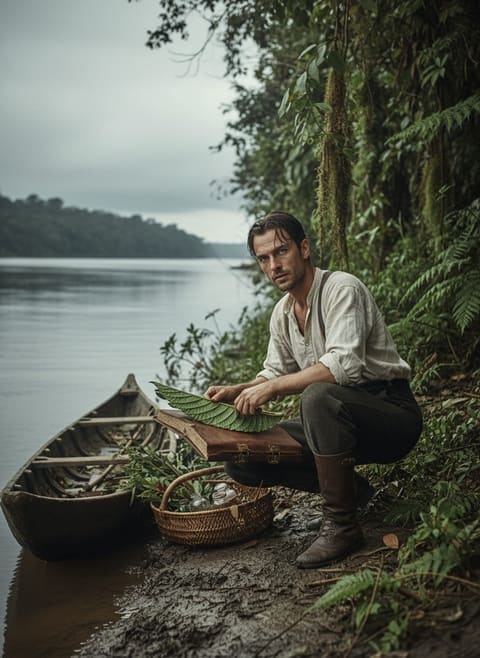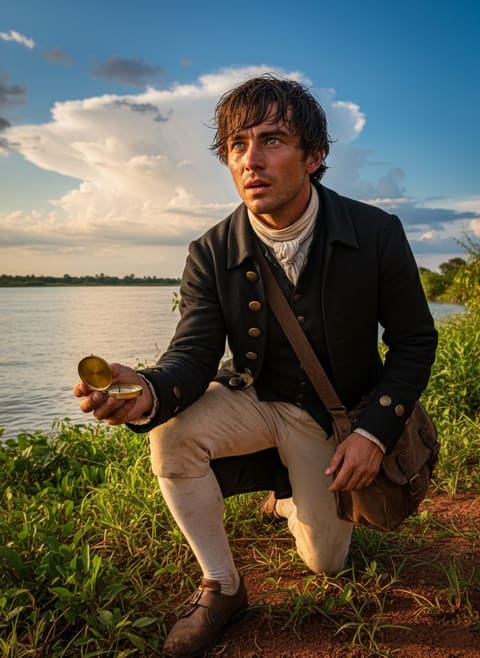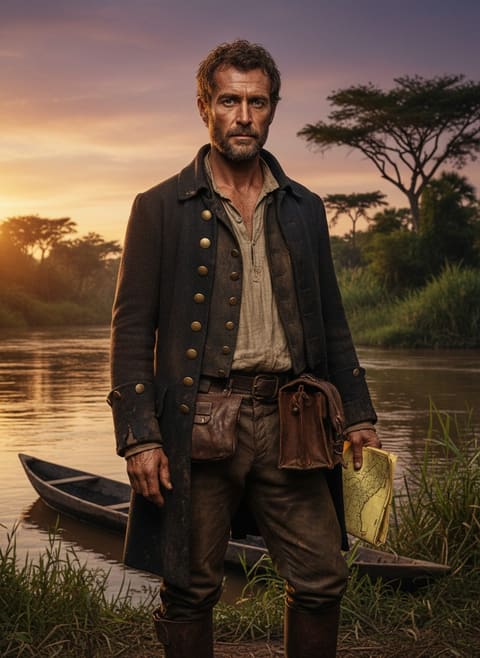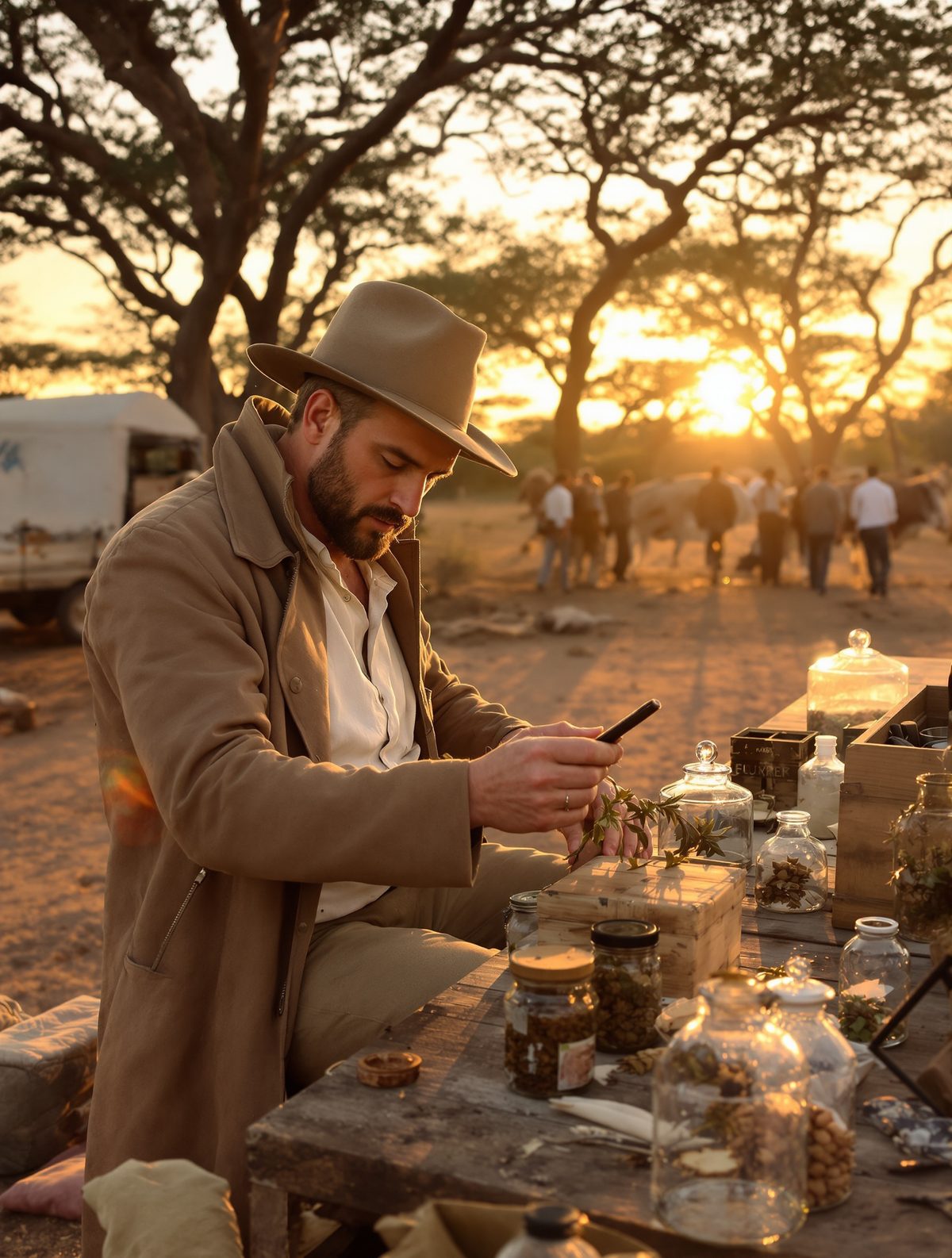
Picture this: a lone Englishman trudging through the scorching Kalahari Desert in 1812, his ox-wagon creaking under the weight of thousands of pressed flowers, preserved insects, and carefully sketched drawings of creatures no European had ever seen. William John Burchell cuts a remarkable figure against the endless African landscape—part Victorian gentleman, part desert wanderer, entirely obsessed with cataloguing every living thing he encounters. What he doesn't know yet is that he's about to discover a zebra that will bear his name for centuries, and fundamentally change how the world sees African wildlife forever.
The Gentleman Who Chose the Wilderness
In 1810, when most respectable English gentlemen were content with their London clubs and country estates, William Burchell was preparing for the adventure of several lifetimes. The 29-year-old naturalist had already spent four years as a schoolmaster on the remote island of St. Helena, where he'd developed an insatiable appetite for collecting specimens. But Africa—wild, unmapped, dangerous Africa—that was calling his name.
On June 19, 1811, Burchell set out from Cape Town with what can only be described as audacious optimism. His "expedition" consisted of an ox-wagon, a handful of scientific instruments, and most crucially, a portable plant press that would preserve thousands upon thousands of specimens. Unlike the grand military expeditions of his era, with their armed escorts and supply chains, Burchell traveled light—just him, local Khoikhoi guides who knew the land, and an almost supernatural determination to document everything he saw.
What makes Burchell's journey extraordinary isn't just its scope, but its spirit. While other explorers sought gold, territory, or glory, Burchell was hunting something far more elusive: knowledge. Every flower, every insect, every bird call was a potential discovery that could reshape scientific understanding.
Read next: The Day a Devon Captain Charted the Pacific and Changed the World
Into the Heart of the Unknown
The scale of Burchell's expedition becomes clear when you consider the numbers. Over four and a half years, he would travel 4,500 miles—roughly the distance from London to Mumbai—through territory that existed on European maps only as blank spaces marked "unexplored." His route took him in a vast loop through what is now South Africa and Botswana, crossing deserts, mountains, and grasslands that had never been systematically studied by a naturalist.
But here's what makes the story truly remarkable: Burchell wasn't just passing through. At every stop, he was collecting, cataloguing, pressing, preserving, and sketching with the methodical precision of a man possessed. His daily routine was almost monastic in its dedication—wake before dawn, travel until the heat became unbearable, then spend hours preparing specimens while his guides rested.
The conditions were brutal. Temperatures in the Kalahari could reach 120°F during the day and drop near freezing at night. Water was scarce, food was whatever could be hunted or gathered, and there was always the very real possibility of encountering lions, elephants, or hostile tribes. Yet Burchell pressed on, driven by an almost mystical belief that every species he documented was a piece of a grand natural puzzle.
The Zebra That Changed Everything
On July 4, 1812—exactly 36 years to the day after America declared independence—Burchell made a discovery that would ensure his immortality in the annals of natural history. Near the banks of the Orange River, he spotted what appeared to be zebras, but something was different. These animals had stripes that didn't extend all the way around their bellies, leaving their undersides white.
To most people, they would have looked like zebras. Period. But Burchell had the trained eye of a naturalist and the patience of a true scientist. He observed, sketched, and documented these animals with meticulous care, noting the distinctive stripe patterns that set them apart from the Cape Mountain zebras he'd already encountered.
What Burchell had discovered was an entirely new subspecies—Equus quagga burchellii—the plains zebra that would eventually bear his name. Burchell's zebra, as it came to be known, was not just another pretty African animal. It represented something profound: proof that Africa's biodiversity was far richer and more complex than anyone had imagined.
But here's the detail that will give you chills: the original quagga, the zebra's closest relative that Burchell also documented, went extinct in 1883. Burchell's careful observations and specimens became the only scientific record of these magnificent creatures. Without his obsessive documentation, we would have lost forever our understanding of an entire branch of the equine family tree.
50,000 Pieces of a Continental Puzzle
The zebra was just the beginning. By the time Burchell returned to Cape Town in 1815, his ox-wagon had become a mobile museum of African biodiversity. The final tally was staggering: over 50,000 specimens, including 40,000 insects, 9,000 plants, and hundreds of bird skins, all meticulously labeled and preserved.
To put this in perspective, Burchell was averaging about 30 new specimens every single day for four and a half years. This wasn't casual collecting—this was industrial-strength natural history. Among his discoveries were 265 new bird species and hundreds of plant species previously unknown to science. He documented the first scientifically accurate observations of meerkats, secretary birds, and dozens of other animals that are now African icons.
Read next: The Day a Devon Sailor Mapped the Roof of the World Alone
Perhaps most remarkably, Burchell did all of this without the benefit of modern preservation techniques. His plant press was a simple wooden contraption, his preserving spirits were basic alcohol solutions, and his "laboratory" was whatever flat surface he could find in the wilderness. Yet his specimens were so well-prepared that many survive in perfect condition in museums today, nearly 200 years later.
The man was essentially a one-person natural history survey of an entire continent, working with tools that wouldn't have been out of place in the Middle Ages, yet producing results that rival modern scientific expeditions.
The Forgotten Pioneer's Legacy
When Burchell finally returned to England in 1815, he brought with him not just specimens, but a completely new way of understanding African ecosystems. His meticulous observations and comprehensive collecting methods became the gold standard for natural history expeditions. Charles Darwin himself studied Burchell's work and cited his observations in On the Origin of Species.
Yet despite his extraordinary achievements, Burchell never received the recognition he deserved in his lifetime. Unlike the military heroes and territorial conquerors who dominated the headlines, a quiet naturalist with dirty fingernails and a wagon full of pressed flowers didn't capture the public imagination. He spent his later years cataloguing his specimens and writing detailed accounts of his travels, but fame and fortune eluded him.
The irony is profound: while the empire-builders and gold-seekers of Burchell's era are now largely forgotten footnotes in history, his scientific discoveries continue to shape our understanding of the natural world. Every zoo that displays a plains zebra, every nature documentary that features African wildlife, every conservation effort in southern Africa builds on the foundation that William Burchell laid with his ox-wagon and his inexhaustible curiosity.
Today, as we face a biodiversity crisis that threatens millions of species worldwide, Burchell's solitary journey across Africa feels remarkably contemporary. He understood something that we're only beginning to fully appreciate: that documenting and preserving the natural world isn't just an academic exercise—it's essential to our survival as a species. In an age when we can lose entire ecosystems before we even know what they contain, the image of one determined man walking across a continent, carefully cataloguing every living thing he encounters, seems less like historical curiosity and more like prophecy.