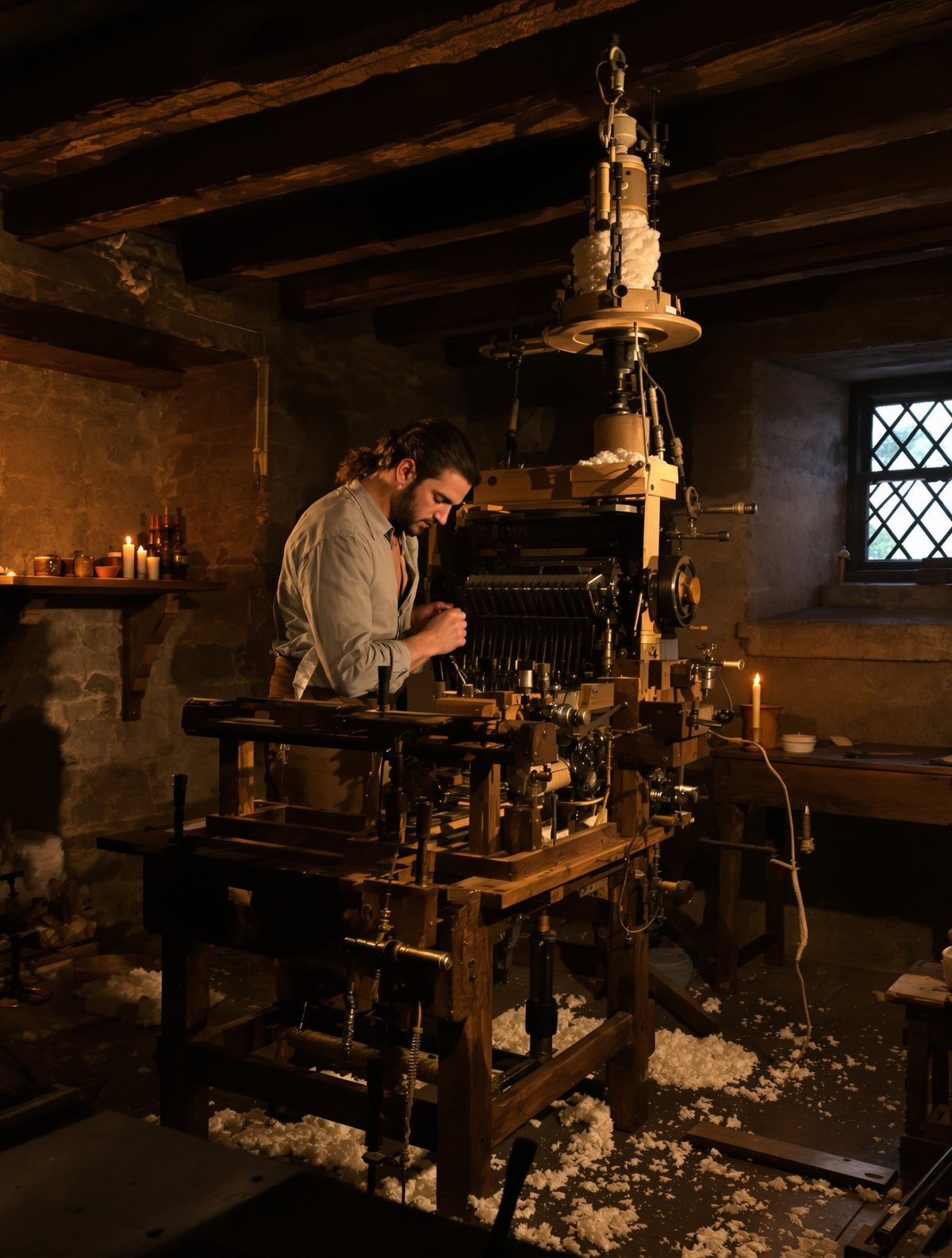
The neighbors were getting suspicious. For months, strange mechanical sounds had been echoing from Samuel Crompton's cottage in Bolton—clicking, whirring, and the unmistakable rhythm of something spinning. But whatever was happening behind those closed doors, it wasn't normal weaving. The 25-year-old had become increasingly secretive, working only at night, covering his windows, and refusing visitors. Some whispered he was going mad. Others suspected he was up to something that could change everything.
They were right about the second part. In that cramped Lancashire cottage, working by candlelight with nothing but his wits and whatever materials he could scrounge, Crompton was about to unleash a machine that would transform the global economy forever.
The Spinner's Dilemma
To understand why Crompton's neighbors were so intrigued, you need to picture the cotton crisis of the 1770s. Britain was in the grip of textile fever—demand for cotton cloth was exploding, but the technology couldn't keep up. James Hargreaves had invented the spinning jenny in 1764, which could spin multiple threads at once but produced weak, coarse yarn suitable only for the weft (the horizontal threads in weaving). Richard Arkwright's water frame, patented in 1769, spun stronger thread but required enormous water-powered mills.
Here's what the textbooks don't tell you: there was no machine that could spin both fine and strong thread. Cotton manufacturers were importing expensive, high-quality warp thread from India at enormous cost, while British spinners could only produce inferior yarn. It was a national embarrassment wrapped in an economic nightmare.
Read next: The Day a Weaver's Son Lit Britain's First Public Railway
Samuel Crompton knew this frustration intimately. The son of a weaver, he'd grown up watching his family struggle with the limitations of existing spinning technology. When he inherited his father's cottage at Hall-i'-th'-Wood in 1774, he was determined to solve the problem that was strangling Britain's cotton industry. He just had no idea it would take five grueling years of secret experimentation.
Five Years of Midnight Oil
What Crompton attempted in his cottage workshop would have challenged the finest engineers of his day. He was trying to combine two completely different spinning principles—the jenny's moving carriage system with the water frame's roller drafting—into a single machine. It was like trying to mate a horse with a steam engine.
Working mostly at night to avoid prying eyes, Crompton hand-carved wooden rollers, fashioned metal components from whatever iron he could afford, and spent countless hours adjusting, testing, and rebuilding. The machine gradually took shape: a massive contraption stretching nearly six feet wide, with moving carriages, spinning bobbins, and an intricate system of rollers that could draft cotton fibers with unprecedented precision.
But here's the detail that brings tears to your eyes: Crompton was so poor he couldn't afford proper materials. He carved wooden parts by hand, made springs from whalebone corset stays, and used every spare penny from his weaving work to buy iron. When curious neighbors knocked, he would hastily throw a cloth over his machine and pretend to be doing normal household tasks, his heart pounding as they peered through his windows.
The breakthrough moment came sometime in late 1779. After five years of relentless tinkering, Crompton's hybrid machine finally produced its first perfect thread—finer than anything spun in Britain, yet strong enough for the most demanding weaving. He had solved the impossible puzzle.
The Secret Revealed
By early 1780, Crompton couldn't hide his success any longer. The quality of yarn coming from his cottage was so extraordinary that word spread through Bolton's tight-knit weaving community like wildfire. Manufacturers began appearing at his door, desperate to see this miraculous machine for themselves.
The revelation was dramatic. When Crompton finally pulled back the cloth covering his invention, even experienced textile men stood speechless. The machine was unlike anything they'd seen—part jenny, part water frame, but entirely revolutionary. Someone dubbed it the "spinning mule" because, like the hybrid animal, it combined the best characteristics of two different breeds.
Here's the staggering part: Crompton's mule could spin thread of count 60 and higher—meaning 60 hanks of yarn per pound of cotton. The finest jenny could barely manage count 20. Indian hand-spinners, legendary for their skill, typically produced count 40. Crompton had not just improved British spinning; he had surpassed the best in the world.
Within weeks, textile manufacturers were clamoring to buy or license his design. The machine could produce thread so fine it was almost gossamer, yet strong enough for the warp threads that had previously required expensive imports. Britain's cotton industry was about to explode.
The Innovator's Tragedy
What happened next reveals the brutal realities of innovation in the Industrial Revolution. Despite creating one of the most important machines in history, Samuel Crompton never profited from his invention. He was too poor to afford a patent, and when local manufacturers pressured him to reveal his design, he naively agreed to share the technical details in exchange for a subscription fund that was supposed to compensate him.
The fund raised a measly £60—roughly equivalent to $8,000 today for an invention that would generate millions in profits for others. By 1812, there were over 4.6 million mule spindles operating in British mills, but Crompton remained in relative poverty, watching others grow rich from his genius.
Read next: The Day a Mill Owner Walked Into Court and Freed His Rivals' Children
Parliament eventually granted him £5,000 in recognition of his contribution, but it was too little, too late. The man who revolutionized the global textile industry died in modest circumstances in 1827, while cotton lords built palatial mansions with profits from machines based on his design.
The Thread That Rewove the World
The spinning mule's impact was nothing short of revolutionary. Within a generation, British cotton production exploded from a cottage industry to the driving force of the world's first industrial economy. The ability to spin fine, strong thread cheaply transformed cotton from a luxury fabric into everyday clothing for millions.
But the mule's influence reached far beyond Britain's mill towns. The demand for raw cotton to feed these miraculous machines intensified the brutal expansion of slavery in America's South. The profits from mule-spun textiles funded railway expansion, shipbuilding, and the vast infrastructure of industrial capitalism. Cotton cloth became Britain's most valuable export, flooding global markets and destroying traditional textile industries from India to Ireland.
Here's a mind-bending statistic: by 1850, Britain was importing 628 million pounds of raw cotton annually and exporting £31 million worth of cotton goods—much of it spun on machines descended from Crompton's original mule. A weaver's son working by candlelight in a Bolton cottage had inadvertently reshaped the global economy.
The Legacy Hidden in Plain Sight
Today, as we debate artificial intelligence, automation, and the future of work, Samuel Crompton's story feels remarkably contemporary. Here was a brilliant innovator working in isolation, driven by curiosity and necessity, who created technology that transformed entire industries overnight. Like many modern tech pioneers, he combined existing innovations in a completely new way—and like too many of them, he watched others reap the financial rewards of his breakthrough.
The spinning mule reminds us that the most revolutionary innovations often emerge not from well-funded laboratories, but from individuals willing to spend years pursuing an impossible dream. In our age of venture capital and patent lawyers, it's worth remembering the weaver's son who changed the world with whalebone springs and hand-carved wooden rollers, working by candlelight because he couldn't afford to fail.
Every time you put on a cotton shirt, you're wearing the legacy of those five secretive years in Bolton. The thread connecting your clothing to Samuel Crompton's cottage workshop is more than metaphorical—it's the literal foundation of the modern textile industry, spun from one man's refusal to accept that the impossible would remain impossible forever.