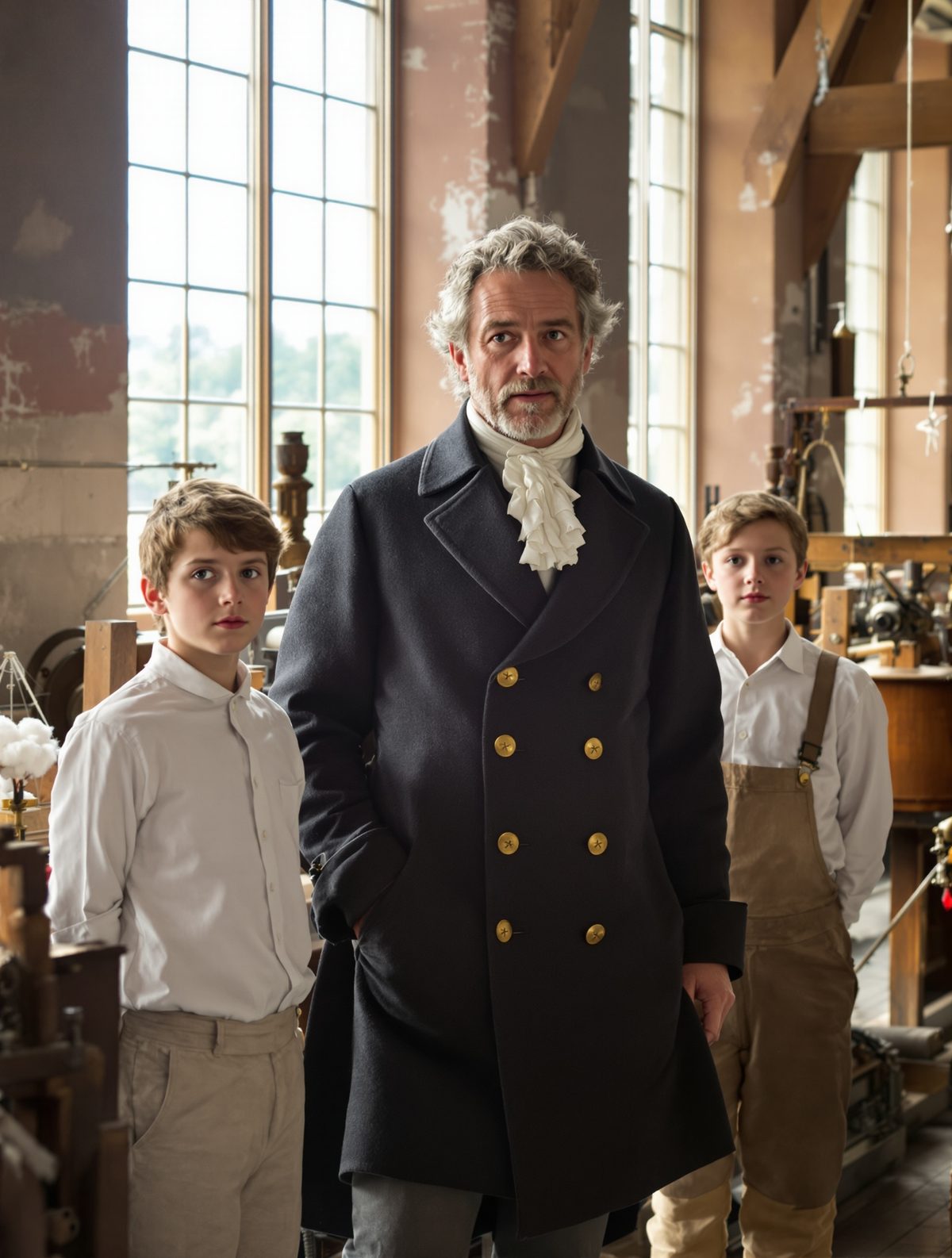
Picture this: a gruff Scottish mill owner strides through his factory floor in 1785, but instead of the usual screams and sobbing, he hears something extraordinary—laughter. Children, some barely eight years old, are not cowering from his approach but running toward him, calling out "Father Dale!" with genuine affection. In an age when factory children were treated as disposable machinery, David Dale had done the unthinkable: he'd proven that kindness could be more profitable than cruelty.
While Charles Dickens wouldn't write about industrial horrors for another fifty years, Dale was already rewriting the rules of the game. His New Lanark cotton mill would become the most productive facility in Scotland, not despite treating workers humanely, but because of it.
The Unlikely Revolutionary in a Wig and Waistcoat
David Dale looked nothing like a revolutionary. Born in 1739 to a shopkeeper in Stewarton, Ayrshire, he was a devout member of the Old Scotch Independents—a religious sect so strict they made Presbyterians look liberal. By his thirties, Dale had built a modest fortune importing linen from the Low Countries, but it was his partnership with the famous inventor Richard Arkwright that would change everything.
In 1785, Dale and Arkwright established their cotton spinning mill beside the thundering Falls of Clyde, naming it New Lanark. The location was perfect—the waterfalls provided endless power, and the remote setting meant Dale could build his own miniature kingdom. What visitors didn't expect was that this kingdom would be run on principles of compassion rather than fear.
Read next: The Day a Scots Weaver's Son Freed the Kirk From a King
The scale was breathtaking. By 1793, New Lanark employed over 1,300 people, with nearly 500 of them children under sixteen. In any other British mill, this would have been a recipe for misery. Instead, Dale created something unprecedented: an industrial operation that actually cared about its workers' wellbeing.
When "Father Dale" Tucked Scotland's Orphans Into Clean Beds
The children who arrived at New Lanark came from Edinburgh's overcrowded poorhouses and charitable institutions, often malnourished and bearing the psychological scars of abandonment. What they found at Dale's mill must have seemed like a fever dream.
Instead of sleeping ten to a fetid basement room—standard practice in most mills—Dale's children were housed just two to a bed in purpose-built accommodation. Each child received three meals a day, a revolutionary concept when most factory children were lucky to get gruel and scraps. Breakfast consisted of porridge, milk, and bread. Dinner featured broth, potatoes, and occasionally meat. Supper brought more bread and milk—a diet that would have been enviable even for children from working families.
Perhaps most remarkably, Dale limited working hours to just ten and a half per day for children under ten, and twelve hours for older children. While this might sound harsh by modern standards, it was positively enlightened for the 1780s, when fourteen to sixteen-hour days were the norm. Children actually had time to be children.
Visitors were astounded by what they witnessed. One contemporary observer noted that the children "appeared healthy and cheerful," while another wrote of seeing them "clean, well-fed, and displaying a contentment rarely observed in such establishments." Dale had achieved something that seemed impossible—he'd created an industrial operation that enhanced rather than destroyed young lives.
The School That Made Factory Inspectors Weep
Dale's masterstroke was his insistence on education. At a time when literacy was considered dangerous for the working classes—after all, educated workers might start getting ideas—Dale established schools that operated in the evenings and on Sundays. Children learned reading, writing, arithmetic, and even music and dancing.
The results were spectacular. By 1799, Dale's young workforce was not only literate but demonstrably more skilled than their peers elsewhere. New Lanark consistently produced finer cotton thread than competing mills, and productivity levels were unmatched across Scotland. The children weren't just surviving their industrial education—they were excelling because of it.
Dale's educational philosophy went beyond mere technical training. He believed that treating children with dignity and respect would create more loyal, more capable workers. He was proven spectacularly right. While other mills suffered constant turnover, theft, and sabotage, New Lanark hummed along with remarkable efficiency.
One particularly telling detail: Dale banned corporal punishment entirely. In an era when beating children was considered not just acceptable but necessary for maintaining discipline, this was revolutionary. Instead of fear, Dale relied on positive reinforcement and genuine care. The children responded by working harder and better than any whip could have compelled them to.
The Numbers That Proved Kindness Pays
Dale's humanitarian approach wasn't just morally superior—it was devastatingly profitable. By 1800, New Lanark was generating annual profits of over £40,000, equivalent to roughly £3 million today. The mill's cotton yarn was renowned across Europe for its quality, commanding premium prices in markets from London to Amsterdam.
Compare this to mills that relied on harsh treatment: they struggled with constant worker replacement costs, poor product quality, and frequent disruptions. Dale's approach eliminated these problems entirely. His worker retention rate was over 90%, unheard of in an industry where most employees fled at the first opportunity.
The health statistics were equally impressive. While child mortality rates in Manchester's cotton mills hovered around 60% by age fifteen, New Lanark's children not only survived but thrived. Many went on to skilled positions within the mill or established successful businesses elsewhere, becoming walking advertisements for Dale's methods.
Even the adult workers benefited from Dale's philosophy. He provided company stores that sold goods at cost price rather than the inflated rates common elsewhere. He built decent housing and maintained sanitary conditions. The result? Families competed for positions at New Lanark.
The Legacy That Launched a Movement
Dale's influence extended far beyond New Lanark's boundaries. When he sold the mill to his son-in-law Robert Owen in 1800, Owen built upon Dale's foundations to create an even more progressive community. New Lanark became a pilgrimage site for social reformers across Europe, inspiring everything from model villages to early socialist movements.
Read next: The Day a Highland Clan Turned a Massacre Into a Legend
More immediately, Dale's success forced other mill owners to reconsider their practices. While few matched his humanitarian standards, many began to realize that worker welfare and profitability weren't mutually exclusive. Dale had demonstrated that the race to the bottom wasn't the only path to success.
Perhaps most importantly, Dale proved that the Industrial Revolution didn't have to be synonymous with human misery. At a time when progress seemed to require suffering, he showed that technological advancement and human dignity could advance hand in hand.
His religious convictions played a crucial role in his approach. As a member of the Old Scotch Independents, Dale believed he would answer to God for how he treated his workers. This wasn't mere sentimentality—it was a deeply held conviction that every child under his care deserved respect and opportunity.
Why Dale's Revolution Still Matters
Today, as we grapple with questions about corporate responsibility and worker rights in our globalized economy, David Dale's story feels remarkably contemporary. His fundamental insight—that treating people well isn't just morally right but economically smart—remains as relevant in the age of Amazon warehouses as it was in 18th-century cotton mills.
Dale demolished the persistent myth that exploitation is necessary for progress. His New Lanark experiment proved that businesses could be both humane and profitable, both innovative and ethical. In an era when we're told that competitive pressures make worker welfare a luxury we can't afford, Dale's example suggests otherwise.
The children who called him "Father Dale" grew up to become skilled workers, entrepreneurs, and citizens who contributed far more to society than they ever could have as broken, illiterate factory hands. Dale understood something that many modern executives miss: investing in people pays dividends that extend far beyond the next quarterly report.
His story reminds us that behind every industrial statistic was a human being with hopes, dreams, and potential. Dale chose to nurture that potential rather than exploit it—and in doing so, he didn't just build a more successful business. He built a more successful society.