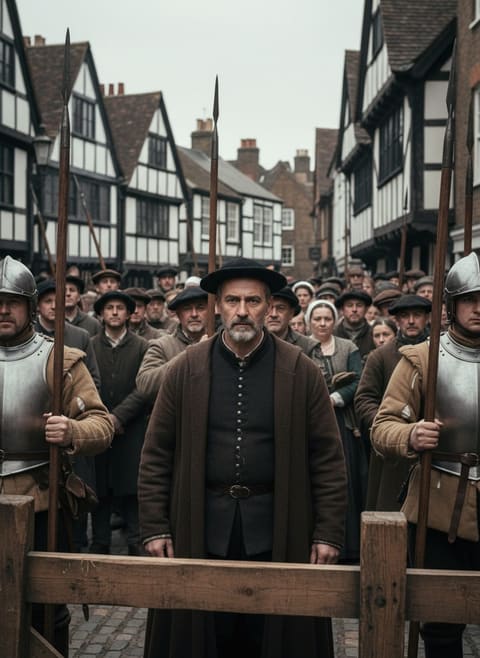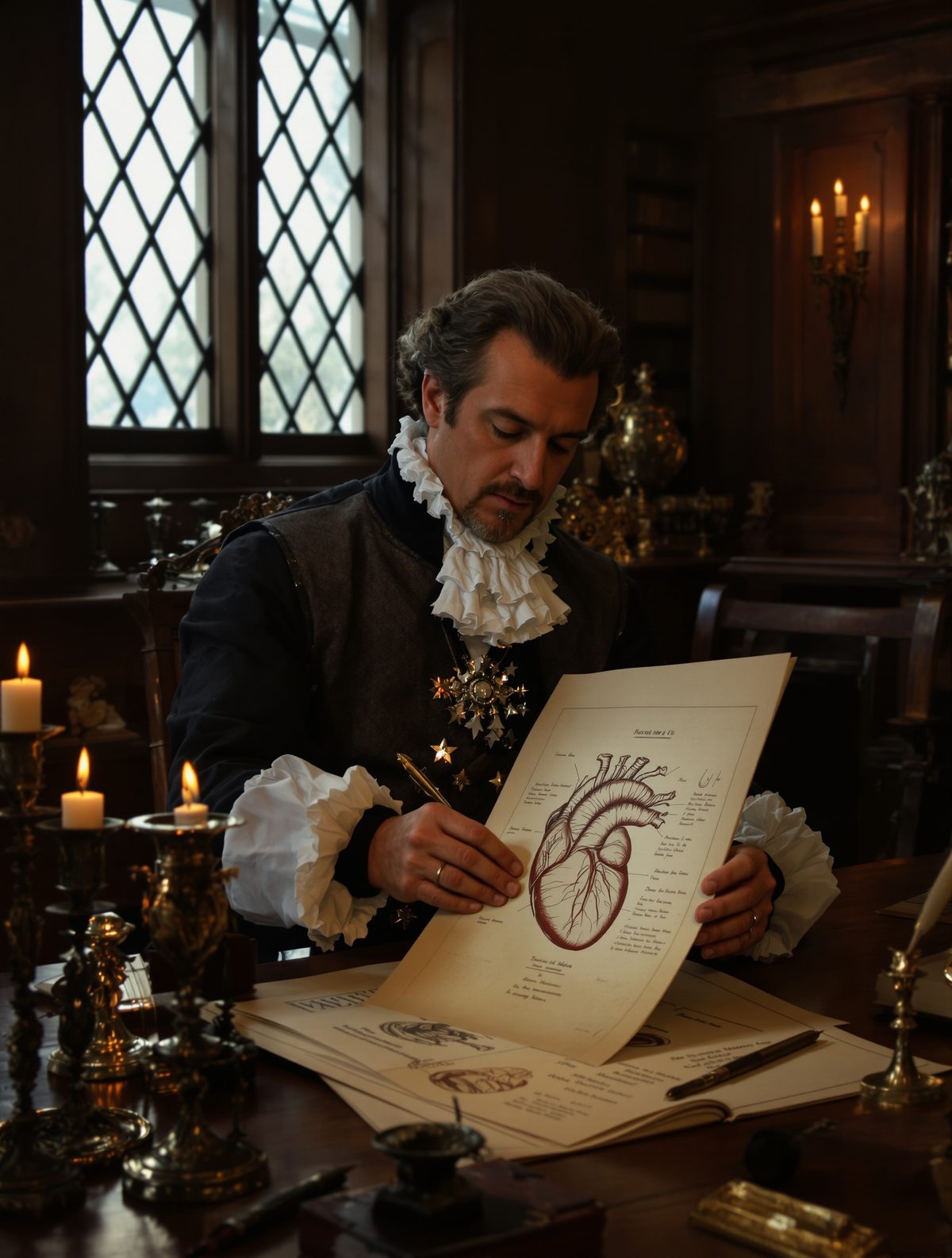
The silence in the Royal College of Physicians was deafening. Fifty of London's most distinguished doctors sat motionless, their faces frozen in disbelief. At the front of the oak-panelled chamber, a slight man with piercing eyes had just committed what they considered medical heresy. Dr William Harvey, physician to King Charles I himself, had dared to suggest that everything they knew about the human body was wrong.
It was 1628, and Harvey had just published a slim volume with an impossibly long Latin title that would change medicine forever: Exercitatio Anatomica de Motu Cordis et Sanguinis in Animalibus. In plain English, it meant "An Anatomical Exercise on the Motion of the Heart and Blood in Living Beings." Those 72 pages would overturn 1,500 years of medical doctrine and ignite a controversy that would rage across Europe for decades.
The Ancient Wisdom That Ruled Medicine
To understand the earthquake Harvey caused, we must first grasp what doctors believed before 1628. For fifteen centuries, European medicine had been dominated by the teachings of Galen, a brilliant Greek physician who served Roman emperors in the 2nd century AD. Galen's theories were so revered they were considered almost sacred—challenging them was tantamount to questioning the Bible itself.
According to Galenic doctrine, the body contained not one but two separate blood systems. The liver, they believed, transformed food into dark venous blood that flowed sluggishly through the body like a slow river, carrying nourishment to the organs before being consumed entirely. Meanwhile, the lungs mixed air with bright arterial blood that surged through a completely separate network, delivering vital spirits to enliven the flesh.
Read next: The Day a Tudor Chancellor Chose Death Over a Royal Lie
The heart, in this ancient view, was merely a passive furnace that warmed the blood. It certainly didn't pump—that idea was preposterous. After all, if you cut an artery in a dead body, no blood spurted out. How could the heart be a pump if it didn't pump in death?
This wasn't just medical theory—it was the foundation of how doctors treated patients. They prescribed bloodletting to drain "excess" blood, believing it would never return. They avoided certain surgical procedures, convinced that blood moved too slowly to cause dangerous bleeding. Thousands of patients lived or died based on these ancient assumptions.
The Curious Doctor Who Asked Dangerous Questions
William Harvey was an unlikely revolutionary. Born in 1578 in Folkestone to a prosperous merchant family, he seemed destined for a comfortable, conventional medical career. After studying at Cambridge, he travelled to the University of Padua—Europe's most progressive medical school—where he learned from the great anatomist Hieronymus Fabricius.
It was in Padua's candlelit dissection chambers that Harvey first encountered the puzzle that would consume his life. Fabricius had discovered strange flap-like structures inside veins, which he called "little doors" or valves. But the great anatomist couldn't explain their purpose—they seemed to serve no function in Galen's system.
Harvey's brilliant mind seized on this mystery. If blood was consumed as it travelled through the body, why did veins need one-way valves? What were they preventing from flowing backward? The questions gnawed at him as he returned to London, established a practice, and began his meteoric rise through the medical establishment.
By 1615, Harvey had been appointed Lumleian Lecturer at the Royal College of Physicians—a prestigious position that required him to give public demonstrations of anatomy. It was during these lectures that he began sharing his heretical ideas, carefully testing the waters before committing his thoughts to paper.
The Shocking Experiments That Changed Everything
What Harvey did next was revolutionary: he applied mathematics to medicine. Using careful measurements and repeatable experiments, he began to dismantle Galen's ancient edifice brick by brick.
First, Harvey calculated how much blood the heart actually moved. By measuring the heart's capacity and counting its beats, he made a startling discovery. The human heart pumped roughly two ounces of blood with each contraction. Multiplying by the pulse rate, Harvey found that the heart moved 8,640 ounces of blood every hour—that's 540 pounds, or about three times the weight of an average man.
The implications were staggering. If Galen was correct that blood was continuously manufactured and consumed, the liver would need to produce over half a ton of new blood every single hour. It was impossible.
Harvey's experiments grew more ingenious. He tied ligatures around human arms, creating living laboratories on willing volunteers. When he applied gentle pressure that blocked veins but not arteries, the hand below the ligature became engorged with blood while the area above emptied. When he pressed harder, stopping arterial flow as well, the opposite happened.
In one particularly dramatic demonstration, Harvey showed how the venous valves worked. He pressed his finger along a visible vein in a volunteer's arm, pushing the blood toward the heart. When he lifted his finger, the vein remained empty—the valves prevented blood from flowing backward. Only when he released the pressure point near the heart did blood flow back to refill the vein.
The evidence was overwhelming: blood moved in a circle, pumped by the heart through arteries to the body's extremities, then returning through veins to complete the circuit. It was a revolutionary concept that made the heart not just another organ, but the engine of life itself.
The Storm That Followed Publication
When Harvey's book appeared in 1628, the medical establishment erupted in fury. Dr Jean Riolan, France's most distinguished anatomist, declared Harvey's theories "dangerous paradoxes" that "subvert the practice of medicine." In Germany, physicians burned Harvey's book publicly. One contemporary wrote that Harvey's patient numbers dropped significantly because people considered his ideas so radical.
The resistance wasn't entirely unreasonable. Harvey had identified a logical problem with Galen's system, but he couldn't explain how blood actually moved from arteries to veins. The microscopic capillaries that connect these vessels wouldn't be discovered until 1661, when Marcello Malpighi peered through an early microscope at a frog's lung.
Moreover, Harvey's discovery threatened more than medical theory—it challenged the entire intellectual hierarchy of the age. If ancient authorities could be so fundamentally wrong about something as basic as blood flow, what other "eternal truths" might crumble under careful observation?
Read next: The Day a Tudor Bishop Refused to Crown a Usurper
The controversy raged for decades. In Paris, medical schools banned Harvey's teachings. In London, however, the Royal College gradually embraced their colleague's work. Harvey's meticulous methodology and mathematical precision made his conclusions increasingly difficult to refute.
The King's Doctor and His Secret Experiments
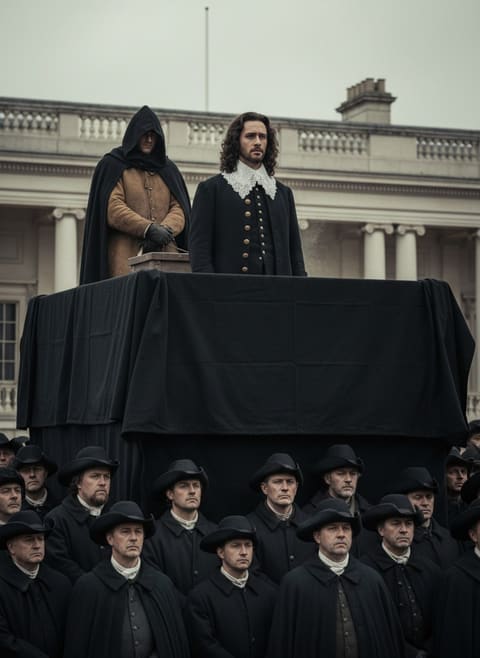
Harvey's position as royal physician provided him with unique opportunities to advance his research. When King Charles I executed the Earl of Strafford in 1641, Harvey was granted permission to examine the nobleman's body immediately after death—a rare chance to observe the heart's final moments.
Even more remarkably, Harvey conducted experiments on the living king himself. Charles I, fascinated by Harvey's theories, allowed the doctor to demonstrate circulation using the royal arms as a laboratory. Court records suggest the king became one of Harvey's most enthusiastic supporters, even participating in dissections of deer from the royal parks.
Harvey also made an extraordinary discovery about reproduction that further cemented his reputation. Through careful observation of deer in the royal hunting grounds, he determined that all life comes from eggs—"omne vivum ex ovo"—overturning another ancient belief that some creatures arose spontaneously from mud or decay.
A Revolution That Echoes Through Time
Harvey's triumph was more than a medical breakthrough—it was a triumph of the scientific method itself. By insisting on observation, measurement, and reproducible experiments over ancient authority, Harvey helped establish the principles that would drive the Scientific Revolution.
His work laid the foundation for everything from blood transfusions to heart surgery to our modern understanding of cardiovascular disease. When doctors today insert stents to open blocked arteries, transplant hearts, or prescribe medications to lower blood pressure, they're building on insights that Harvey first glimpsed in those Paduan dissection rooms four centuries ago.
Perhaps most remarkably, Harvey's basic description of circulation remains essentially unchanged today. In an age when most scientific theories have been refined, modified, or completely replaced, Harvey's vision of the heart as a muscular pump driving blood through a closed circulatory system stands as one of history's most enduring scientific insights.
The next time you feel your pulse or watch a heart monitor trace its rhythmic peaks, remember the quiet revolutionary who dared to challenge fifteen centuries of conventional wisdom. William Harvey didn't just discover how blood moves through our bodies—he showed us how careful observation and rigorous thinking could unlock the deepest secrets of life itself. In our age of medical miracles and life-saving treatments, we are all beneficiaries of that one shocking day in 1628 when a royal physician proved the heart was more powerful than anyone had ever imagined.