The flickering candle cast dancing shadows across the mud-brick walls as Susi and Chuma pushed open the door to their master's hut. It was May 4th, 1873, and the two men had come to wake David Livingstone for the day's journey across the fever-soaked wilderness of what is now Zambia. But the great Scottish explorer would never wake again.
There, beside his simple camp bed, knelt the 60-year-old missionary in what appeared to be his final prayer. His weathered hands were clasped, his gray head bowed in devotion to the God he had served across three decades in the African interior. David Livingstone, the mill worker's son from Blantyre who had become Britain's most celebrated explorer, was dead—1,500 miles from the nearest coast, further still from the Scottish hills he called home.
What happened next would become one of history's most extraordinary displays of loyalty, as his African companions made a decision that defied logic, endurance, and every law of tropical decay. They would take their beloved bwana home—but first, they would leave his heart in Africa.
The Impossible Decision in Chief Chitambo's Village
When word of Livingstone's death reached the nearby village of Chief Chitambo, it triggered a crisis that would have tested Solomon himself. The great explorer had died seeking the source of the Nile, convinced that solving this ancient mystery would bring glory to God and help end the slave trade that had haunted his every step through Africa. Now his body lay in a remote hut, while the rains threatened and his small expedition faced an impossible choice.
Read next: The Day a Scots Village Chose Its Own Name and Kept It
Susi, a freeman from Shupanga, and Chuma, freed from slavery by Livingstone himself years earlier, led a group of 79 followers who had remained faithful through months of hardship. They could bury their leader where he died, beside the marshy shores of Lake Bangweulu, and return to their homes. Or they could attempt something that seemed to border on madness: carry his remains across 1,500 miles of hostile territory, through kingdoms at war, across rivers in flood, past lions and slave raiders, to deliver him to the British authorities at the coast.
But Livingstone's men knew their master's deepest wish. Years earlier, he had spoken of his desire to rest in British soil, among his own people. The decision was made without debate—they would take him home, whatever the cost.
A Heart Left Beneath the Mvula Tree
What followed was a process so extraordinary that when news of it reached Britain months later, it would move a nation to tears. Under the direction of James Chuma, who had learned some anatomy from Livingstone during their travels, the men performed a careful preservation of the body. But first came the most symbolic act of all.
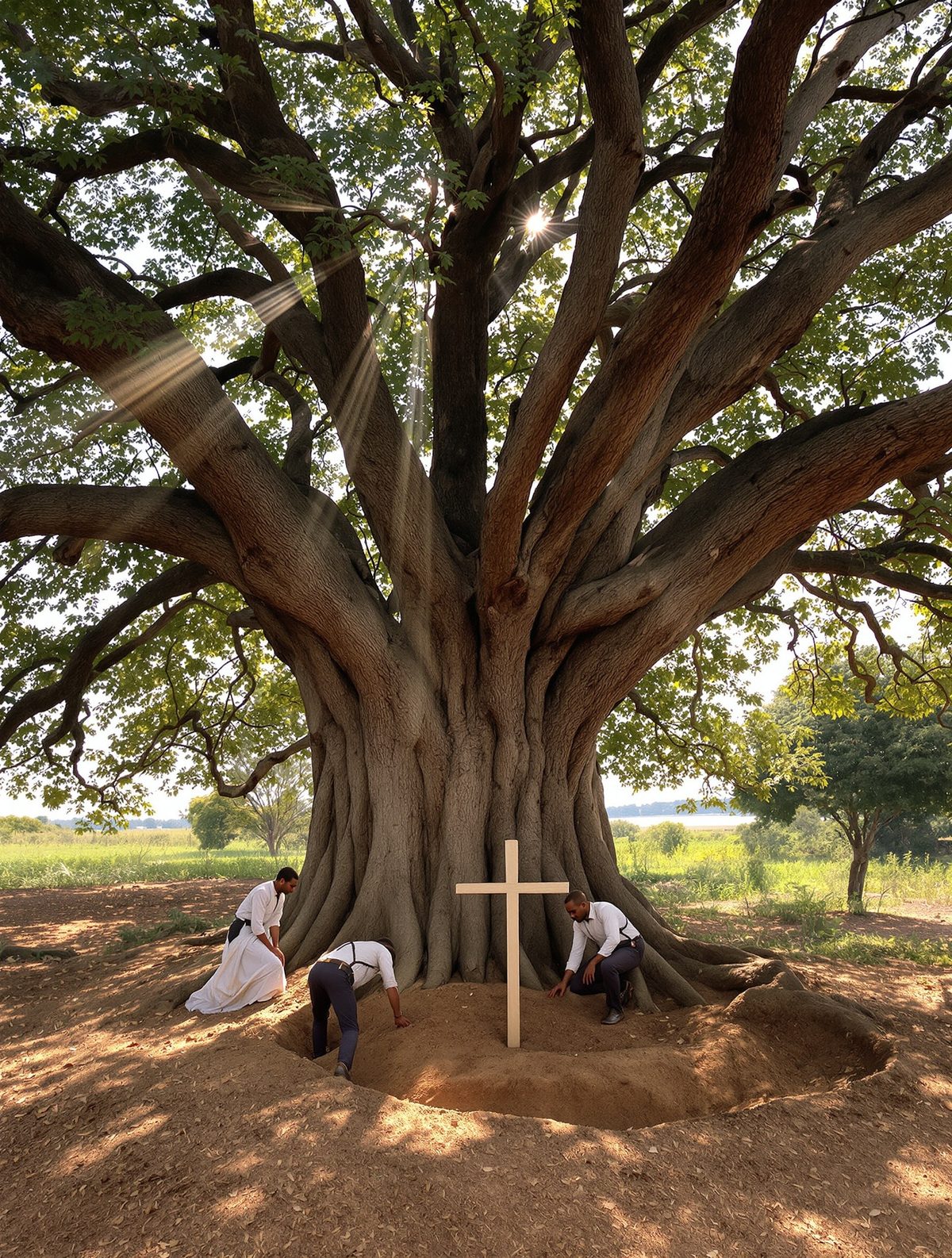
They removed Livingstone's heart and buried it beneath a large mvula tree—what we know as the African teak—in Chief Chitambo's village. Here was a gesture of profound poetry: the heart of the man who had fallen in love with Africa would remain forever in the soil he had devoted his life to serving. The tree still stands today, marked by a simple monument, in what is now the Zambian countryside.
The inscription they carved into the mvula's bark was heartbreakingly simple: "Dr. Livingstone. May 4th, 1873." Then came the practical magic of preservation. They removed the internal organs, dried the body with salt (a precious commodity they had carried for trade), filled the cavity with salt and brandy, and wrapped everything in calico and bark-cloth. The result looked nothing like the bearded explorer who had captivated Victorian Britain—it resembled a large bale of trade goods, which may well have saved their lives in the trials ahead.
The March That Defied Belief
On May 16th, 1873, the most remarkable funeral procession in history began its march to the sea. Seventy-nine men carrying their dead master's body, his scientific instruments, journals, and maps—everything needed to preserve his legacy and complete his work. They had no guarantee of success, no promise of reward, and every reason to expect death along the way.
The geography alone was staggering. From the interior of present-day Zambia to Bagamoyo on the coast of Tanzania, they would cross the breadth of the continent through regions that had never seen a European flag. They navigated by the stars and by the ancient trade routes that connected the great lakes to the Indian Ocean. Their pace was necessarily slow—not just because of the burden they carried, but because they were entering territories where Livingstone's name meant nothing, where his followers were just another group of travelers who might be traders, raiders, or spies.
The journey took nine months—nine months of carrying a dead man through country that had already proven lethal to the living. They faced down suspicious chiefs, negotiated passage across rivers swollen by rains, and somehow managed to avoid the Arab slave raiders who made these routes deadly for small, undefended parties.
When Two Expeditions Met
Meanwhile, Britain had not been idle. Reports of Livingstone's failing health had reached London, and two separate rescue expeditions had been dispatched. Lieutenant Verney Lovett Cameron led one by land from the east coast, while Lieutenant William Grandy pushed up from the west coast of Africa. It was Cameron's expedition that would provide one of history's most poignant near-misses.
In October 1873, just five months into their marathon journey, Susi and Chuma's party encountered Cameron's relief expedition at Tabora, in present-day Tanzania. The British lieutenant found himself in an extraordinary situation: he had come to rescue Livingstone, only to meet the great man's preserved corpse being carried toward the coast by his faithful followers.
Cameron examined the remains and confirmed the identity through distinctive markings—including the badly healed left arm bone that had been crushed by a lion decades earlier, a detail that would later provide absolute proof of authenticity. He offered to take charge of the body himself, but Susi and Chuma respectfully refused. They had begun this journey, and they would finish it. Cameron continued inland to complete Livingstone's mapping work, while the funeral procession continued its march to the sea.
The Coast at Last
On February 15th, 1874—284 days after Livingstone's death—the lights of Bagamoyo finally appeared through the coastal palms. Susi, Chuma, and their surviving companions had achieved the impossible. They had carried their master's body across a continent, through kingdoms and across rivers, past every danger that Africa could throw at them. When asked years later why they had undertaken such an ordeal, Chuma's answer was simple: "We loved him."
The British authorities who received the body were overwhelmed by the magnitude of the achievement. Here was devotion beyond any contract, loyalty beyond any reward. The body was shipped to Britain aboard HMS Vulture, while Susi and Chuma were brought to London as honored guests, to witness the final chapter of their extraordinary journey.
On April 18th, 1874, Westminster Abbey witnessed scenes of mourning rarely matched in Victoria's reign. The great and good of the Empire gathered to honor the mill worker's son who had mapped a million square miles of Africa and had inspired a generation of Britons with his vision of commerce, Christianity, and civilization replacing the slave trade. But among the mourners, none had earned their place more than the two African men who had carried him home.
A Legacy Written in Footsteps
Today, when we speak of loyalty, devotion, or going the extra mile, we rarely have examples as literal or as moving as Susi and Chuma's nine-month march across Africa. Their story challenges every assumption about the colonial period, about the relationships between Europeans and Africans, and about the power of human connection to transcend the boundaries of race, culture, and continent.
In our age of global communication, when we can speak to anyone anywhere in seconds, there's something profoundly moving about men who walked for nine months to honor their word to a dead friend. Livingstone's heart remains under that mvula tree in Zambia—a reminder that sometimes the most powerful monuments are not built of stone, but of love, determination, and the simple decision to keep walking when everything tells you to stop.
The Victorian era called it the age of exploration, but perhaps it was really the age of extraordinary friendship—when two African men proved that the greatest journeys are not measured in miles, but in the depths of loyalty that drive us to carry each other home.