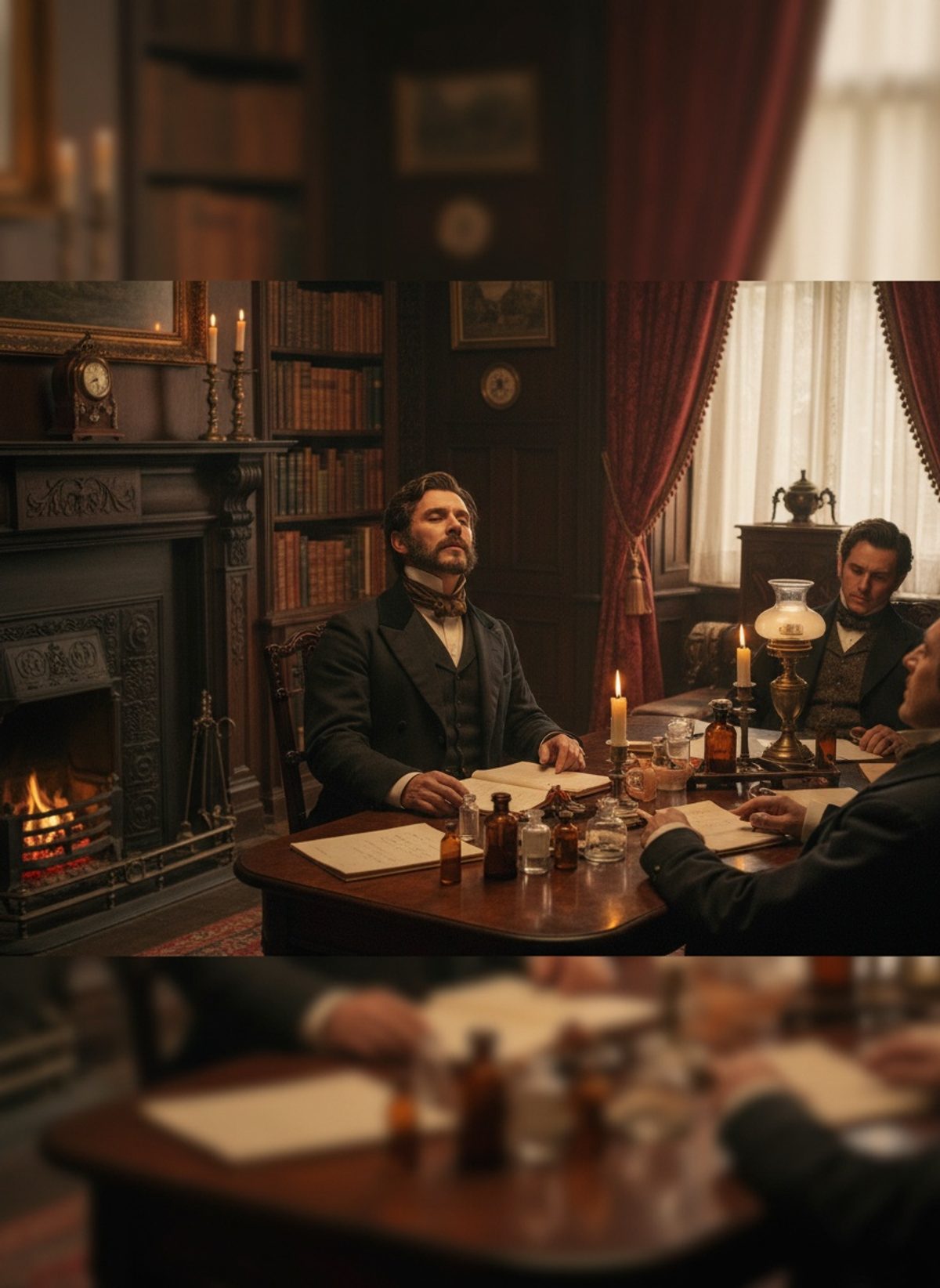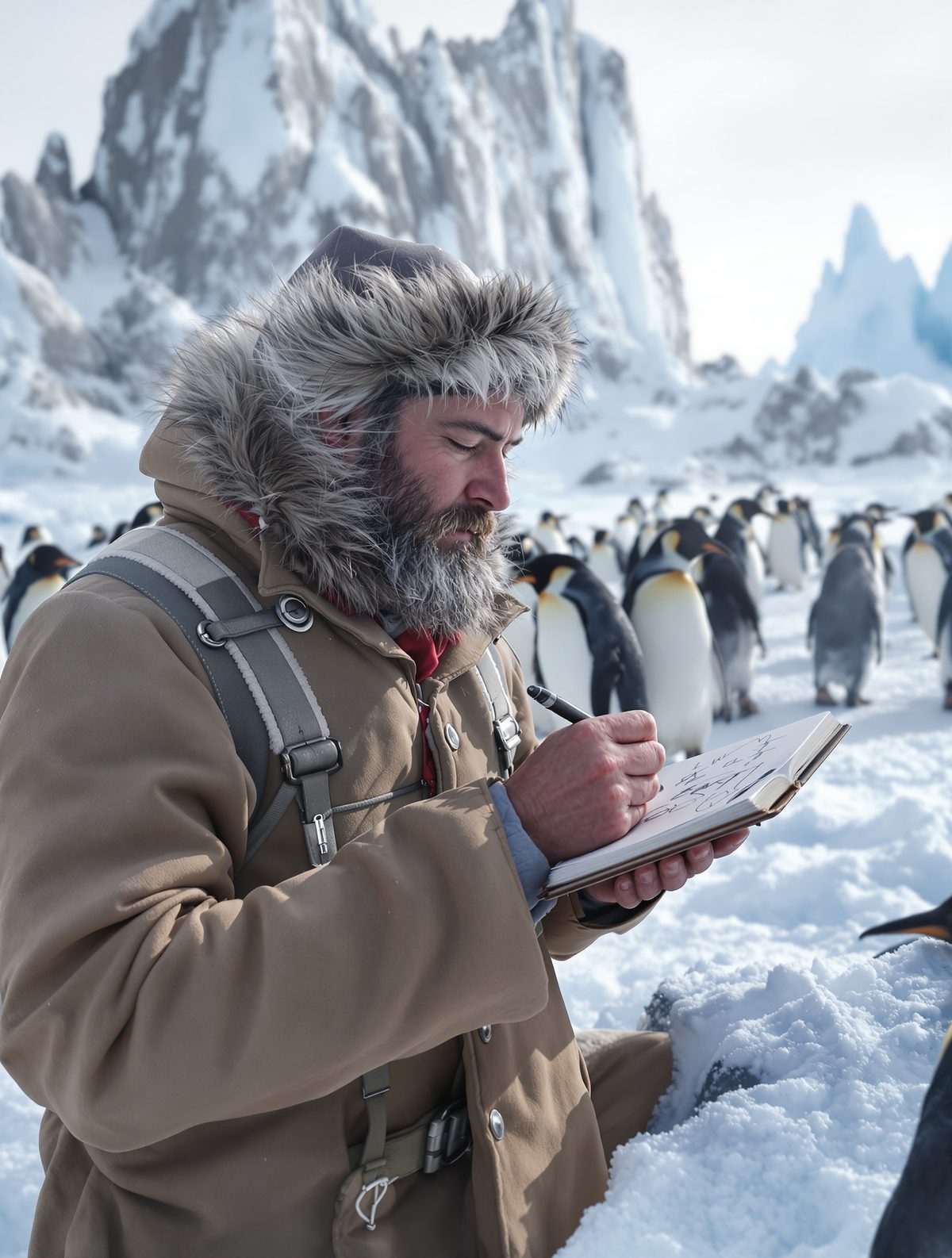
The pencil had frozen to his fingers again. Dr Edward Wilson tried to flex his hand, but the graphite stick wouldn't budge from his frost-bitten grip. Around him, the Antarctic wind howled at minus 77 degrees Fahrenheit—cold enough to freeze human breath before it left the lungs. Most men would have retreated to their tent, huddled around a meager flame, and waited for death or rescue. But Wilson had spotted something extraordinary waddling across the ice: a creature no human had ever properly documented. So he kept drawing, even as his fingers turned black with frostbite.
It was July 1902, and Wilson was enduring what many consider the most brutal scientific expedition in human history. But this Yorkshire doctor wasn't just fighting for survival—he was racing to capture the first detailed images of Antarctica's hidden wildlife before the merciless continent claimed his life.
The Artist Who Chose Ice Over Comfort
Edward Adrian Wilson wasn't supposed to be freezing to death at the bottom of the world. Born in 1872 to a well-to-do family in Cheltenham, he had trained as a doctor and shown exceptional talent as a natural history artist. By 1900, he could have lived comfortably treating wealthy patients and painting British birds in his spare time. Instead, when Captain Robert Falcon Scott announced his Discovery expedition to Antarctica, Wilson volunteered to serve as the team's doctor, zoologist, and official artist.
His friends thought he'd lost his mind. Antarctica remained largely unmapped, and previous expeditions had ended in disaster. The continent's wildlife was a complete mystery—scientists had only sketchy reports of strange penguins and seals from the few sailors who'd survived encounters with the ice. But Wilson saw opportunity where others saw suicide. "Someone must record what's down there," he wrote to his wife Oriana before departing. "Someone must show the world these creatures that God has hidden at the ends of the earth."
Read next: The Day a Widow's Son Lit Up the Victorian Night
What Wilson didn't anticipate was just how literally his fingers would freeze to his tools in service of that mission.
When Art Becomes a Matter of Life and Death
The Discovery expedition reached Antarctica in January 1902, during the continent's brief summer. Even then, temperatures rarely rose above minus 20 degrees Fahrenheit. Wilson immediately began sketching the alien landscape and its inhabitants, but he quickly discovered that normal artistic techniques were useless in the Antarctic.
Watercolors froze solid in their tubes. Oil paints became thick as concrete. Metal pencils conducted the cold so effectively that touching them meant instant frostbite. Wilson had to develop entirely new methods: he kept pencils inside his coat, close to his body heat. He mixed his own paints with glycerin to prevent freezing. Most remarkably, he learned to sketch while wearing thick mittens, developing an almost supernatural ability to capture fine details through layers of wool and leather.
But Wilson's real test came during the expedition's "winter journey"—a three-month trek into Antarctica's interior during the continent's pitch-black winter. Between June and August 1902, Wilson, Scott, and expedition member Ernest Shackleton pushed south into territory no human had ever seen, hauling sledges across ice fields in temperatures that regularly dropped below minus 70 degrees.
It was during this journey that Wilson encountered the emperor penguins.
The Penguins That Defied Belief
On July 27, 1902, Wilson spotted something that made him question his own eyesight. Through the swirling snow, he saw what appeared to be a group of enormous penguins—far larger than any species known to science. These creatures stood nearly four feet tall, with distinctive orange and yellow markings around their necks. Even more incredibly, they were caring for chicks in the middle of the Antarctic winter, when temperatures made survival seem impossible.
Wilson had discovered emperor penguins during their breeding season—a biological phenomenon so extraordinary that many scientists would later refuse to believe his reports. These birds had evolved to breed during Antarctica's harshest months, incubating their eggs through the polar night by balancing them on their feet and covering them with warm flaps of skin.
Desperate to document these unknown creatures, Wilson spent hours sketching them despite conditions that would have killed most people within minutes. His journal from that day records the temperature at minus 77 degrees Fahrenheit—cold enough that his breath created instant ice crystals that obscured his vision. His fingers repeatedly froze to his pencil, requiring him to warm them against his body before continuing to draw.
"The pencil moves like a knife through butter when the temperature drops this low," Wilson wrote. "But I must capture their posture, the way they huddle together, the remarkable devotion they show to their young. No one will believe such creatures exist without seeing them."
Painting with Frostbitten Fingers
Wilson's dedication to his art nearly killed him several times. During one sketching session in August 1902, he became so absorbed in drawing a group of Weddell seals that he didn't notice a blizzard approaching. His companions found him hours later, unconscious and buried in snow, still clutching his sketchbook. The drawings he'd completed that day—detailed studies of seal anatomy and behavior—became some of the most scientifically valuable illustrations of the expedition.
Perhaps most remarkably, Wilson discovered that the extreme cold actually enhanced certain aspects of his artistic technique. The dry Antarctic air meant that his pencil marks became incredibly sharp and precise. Colors, when he could use them, appeared more vivid against the stark white landscape. He developed what he called "ice drawing"—a technique where he used the natural frost patterns on paper to create texture and depth in his illustrations.
By the time the expedition returned to England in 1904, Wilson had created over 400 detailed drawings and paintings of Antarctic wildlife. His portfolio included the first scientific illustrations of emperor penguins, leopard seals, and numerous bird species. Many of these creatures had never been properly documented—Wilson's frozen fingers had captured images of animals that existed nowhere else on Earth.
The Art That Changed Science
When Wilson's Antarctic artwork was first displayed at the Royal Geographical Society in London, the audience sat in stunned silence. The emperor penguins seemed too fantastical to be real. The landscapes appeared too harsh to support life. Several prominent scientists initially dismissed Wilson's illustrations as artistic exaggeration.
But Wilson had done more than create beautiful pictures—he had produced scientifically accurate documentation that revolutionized understanding of polar biology. His detailed anatomical drawings allowed taxonomists to classify new species. His behavioral observations, captured in quick field sketches, revealed how Antarctic animals had adapted to the world's most extreme environment.
The emperor penguin illustrations proved particularly significant. Wilson had not only discovered the species but had documented their extraordinary breeding behavior—incubating eggs during the polar winter, a strategy so counterintuitive that it challenged existing theories about animal behavior in extreme climates.
Wilson's artistic techniques, developed under impossible conditions, influenced a generation of field researchers. His methods for preserving art supplies in extreme cold, for sketching while wearing protective gear, and for capturing accurate colors in challenging light became standard practice for polar expeditions.
The Legacy Frozen in Time
Edward Wilson returned to Antarctica with Scott's fatal Terra Nova expedition in 1910. On March 29, 1912, he died alongside Scott in their tent, just eleven miles from a supply depot that might have saved their lives. His final sketches, found with his body, showed Antarctic flowers he'd discovered during their last march.
Today, Wilson's artwork hangs in natural history museums worldwide, but its significance extends far beyond aesthetic value. In an age before reliable photography could capture wildlife in extreme conditions, Wilson's illustrations provided the only accurate record of species that remained largely mysterious until the modern era of polar research.
Climate scientists now study Wilson's detailed drawings to understand how Antarctic ecosystems have changed over the past century. His precise documentation of ice formations, weather patterns, and animal behaviors provides a baseline for measuring environmental change in one of Earth's most sensitive regions.
Perhaps most remarkably, Wilson's dedication to his art under impossible conditions reminds us that some forms of human knowledge can only be preserved through individual courage and sacrifice. In our age of satellite imagery and remote sensing, it's easy to forget that our understanding of the natural world was built by people like Wilson—individuals willing to freeze their fingers to a pencil rather than let remarkable discoveries go unrecorded.
Every time we see a documentary about emperor penguins or marvel at Antarctica's wildlife, we're seeing through eyes that Edward Wilson opened for us, one frostbitten sketch at a time.