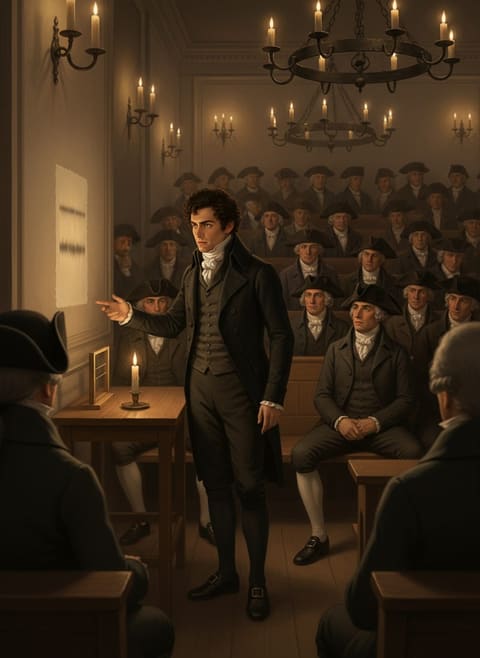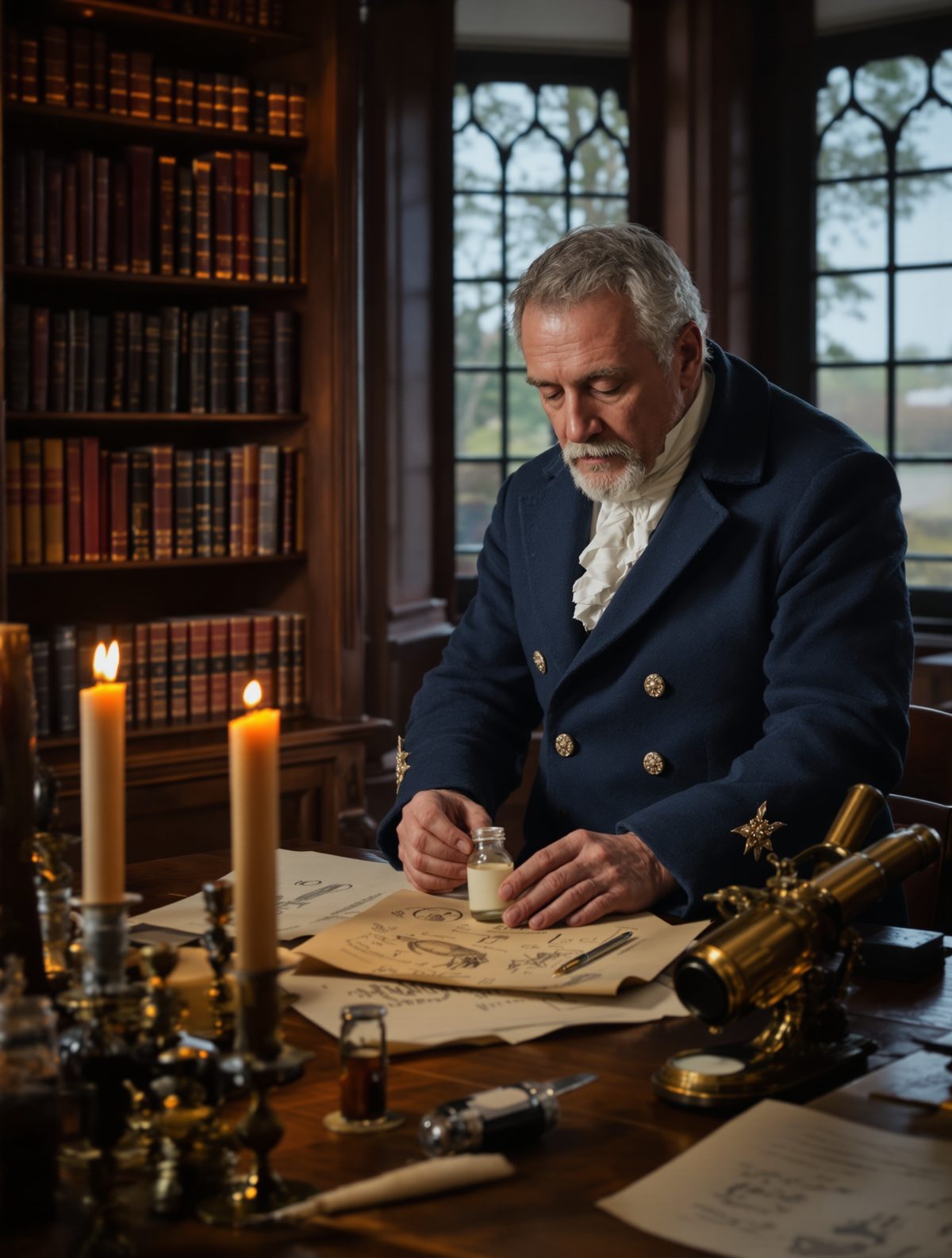
The eight-year-old boy sat perfectly still as the country doctor approached with his lancet, but James Phipps had no idea he was about to become the most important test subject in medical history. On this spring morning in 1796, in a small Gloucestershire cottage, Dr Edward Jenner was preparing to deliberately infect a healthy child with disease—gambling the boy's life on nothing more than village folklore and his own desperate theory.
Outside, the rolling hills of Berkeley were dotted with dairy farms where milkmaids went about their daily work, their hands often bearing the telltale pustules of cowpox. These women had unknowingly held the key to humanity's greatest medical breakthrough for generations. They just didn't know it yet.
The Milkmaid's Secret
Sarah Nelmes didn't think much of the blisters on her hands when she arrived at Jenner's surgery that May morning. The young milkmaid had contracted cowpox from Blossom, a Gloucester cow whose hide now hangs in St George's Medical School as one of medicine's most precious relics. For Sarah, it was just an occupational hazard—painful pustules that would heal in a few weeks.
But Jenner saw something far more significant. The 47-year-old physician had spent years investigating local folklore that claimed milkmaids who caught cowpox never succumbed to smallpox. In an era when smallpox killed 400,000 Europeans annually and left survivors blind, scarred, or disfigured, this rural superstition represented hope beyond measure.
Read next: The Day a Weaver's Son Mapped the Invisible World
Smallpox was the undisputed king of killers. It had toppled empires, decimated populations, and left its mark on virtually every family in Britain. Even those who survived bore its signature for life—the distinctive pitted scars that marked smallpox survivors were so common they were barely remarked upon. Queen Mary II had died of it in 1694. Mozart would succumb to it in just a few years' time.
Yet here were these country women, working daily with cattle, who seemed mysteriously protected from the disease that terrorised everyone else. Jenner had been mulling over this puzzle for decades, ever since his apprenticeship when he first heard a milkmaid declare with confidence: "I shall never have smallpox for I have had cowpox."
The Gamble of a Lifetime
On 14th May 1796, Jenner made two small incisions in James Phipps's arm—the boy was the son of his gardener, a detail that speaks volumes about the class dynamics of Georgian medical experimentation. Using matter from Sarah Nelmes's cowpox pustules, he deliberately infected the child with what he hoped was a benign cousin of humanity's greatest enemy.
What followed were the longest six weeks of Jenner's career. James developed the expected cowpox symptoms—fever, discomfort, and the characteristic blisters. But he recovered completely, exactly as Jenner had hoped. The real test, however, was yet to come.
On 1st July, Jenner performed an act that would be considered unconscionable today. He deliberately exposed James Phipps to smallpox itself—not once, but multiple times over several months. He rubbed smallpox matter into fresh cuts on the boy's skin. By any reasonable expectation, James should have developed the disease that killed three out of every ten people it touched.
Instead, nothing happened. James remained perfectly healthy, apparently immune to the scourge that had haunted humanity for millennia. Jenner's gamble had paid off, though the true magnitude of his success wouldn't become clear for years to come.
The Dangerous Precedent
Jenner wasn't working in a complete vacuum. The practice of variolation—deliberately infecting people with mild smallpox strains—had been imported from the Ottoman Empire decades earlier. Lady Mary Wortley Montagu had observed the practice in Constantinople and controversially had her own children inoculated in the 1720s.
But variolation was a deadly gamble. While it often produced milder smallpox cases, it still killed roughly two percent of patients—and worse, those patients could spread full-strength smallpox to others. The practice created as many problems as it solved, leaving physicians desperate for alternatives.
Jenner's approach was fundamentally different. By using cowpox—a related but much milder disease—he had potentially found a way to provide protection without the Russian roulette of variolation. The word he coined for his technique derived from the Latin word for cow: vacca. He called it vaccination.
Yet even Jenner couldn't have predicted the resistance his discovery would face. When he submitted his findings to the Royal Society, they were rejected. The scientific establishment wasn't ready to embrace a country doctor's radical theory based on folklore and a sample size of one terrified child.
From Village Experiment to Global Revolution
Undeterred by institutional rejection, Jenner continued his experiments and self-published his findings in 1798. His pamphlet, "An Inquiry into the Causes and Effects of the Variolæ Vaccinæ," documented 23 cases and laid the groundwork for the science of immunology—though that term wouldn't be coined for another century.
The medical community's response was explosive and polarised. Some physicians embraced vaccination immediately, recognising its potential to save countless lives. Others were horrified by the idea of deliberately introducing animal matter into human bodies. Critics published cartoons showing vaccinated people sprouting cow heads and udders, playing on public fears about the unnaturalness of Jenner's intervention.
Religious objections proved equally fierce. Many clergy denounced vaccination as interference with divine will—if God intended people to have smallpox, who was Jenner to intervene? The familiar ring of these arguments might surprise modern readers who assume vaccine hesitancy is a recent phenomenon.
Read next: The Day a Clockmaker's Son Rewired How We See the Stars
But results spoke louder than rhetoric. As vaccination spread across Europe and beyond, smallpox deaths plummeted in vaccinated populations. Napoleon, despite being at war with Britain, had his entire army vaccinated and declared Jenner a benefactor of mankind. Thomas Jefferson personally vaccinated his family and neighbours, writing to Jenner: "Medicine has never before produced any single improvement of such utility."
The Boy Who Changed Everything
James Phipps lived to the age of 65, never contracting smallpox despite repeated exposures throughout his life. Jenner built him a cottage and remained close to the family—a relationship that speaks to both the doctor's genuine affection and perhaps his ongoing need to monitor his most important test case.
The broader implications of that spring day in 1796 continue reverberating today. Jenner's work laid the foundation for modern immunology and the understanding that controlled exposure to pathogens could provide protection against disease. His methodology—careful observation, hypothesis formation, controlled testing—became a template for medical research.
Most remarkably, Jenner's vaccination led to the first and only time in human history that we have completely eliminated a disease through medical intervention. In 1980, the World Health Organisation declared smallpox eradicated—a victory made possible by the country doctor who was willing to risk everything on a milkmaid's wisdom.
The Legacy of a Single Moment
Today, as we navigate new pandemics and vaccine technologies that would astound Jenner—mRNA vaccines developed in months rather than years—the story of James Phipps reminds us that medical breakthroughs often require extraordinary leaps of faith. Jenner's willingness to trust folk knowledge, to challenge medical orthodoxy, and to risk professional ruin for potential humanitarian gain changed the trajectory of human civilisation.
The next time you receive a vaccination, remember the eight-year-old boy who sat still while a country doctor made history with a lancet and a theory. James Phipps couldn't have known it, but his courage—willing or not—helped save hundreds of millions of lives and opened the door to conquering diseases that had plagued humanity since the dawn of civilisation.
In an age when medical miracles seem routine, Jenner's story reminds us that behind every breakthrough lies human courage, scientific curiosity, and sometimes, the wisdom of those society overlooks—like a milkmaid who knew something the learned men had missed.