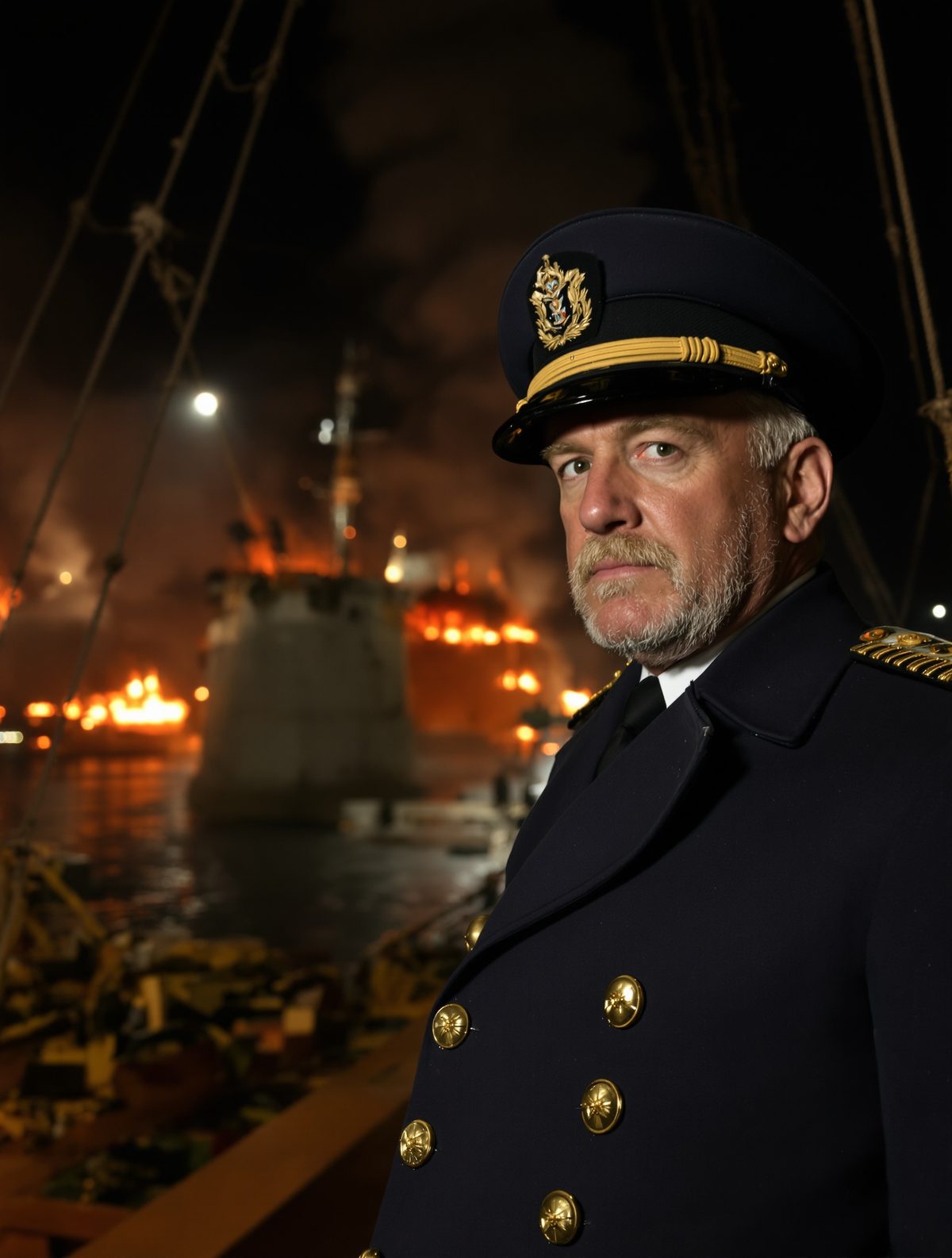
The church bells of England had barely finished chiming midnight when the first German shells began screaming overhead. Captain Alfred Carpenter stood on the bridge of HMS Vindictive, watching tracer rounds slice through the darkness like deadly fireworks. Behind him, 600 Royal Marines crouched in the ship's holds, checking their rifles one final time. Ahead lay the concrete fortress of Zeebrugge—a German naval stronghold bristling with guns, searchlights, and the promise of certain death.
It was April 23rd, 1918. St. George's Day. And Carpenter was about to sail his ship straight into hell.
The U-Boat Menace That Nearly Starved Britain
By the spring of 1918, German U-boats had brought Britain to its knees. Every month, nearly 300,000 tons of Allied shipping disappeared beneath the waves—grain ships from America, oil tankers from the Middle East, troop transports carrying fresh soldiers to the Western Front. The statistics were terrifying: at this rate, Britain would starve within six months.
The epicenter of this maritime carnage lay along the Belgian coast, where the Germans had transformed the ports of Zeebrugge and Ostend into virtually impregnable submarine bases. From these concrete fortresses, U-boats slipped out under cover of darkness, stalked Allied convoys, and returned laden with the spoils of war. The Royal Navy's surface ships couldn't touch them—the harbors were too shallow for battleships, too well-defended for destroyers.
Read next: The Day a British Stretcher-Bearer Refused an Order to Save Lives
Something desperate was needed. Something audacious beyond belief.
That something was Operation Z-O: a plan so dangerous that when Admiral Sir Rosslyn Wemyss first heard it, he reportedly muttered, "Good God, they'll never come back alive." The strategy was deceptively simple—sail obsolete warships directly into the German harbors and sink them in the entrance channels, sealing the U-boats inside like corked bottles.
The Floating Fortress That Defied Death
HMS Vindictive had seen better days. Originally built in 1897 as an elegant cruiser, she had been hastily converted into what naval engineers euphemistically called a "landing ship." In reality, she was a floating battering ram packed with explosives and bristling with improvised armor.
The transformation was extraordinary. Engineers had welded steel plates to her sides, creating a protective shell around her vital areas. Her upper deck had been fitted with eighteen specially-designed gangways—each one a potential bridge of death that would allow Marines to leap onto the Zeebrugge mole under heavy fire. Flame-throwers, machine guns, and even a primitive smoke-making apparatus had been bolted to every available surface.
But perhaps the most remarkable addition was Captain Carpenter himself. A 43-year-old career naval officer with a reputation for unshakeable calm, Carpenter had volunteered for what everyone knew was a suicide mission. His orders were simple: ram Vindictive against the concrete mole at Zeebrugge, hold position under enemy fire, and give the Marines enough time to storm ashore and destroy the German gun batteries.
The fact that no one expected him to survive was left tactfully unspoken.
Into the Blazing Guns of Zeebrugge
At 11:30 PM on April 22nd, Vindictive and her escorts slipped out of Dover Harbor into the darkness of the English Channel. The sea was rough, with a stiff wind blowing from the northwest—perfect conditions for concealing their approach but terrible for landing operations.
By midnight, they could see the glow of German searchlights sweeping the horizon. Zeebrugge's mole—a massive concrete breakwater stretching nearly a mile into the sea—loomed ahead like a medieval castle wall. At its seaward end sat a fortress bristling with artillery, machine gun nests, and observation posts. Intelligence reports suggested the Germans had stationed over 1,000 troops on the mole itself.
The German lookouts spotted them at 12:20 AM. Within seconds, the night erupted in violence.
Captain Carpenter later described the scene with characteristic British understatement: "The enemy appeared somewhat surprised by our arrival." The reality was far more dramatic. Star shells burst overhead, turning night into artificial day. Heavy artillery rounds screamed from the shore batteries, sending towering columns of water skyward as they missed their mark. Machine gun fire swept Vindictive's deck like deadly hail.
And through it all, Carpenter held his course, driving his ship directly toward the mole at full speed.
The Marines Who Stormed a Fortress
The collision, when it came, shook Vindictive from stem to stern. Her reinforced bow smashed against the concrete wall with a grinding crash that could be heard above the gunfire. Immediately, her specially-designed gangways swung out over the gap, creating precarious bridges between ship and shore.
What happened next defied every principle of military common sense. Led by Lieutenant-Colonel Bertram Elliot, the Royal Marines charged across those narrow gangways directly into the teeth of concentrated German fire. They carried no heavy weapons—there had been no room—just rifles, grenades, and an inexhaustible supply of courage.
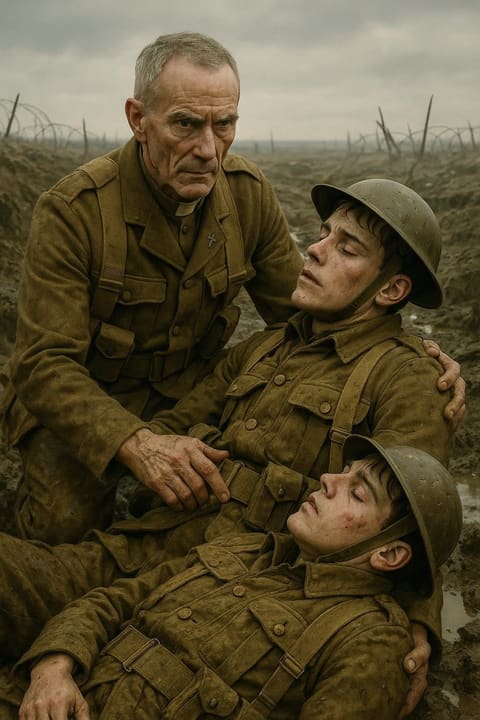
The casualties were immediate and horrific. German machine gunners, firing from prepared positions just yards away, cut down Marines as they attempted to cross. Lieutenant-Colonel Elliot himself fell within minutes, shot through the chest as he led the first wave. Major Bertram Wainwright took command and was killed moments later. Command passed to Captain Edward Bamford, who lasted barely ten minutes before a German shell tore him apart.
Yet somehow, impossibly, the Marines kept coming. They fought their way onto the mole, established a precarious foothold, and began working their way toward the German gun positions. Naval ratings from Vindictive joined the assault, hauling ammunition across the bullet-swept gangways and dragging wounded Marines back to the ship's makeshift medical stations.
For exactly one hour and twenty minutes, this impossible battle raged. British Marines and German soldiers fought hand-to-hand combat on a narrow strip of concrete suspended above the dark waters of the North Sea, while Vindictive's guns blazed away at point-blank range.
Read next: The Day a Army Chaplain Gave His Coat to a Dying Stranger
The Price of Audacity
At 1:40 AM, the recall signal finally came. The main objective—three obsolete cruisers packed with concrete and explosives—had successfully rammed themselves into Zeebrugge's entrance channel. HMS Thetis, Intrepid, and Iphigenia settled onto the harbor bottom, their hulks forming a barrier that would, at least temporarily, trap the German submarines inside.
The withdrawal from the mole proved almost as costly as the assault. German artillery, now properly ranged, pounded Vindictive mercilessly as the surviving Marines stumbled back across the gangways. The ship's funnel had been shot away, her bridge was a twisted wreck, and her hull was holed in dozens of places. Captain Carpenter, blood streaming from shrapnel wounds, somehow managed to back his crippled vessel away from the mole and point her toward the open sea.
The butcher's bill was staggering. Of the 600 Marines who had sailed from Dover, 176 lay dead or wounded. Vindictive herself barely made it home, limping into Dover Harbor with her pumps working frantically to keep her afloat. Yet somehow, impossibly, they had done it. The entrance to Zeebrugge was blocked.
Captain Carpenter survived to receive the Victoria Cross from King George V himself. When asked later how he had found the courage to sail directly into such overwhelming firepower, he reportedly replied, "Courage? My dear fellow, I was far too busy to be frightened."
The Raid That Changed Naval Warfare Forever
The Zeebrugge Raid, as it came to be known, lasted less than two hours. The tactical results were mixed—German engineers had the harbor entrance partially cleared within weeks, and U-boat operations resumed, though at reduced intensity. But the strategic impact was profound and lasting.
For the first time in the war, British forces had struck directly at the enemy's homeland, proving that even the most heavily fortified positions could be assaulted by determined attackers willing to accept terrible casualties. The raid's success inspired similar operations around the world and helped establish the principles of modern amphibious warfare that would prove crucial in World War II.
More importantly, perhaps, the raid demonstrated something essential about human nature—that ordinary people, when faced with extraordinary circumstances, are capable of extraordinary courage. The Marines who charged across those gangways into certain death weren't superhuman. They were fishermen and farmers, clerks and laborers, united only by their willingness to sacrifice everything for a cause larger than themselves.
In our modern age of precision weapons and remote warfare, it's worth remembering that night when HMS Vindictive sailed into Zeebrugge's blazing hell. Sometimes, the most sophisticated strategy is simply the courage to sail directly toward the guns.