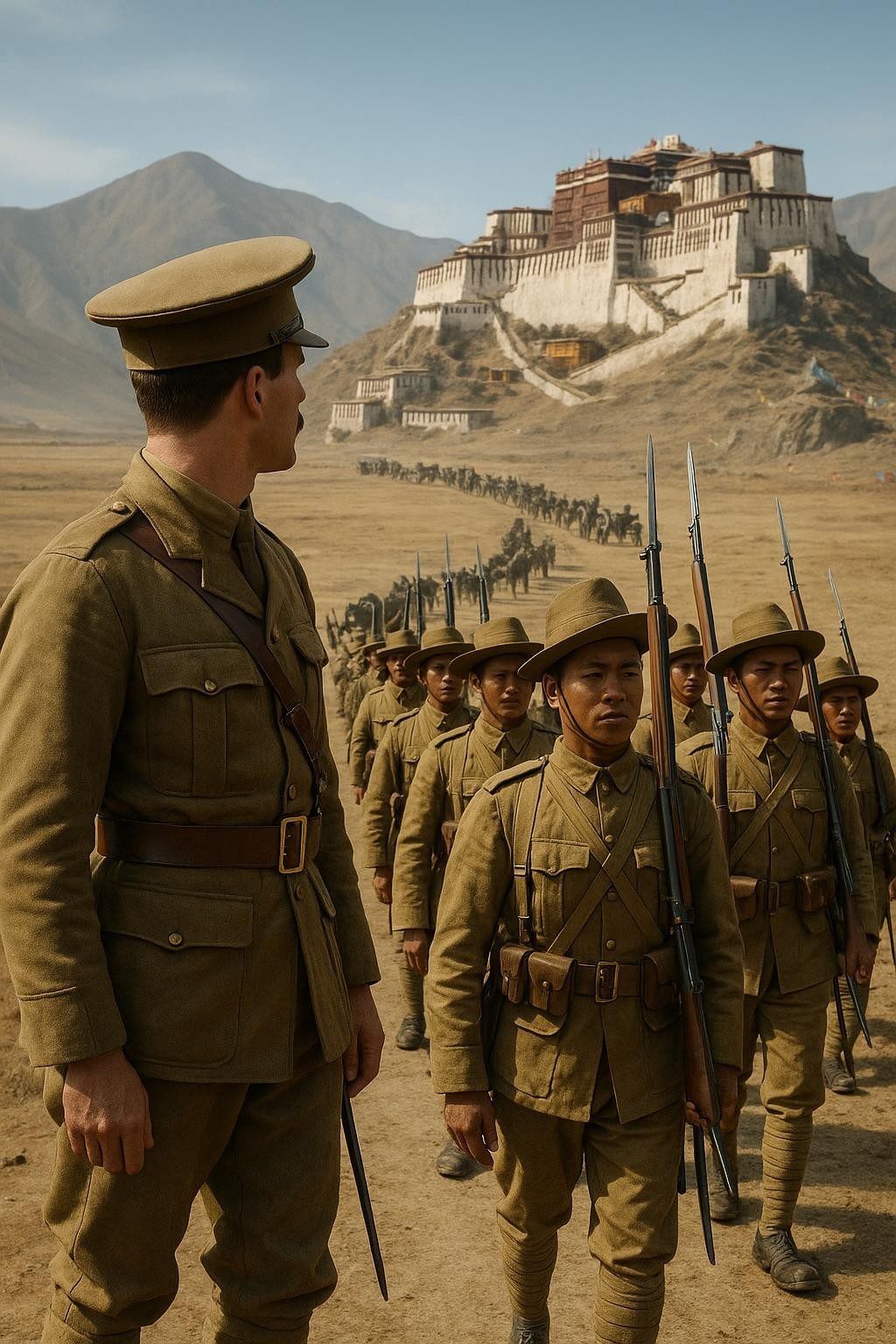
In the pale dawn light of December 12, 1903, Lieutenant Colonel Francis Younghusband, a dashing figure in his British officer’s uniform, stood at the helm of an unprecedented military expedition. As the wind howled across the Himalayan ridges, the ragtag army of 3,000 men and 7,000 mules trudged through the snowfields towards a destination shrouded in legend and isolation: Lhasa, the capital of Tibet, the Forbidden City.
The Road to Lhasa
Our story begins not with a battle cry, but with a political hallucination—a phantom threat crafted from the febrile imaginations of British colonial strategists. Britain, ever fearful of Russian incursions in Asia, conjured the specter of Cossack troops sneaking across Tibetan snows to infiltrate the Raj. Enter Francis Younghusband, chosen as the unlikely spearhead of this misguided gambit. With orders in hand, he embarked from India in December 1903, his heart drumming with the mixture of imperial purpose and personal ambition.
The journey was nothing short of epic. The expedition fought against nature as much as any enemy, their feet treading paths grooved into the world’s highest mountains, scaling altitudes where the air thinned to a gasping whisper. Cold, hunger, and altitude sickness claimed the minds and bodies of men as they marched into the pages of history—a Western army’s first trail towards the traditionally inviolate city of Lhasa.
A Phantom Menace Dissolved
As Younghusband and his troops breached Tibetan borders, they discovered what few had anticipated: a land devoid of any formidable foe. Instead of Russian battalions, their greatest adversaries were the eternal snowdrifts and the ghostly winds, echoing through the passes like ancestral ghosts. The stark emptiness did little to distract Younghusband from his mission, though it offered little too in the way of resistance. The expedition was more an eerie parade than a pitched battle.
Read next: The Day a Scots Surgeon Walked Into Timbuktu Alone
With each village past, the Tibetan resolve dissolved into snowflakes, neither military nor spiritual force worthy of halting the British advance. In this context of futile conquest, on August 3, 1904, Younghusband triumphantly strode into Lhasa, faces of the Tibetans a puzzling mix of resentment and resignation.
The Siege of Silence
Lhasa! The mystical city which had long defied adventurers and had stood remote in its mountainous womb, now faced the uninvited inspection of foreign eyes. Yet the soldiers, led by their weary commander, found neither glorious riches nor a secretive Russian alliance—merely the solemn Potala Palace rising into the mist like an ethereal sentinel. Here, Younghusband would stage his own brand of diplomacy.
Embarking on a series of tense negotiations with a reluctant Tibetan leadership, Younghusband pressed forward a treaty at gunpoint—no cerebration of imperial conquest but rather a forced communion of unaligned interests. The treaty, signed September 7, 1904, was more symbolic than strategic, pulling from its pages a veiled, nominal control over trade and foreign policy in Tibet.
Transcending Borders
As a coda to this imperial overture, Younghusband, now an erect shadow of his erstwhile imperial self, turned alone into the surreptitious highlands. The experience of Lhasa stitched a transformation into his soul, one deeper than geopolitical posturing could weave. Amidst the solitudes of the Tibetan plateau, a metamorphosis unfolded—a soldier turned mystic, casting away the harbingers of war to embrace philosophies previously foreign to him.
Younghusband would later recount that moment of silent epiphany, adrift beneath the waking starlit skies of the Himalayas, as a revolutionary experience. Gone was the solider-king of conquest. In his place stood the harbinger of a burgeoning spiritualism—a man reborn on the roof of the world.
The Legacy of Lhasa
Why does this tale of a soldier mystic on a foray into the unknown matter today? The Younghusband expedition offers a historical allegory against the specter of assumptions—decisions made with fervor and folly from misunderstood knowledge. Despite the Imperial narrative of dominion, Francis Younghusband’s march toward Lhasa was not a victory but rather a journey towards personal enlightenment and introspection, underscoring human pursuits beyond the pretense of power.
In our current era of global interconnectedness and geopolitical insecurities, Younghusband’s journey prompts a reminder of the manifold avenues of diplomacy and understanding that remain open before us. An adventure steeped in the annals of imperial history emerged, unexpectedly, as a quest for deeper human communion beyond borders—a lesson learned high among the whispers of ancient mountain winds.