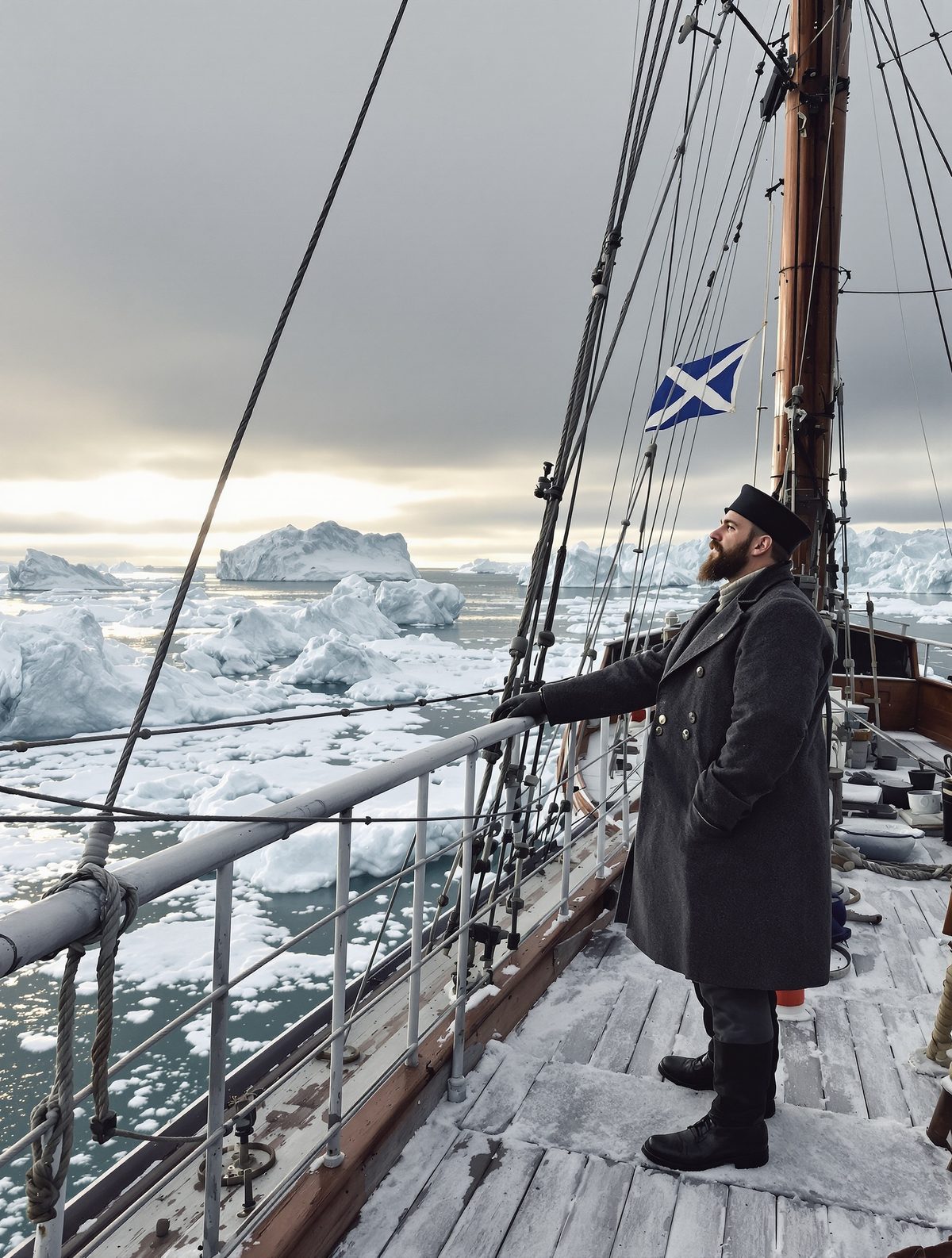
In the early 20th century, against a backdrop of fierce national pride and discovery, a journey unfolded in the icy realm of Antarctica that has often been overshadowed by more famous expeditions. Yet, it remains one of the most significant tales of exploration. In the year 1903, a Scottish scientist named William Speirs Bruce planted a flag on windswept Antarctic shores, not for the British Empire, but for Scotland. This act of quiet defiance marked a unique moment in history, one rich with ambition, scientific triumph, and national pride, that echoes to this day.
The Man Who Heard Antarctica's Call
William Speirs Bruce was not your typical Victorian hero. Born on August 1, 1867, in London, to Scottish parents, Bruce was imbued with a profound curiosity about the natural world from a young age. He soon fell under the influence of the pioneering oceanographer John Murray, which steered him towards a destiny entwined with the sea. Bruce was not, however, in pursuit of fame or fortune. By the time he founded the Scottish National Antarctic Expedition, he had already turned down an invitation to join Robert Falcon Scott’s better-funded British National Antarctic Expedition. Bruce's allegiance lay not with the empire, but with his homeland, Scotland.
The Journey South
On November 2, 1902, Bruce and his team set sail from the Scottish port of Troon aboard the vessel Scotia, outfitted with state-of-the-art scientific equipment and steely resolve. Their mission was ambitious: to study the oceanography, biology, and meteorological dynamics of the Weddell Sea. The voyage wasn’t just a scientific endeavor; it was an assertion of Scotland’s capability and intellect. By springing for the expedition themselves, Scots were making a statement about their independence and scientific prowess, undeterred by the imperial narrative of the time.
Scotia Bay: Scotland's Antarctic Outpost
In March 1903, the expedition arrived at Laurie Island in the South Orkney Islands, an archipelago at the northern extent of the Weddell Sea. Here, amid barren cliffs and relentless winds, Bruce and his crew established a permanent scientific station in what became known as Scotia Bay. For the first time, Scotland had established a foothold in the Antarctic, underscoring its commitment to the pursuit of knowledge and exploration. Here, the weather station became the world’s first to operate below the Antarctic Circle, painstakingly collecting meteorological data that would serve scientists for generations.
Read next: The Day a Scots Village Chose Its Own Name and Kept It
Unveiling Antarctica's Secrets
The contributions of Bruce and his team were vast and invaluable. During their two years on the ice, they identified numerous new marine species, surveyed vast stretches of uncharted territory, and brought back to the scientific community a wealth of data on Antarctic weather patterns. Among the enduring legacies of Bruce's expedition was the discovery of over 200 species new to science and a careful charting of the South Orkneys, offering the world one of the most comprehensive descriptions of this remote part of the world.
Unheralded Triumphs and Legacy
Despite his significant achievements, Bruce was denied the post-trip adulation awarded to other explorers of the era. It was an expedition executed on a shoestring budget, which lacked the imperial fanfare, yet yielded results of global scientific importance. Bruce's refusal to plant the Union Jack in favor of raising the Saltire and his commitment to maintaining a distinctly Scottish identity made him something of an outsider in British exploration circles.
William Speirs Bruce passed away on October 28, 1921, in Edinburgh. His contributions, initially overshadowed by more famous imperial expeditions, have begun to receive the recognition they deserve. His pioneering work laid the groundwork for future scientific endeavors and established a tradition of Scottish exploration that continues to inspire today.
Why Should This Matter Today?
In today's geopolitical climate, discussions of nationalism and identity resonate more than ever. William Speirs Bruce’s story is not just of scientific and geographical discovery but also of cultural affirmation. It serves as a reminder that the pursuit of knowledge transcends political boundaries and that national pride can fuel endeavors of immense global significance. As climate change focuses world attention on the polar regions, the data and heritage of early explorers like Bruce hold more relevance than ever. The once overlooked hero of Scottish exploration has cemented his place in history, his expedition a testament to the spirit of innovation and audacity.
As we cast our eyes to new horizons of exploration — in both the physical and intellectual realms — let us remember and draw inspiration from the day William Speirs Bruce defiantly unfurled Scotland's flag in Antarctica, doing what was right for science and for Scotland.