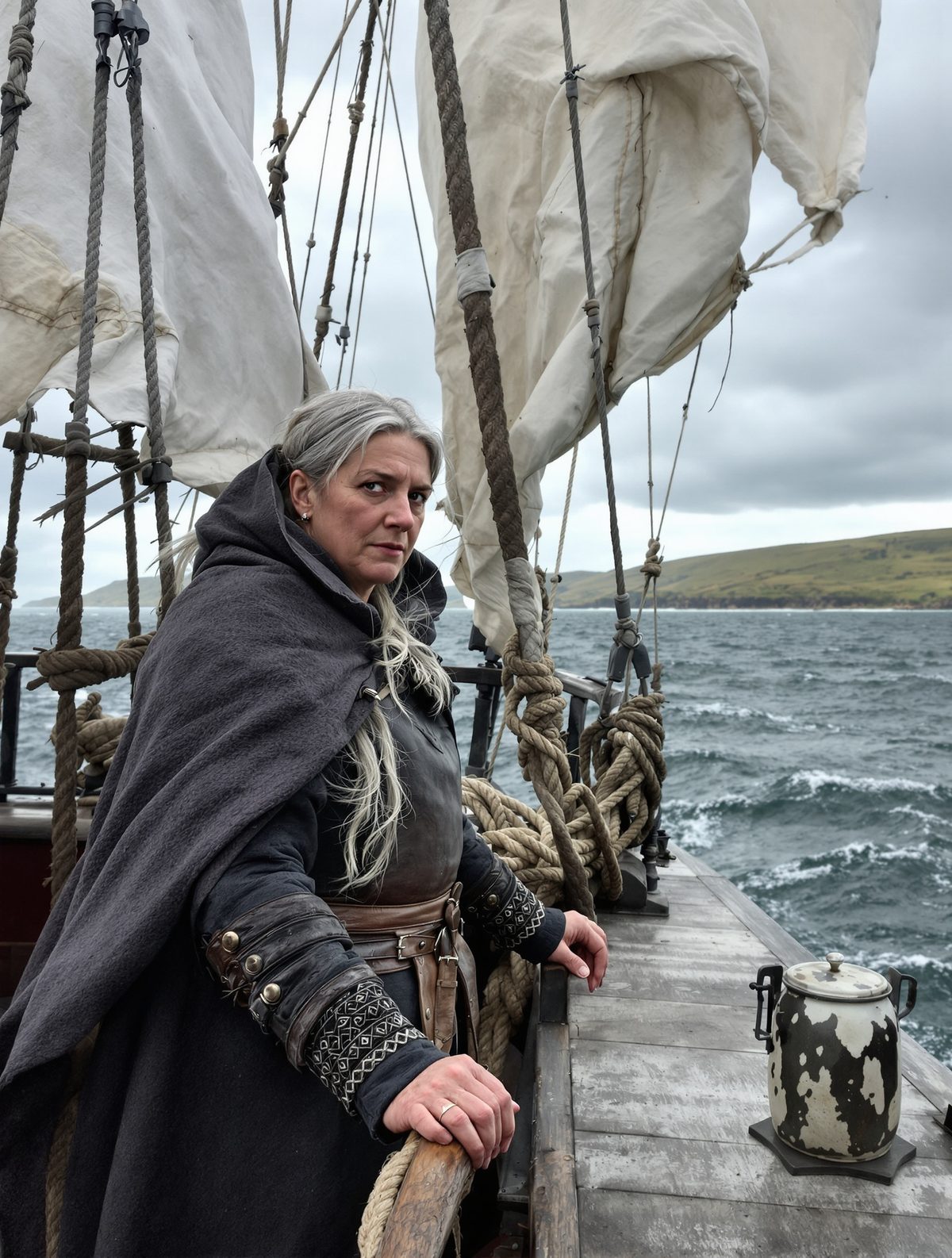
Picture this: a woman in salt-stained silks strides through the marble corridors of Greenwich Palace, her weathered hands having commanded twenty warships through storms that would terrify admirals twice her size. The courtiers whisper as she passes – this is no English rose, but Ireland's most notorious sea captain, come to parley with the Virgin Queen herself. The year is 1593, and Grace O'Malley, the Pirate Queen of Connacht, is about to pull off the most audacious diplomatic coup in Tudor history.
The Making of a Sea Wolf
Long before she sailed into legend, Grace O'Malley – or Gráinne Ní Mháille as she was known in Irish – was born into a world where the Atlantic Ocean was both highway and battleground. Around 1530, she entered the world at Clare Island, a windswept fortress that commanded the entrance to Clew Bay off Ireland's western coast. Her father, Owen "Black Oak" O'Malley, ruled one of the most powerful seafaring clans in Ireland, and from childhood, Grace breathed salt air and learned that the sea belonged to those bold enough to claim it.
The O'Malleys weren't mere fishermen – they were maritime lords who controlled the treacherous waters around Mayo and Galway, exacting tribute from merchant ships and protecting their territory with a fleet that could appear from the morning mist like vengeful spirits. By the time Grace was sixteen, she had already earned her sea legs on raids against rival clans and English merchant vessels. When her father died, she didn't just inherit his title – she seized it with both hands and transformed the O'Malley fleet into the most formidable naval force in the Irish Sea.
What made Grace extraordinary wasn't just her seamanship, but her understanding that in the 16th century, power flowed like the tides. She married strategically – first to Dónal an Chogaidh O'Flaherty, whose lands gave her control of Galway Bay, then to Richard Burke of Mayo, whose castle at Rockfleet became her impregnable stronghold. By 1560, she commanded over 200 men and twenty galleys, controlling trade routes that had enriched her family for three centuries.
Read next: The Day a London Printer Stood Trial and Freed the Press
Terror of the Western Seas
Grace's fleet operated with military precision that would have impressed Nelson himself. Her galleys – sleek, shallow-drafted vessels perfect for Ireland's rocky coastline – could outmaneuver the heavier English warships in coastal waters. Each galley carried between fifteen and twenty oarsmen, with swivel guns mounted fore and aft. When merchant ships appeared on the horizon flying English colors, Grace's crews would emerge from hidden coves like wolves descending on sheep.
But Grace wasn't just a pirate – she was a feudal sea lord operating by ancient Irish law. Ships passing through her waters paid tonnage and poundage, essentially maritime taxes that had been collected by her ancestors since before the Normans arrived. To Grace, the English merchants were the interlopers; she was simply defending her hereditary rights with cannon and cutlass.
The English authorities saw it rather differently. Sir Henry Sidney, Lord Deputy of Ireland, described her fleet as "a nurse to all rebellions in the province for forty years." Her raids extended from the Shannon to Ulster, and she once held the heir to the Earl of Howth hostage until the family agreed to set an extra place at dinner for any O'Malley who called – a tradition reportedly honored for centuries afterward.
Perhaps most remarkably, Grace gave birth to her youngest son Tibbot while at sea, and according to legend, fought off Turkish corsairs the very next day. When enemy ships attacked her galley off the Cork coast, she allegedly emerged from her cabin, musket in hand, roaring at her crew: "May you be seven times worse this day twelve months, who cannot do without me for one day!"
When Queens Collide
By 1593, Grace O'Malley was in her sixties and facing the greatest crisis of her remarkable career. Sir Richard Bingham, the brutal English governor of Connacht, had systematically destroyed the Gaelic lords of western Ireland. Her son Owen had been murdered, another son Murrough was fighting for the English against his own people, and her half-brother Dónal na Píopa lay imprisoned in Dublin Castle. Her fleet was scattered, her castles besieged, and the world she had ruled for four decades was crumbling around her.
A lesser leader might have fled to Spain or submitted to English rule. Grace O'Malley chose a third option that was either brilliant or utterly mad: she would sail to London and petition Queen Elizabeth directly, one monarch to another.
The journey up the Thames must have been surreal. Grace's galley, built for Atlantic storms and coastal raids, now glided past the bustling wharves of England's greatest port. Londoners lined the riverbanks to gawk at the Irish chieftain who had terrorized English shipping for decades. Here was the woman whose very name had become synonymous with rebellion and piracy, come to beard the Virgin Queen in her own den.
The Meeting That Changed Everything
What transpired when the two queens met alone in Greenwich Palace on September 6, 1593, remains one of history's great mysteries. No secretaries took notes, no courtiers witnessed their conversation. We know only that two of the most formidable women of the age – one ruling the emerging Protestant superpower, the other the last great Gaelic sea lord – spoke as equals behind closed doors.
Grace had prepared carefully for this moment. She wrote to Elizabeth in Latin, styling herself as "your majesty's loyal and faithful subject" while making it clear she considered herself a fellow ruler temporarily inconvenienced by overzealous English officials. She explained that her activities were not piracy but the legitimate exercise of ancient rights, and that she was prepared to use her fleet against Elizabeth's enemies – particularly the Spanish, who were already courting Irish rebels for another invasion.
Elizabeth, for her part, recognized a kindred spirit. Both women had clawed their way to power in a world that insisted females should be silent and obedient. Both understood that survival sometimes required ruthless pragmatism. The Virgin Queen, who had executed her own cousin Mary Stuart and sent Drake to singe the King of Spain's beard, could appreciate Grace's combination of audacity and political acumen.
When Grace emerged from that private audience, she carried with her a royal pardon for all past "treasons" and a promise that her son would be released from Dublin Castle. More importantly, Elizabeth granted her a license to "fight in our quarrel with all the world" – effectively commissioning Ireland's most notorious pirate as an English privateer.
The Pirate Queen's Last Act
Grace returned to Ireland transformed from outlaw to official naval commander, but the world she had known was dying. The old Gaelic order was crumbling before English law and Protestant religion. The Spanish Armada's failure in 1588 had demonstrated that Catholic Europe could not save Ireland's chieftains from Tudor conquest.
Still, Grace O'Malley proved that even in defeat, a cunning leader could negotiate survival. She kept her word to Elizabeth, using her local knowledge to help English forces navigate the treacherous waters of western Ireland during the Nine Years' War. When Hugh O'Neill's rebellion finally collapsed at Kinsale in 1601, Grace was among the few Gaelic lords who retained their lands and titles.
She died around 1603, the same year as Elizabeth I, taking with her the last echoes of an Ireland where sea kings ruled from island fortresses and ancient law held sway over English statute. Her son Tibbot, the child born during that legendary sea battle, would serve as a loyal English naval officer and eventually become Viscount Mayo.
The Legend Lives On
Why does Grace O'Malley's story still captivate us four centuries later? Perhaps because she represents something we've lost in our modern world – the audacity to sail into the unknown and demand to be heard. In an age when female leadership still raises eyebrows, here was a woman commanding warships and treating with queens as an equal.
More than that, Grace's story reminds us that history's most fascinating characters often emerge from the margins, from those forgotten corners where empires meet and old worlds collide with new. She navigated between Gaelic tradition and English innovation, between piracy and politics, between rebellion and accommodation. Her greatest victory wasn't any single naval battle, but her ability to transform herself from outlaw to ally without sacrificing her essential identity.
Today, as we face our own uncertain seas, Grace O'Malley's example suggests that sometimes the boldest course is to sail straight toward the storm. Sometimes the only way to survive change is to embrace it on your own terms, to chart a course between what was and what must be. In that wind-lashed meeting between two queens, we see the power of refusing to accept that the game is over – and the wisdom to know when it's time to play by new rules.