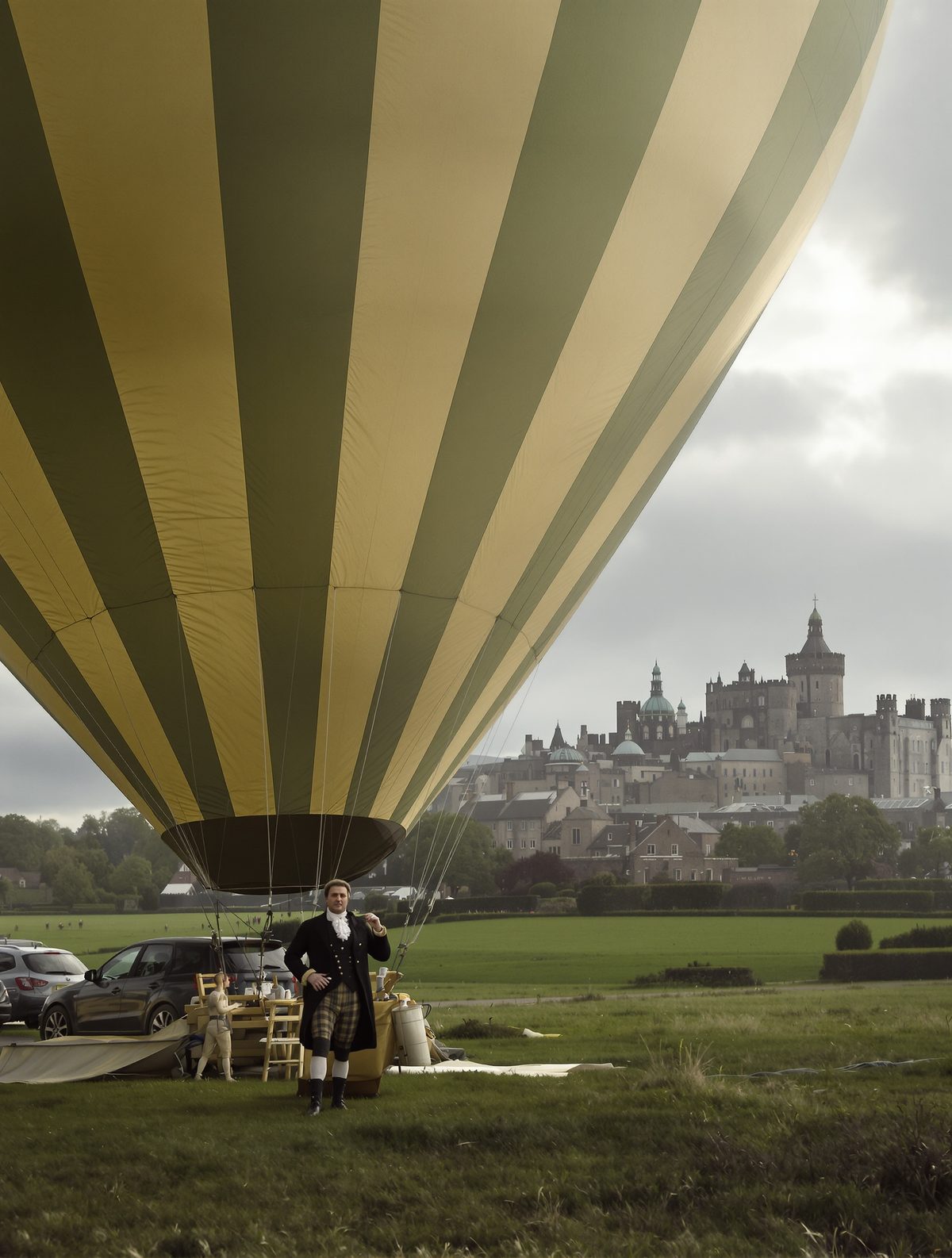
Picture this: a mild-mannered Scottish newspaper editor standing in a wicker basket beneath a billowing silk canopy, watching the cobblestones of Edinburgh shrink away beneath his feet. No parachute. No radio contact. No emergency protocols. Just James Tytler, a few thousand cubic feet of hot air, and the kind of audacious confidence that only comes from having absolutely nothing left to lose. On August 27th, 1785, this unlikely pioneer became the first person in British history to achieve powered human flight – and then history promptly forgot his name.
While the Montgolfier brothers were taking bows in Paris and the newspapers celebrated Continental aviation triumphs, a cash-strapped hack from Edinburgh was quietly preparing to make his own leap into the sky. What happened next would change British aviation forever, though Tytler himself would die in obscurity, his achievement overshadowed by grander names and bigger balloons.
The Unlikely Aeronaut of Auld Reekie
James Tytler was not your typical pioneering aviator. Born in 1745 in the Scottish Borders, he'd stumbled through careers as a ship's surgeon, apothecary, and struggling editor of the Edinburgh Magazine. By 1784, he was drowning in debt, dodging creditors, and desperately casting about for his next opportunity. That's when news reached Edinburgh of the Montgolfier brothers' spectacular balloon flights in France.
Where others saw entertainment, Tytler spotted possibility. Here was a man who had once been thrown in debtors' prison, who knew the bitter taste of failure, suddenly presented with technology that could literally lift him above his problems. He devoured every scrap of information about hot air balloons he could find, studying the principles of heated air, fabric construction, and the delicate mathematics of lift and weight.
Read next: The Day a Scots Weaver's Son Freed the Kirk From a King
Working from his cramped lodgings in Edinburgh's Old Town – the same medieval streets that had housed John Knox and would later inspire Robert Louis Stevenson – Tytler began constructing what would become Britain's first successful hot air balloon. Using his scientific background and considerable ingenuity, he calculated that a balloon roughly 40 feet in diameter would generate enough lift to carry a human passenger.
Silk, Fire, and Scottish Engineering
The construction of Tytler's balloon reads like a masterclass in making do with what you have. Unable to afford the fine French fabrics used by the Montgolfiers, he purchased yards of ordinary silk from Edinburgh's merchants and painstakingly stitched them together in his lodgings. The balloon's distinctive shape – wider at the top, tapering toward the bottom – was calculated to maximize hot air retention while minimizing fabric costs.
For the basket, Tytler commissioned a simple wicker construction from local craftsmen, lightweight but sturdy enough to support a man's weight. The heating apparatus was equally pragmatic: a metal brazier suspended beneath the balloon's opening, designed to burn straw and other readily available materials. No fancy burners or precision instruments – just Scottish engineering at its most resourceful.
The balloon itself was a patchwork beauty, its natural silk panels creating an almost organic pattern when inflated. Contemporary accounts describe it as resembling "a great jellyfish of the air" when fully expanded. At 40 feet in diameter, it was smaller than many of its Continental cousins, but Tytler had calculated every dimension to achieve maximum efficiency with minimum materials.
Testing began in secret during the summer of 1785. Tytler conducted numerous tethered trials in Edinburgh's Restalrig area, gradually increasing the balloon's altitude while remaining safely connected to the ground. Local residents grew accustomed to the sight of the strange silk sphere bobbing above the rooftops, though few understood they were witnessing the birth of British aviation.
Ten Minutes That Changed Everything
August 27th, 1785, dawned crisp and clear over Edinburgh – perfect flying weather. Word had spread through the city's coffeehouses and taverns that the eccentric magazine editor planned to attempt an untethered flight. By mid-morning, a crowd of several hundred had gathered in the field at Restalrig, a mixture of curious onlookers, scientific observers, and sensation-seekers hoping to witness either triumph or disaster.
Tytler appeared calm as he made his final preparations, methodically checking the balloon's rigging and testing the brazier's flame. Contemporary accounts describe him as wearing his everyday clothes – no special flight suit or protective gear – with only a heavy coat as concession to the altitude he hoped to reach. The balloon, fully inflated, strained against its moorings like a living thing eager to escape earthly bonds.
At approximately 11:30 AM, with the crowd holding its collective breath, Tytler climbed into the wicker basket and gave the signal to release the ropes. What happened next was, by all accounts, breathtaking. The balloon rose smoothly and steadily, carrying its human cargo higher and higher above the Scottish capital. Within minutes, Tytler had achieved an altitude of 350 feet – high enough to see across the Firth of Forth to the hills of Fife.
For ten glorious minutes, James Tytler floated above Edinburgh like a Scottish Icarus who had finally gotten his wings right. Below him, the crowd cheered and pointed as their compatriot achieved what no Briton had ever done before. Church spires that normally dominated the skyline now lay beneath his feet. The bustling Royal Mile appeared as a thin ribbon threading between ancient buildings.
The landing was less graceful than the takeoff. As the air in the balloon cooled, Tytler descended rapidly, eventually crash-landing in a field nearly half a mile from his starting point. But he emerged uninjured and exhilarated, having just secured his place in aviation history.
The Fame That Never Came
You might expect that Britain's first aeronaut would become a household name, celebrated in the press and feted by society. Instead, Tytler's achievement was met with a curious mixture of local pride and national indifference. Edinburgh's newspapers covered the flight with enthusiasm, but London's journals barely mentioned it. The English press seemed reluctant to acknowledge that a Scottish provincial had beaten the entire British establishment into the air.
Read next: The Day a Highland Clan Turned a Massacre Into a Legend
Part of the problem was timing. Just two weeks after Tytler's flight, the flamboyant Italian aviator Vincenzo Lunardi made his own balloon ascent from London, complete with publicity campaign, royal patronage, and society connections. Lunardi's flight – though it came after Tytler's – captured the national imagination in a way the modest Scottish attempt never did. The Italian was handsome, charming, and knew how to work the media. Tytler was a debt-ridden journalist with ink-stained fingers and a thick Border accent.
The injustice rankled. Lunardi became known as "the first aerial traveller in the English atmosphere," a title that technically belonged to Tytler. History has a way of favoring the stories that fit its preferred narrative, and apparently that narrative didn't include a struggling Scottish magazine editor who built his balloon from silk scraps and determination.
Tytler attempted several more flights over the following months, including one that carried him across the Firth of Forth – an achievement that prefigured modern cross-channel aviation by more than a century. But financial pressures and lack of support eventually forced him to abandon ballooning. He died in poverty in Salem, Massachusetts, in 1804, having emigrated to America in hopes of a fresh start that never materialized.
The Legacy Written in Scottish Sky
Today, a small plaque in Edinburgh marks the approximate site of Tytler's historic flight, though few tourists pause to read it. Aviation museums typically mention him as a footnote, if at all. Yet his achievement resonates far beyond those ten minutes above Edinburgh in 1785.
James Tytler represents something quintessentially human: the refusal to accept limitations, the willingness to risk everything on an untested idea, the quiet determination that changes the world one small step at a time. He flew not because he had backing or resources or official support, but because the idea of flight captured his imagination and wouldn't let go.
In our age of calculated risks and safety protocols, there's something both terrifying and inspiring about Tytler's leap of faith. He climbed into that basket knowing he might die, but believing the chance of flight was worth the risk. Every time we board an aircraft today, we're benefiting from the courage of pioneers like him – the forgotten figures who took the first tentative steps into the sky.
Perhaps most remarkably, Tytler's flight reminds us that world-changing innovations don't always emerge from well-funded laboratories or prestigious institutions. Sometimes they come from debt-ridden journalists working alone in Edinburgh tenements, stitching together silk panels by candlelight and dreaming of touching the clouds. In a world that often celebrates only the biggest and loudest achievements, James Tytler's quiet triumph stands as testament to the power of human ingenuity unleashed. The sky, after all, belongs to anyone brave enough to reach for it.