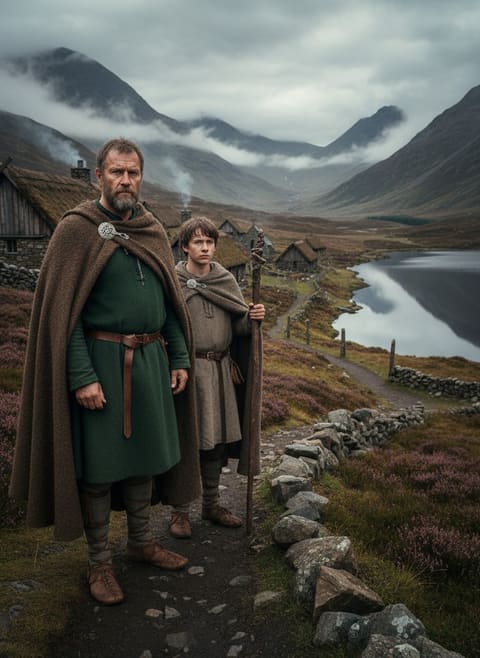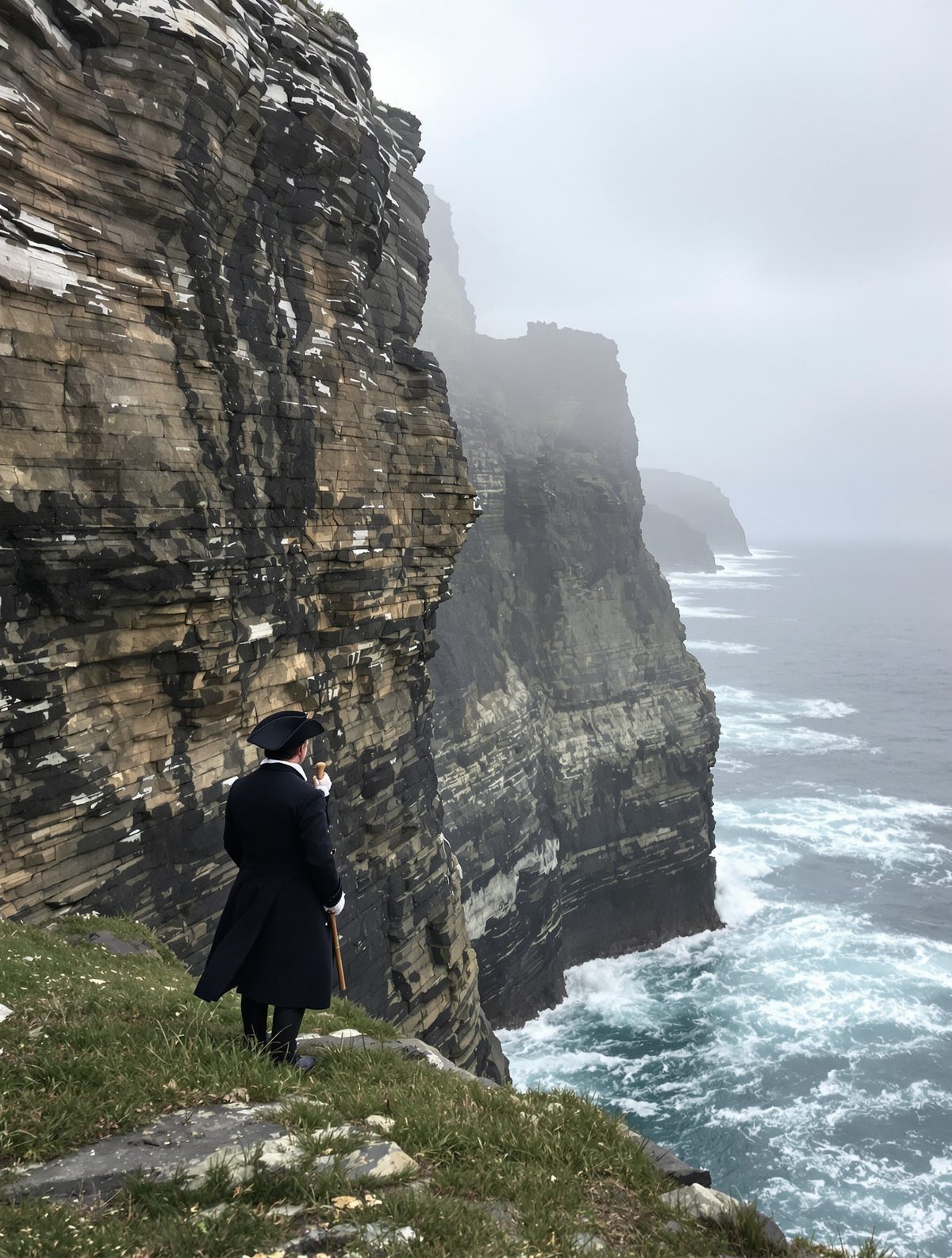
On a windswept morning in June 1788, three men stood on a rocky outcrop overlooking the North Sea, staring at what would become the most important cliff face in the history of science. Dr. James Hutton, a quiet 62-year-old physician from Edinburgh, pointed his walking stick at layers of ancient stone jutting from the Scottish coastline. What he saw there would shatter humanity's understanding of time itself—and launch a revolution that still echoes through every geology textbook today.
The rocks at Siccar Point, near Cockburnspath in Berwickshire, looked unremarkable to most eyes. But to Hutton, they whispered an impossible secret: Earth wasn't the biblical 6,000 years old that every respectable person believed. It was older than anyone had dared imagine. Millions upon millions of years older.
The Heretical Doctor Who Talked to Stones
James Hutton was an unlikely revolutionary. Born in Edinburgh in 1726, he'd trained as a physician but never quite settled into conventional practice. Instead, this restless mind bounced between chemistry, agriculture, and his true passion—wandering the Scottish countryside, hammer in hand, collecting rocks like other men collected coins.
His friends thought him eccentric. While fashionable Edinburgh society debated philosophy in drawing rooms, Hutton tramped through muddy fields and scrambled up hillsides, obsessing over the stories written in stone. He'd return from these expeditions with pockets full of specimens and ideas that made his contemporaries deeply uncomfortable.
Read next: The Day a Scots Weaver's Son Freed the Kirk From a King
By the 1780s, Hutton had developed a radical theory that flew in the face of everything the Christian world believed about Earth's origins. He called it "uniformitarianism"—the idea that the same natural processes shaping the world today had been working, slowly and steadily, for an almost incomprehensible span of time. No great catastrophes or divine interventions required. Just wind, water, heat, and an ocean of years.
But theories needed proof. And proof, Hutton knew, lay hidden in Scotland's dramatic landscape.
The Expedition That Changed Everything
Hutton's companions that fateful June morning were fellow members of Edinburgh's intellectual elite. Sir James Hall, a young aristocrat fascinated by natural philosophy, and John Playfair, a brilliant mathematician who would later become Hutton's most devoted disciple. They'd hired a boat in Dunbar and sailed east along the rugged Berwickshire coast, searching for evidence of Hutton's controversial ideas.
The trio had already spent days examining coastal exposures, but nothing had prepared them for what they discovered at Siccar Point. There, where the sea had carved away millennia of accumulated debris, lay the most perfect geological textbook nature had ever written.
The lower layer of rock—ancient red sandstone—stretched horizontally along the shoreline. But above it, separated by what geologists now call an "unconformity," sat a completely different formation: vertical slabs of grey sedimentary rock, twisted and tilted at impossible angles. It was as if some giant hand had taken two entirely different books, written millions of years apart, and pressed them together into a single volume.
Playfair later wrote that the discovery left them all "giddy with the prospect of time." Standing there on that clifftop, they were quite literally looking at deep time made visible—geological evidence of processes so slow and ancient that the human mind could barely grasp them.
Reading Earth's Ancient Autobiography
What Hutton saw at Siccar Point was a story written across eons. The vertical rocks below had once been horizontal layers of sediment, accumulated grain by grain at the bottom of an ancient sea. Over vast periods, they'd been compressed into solid rock, then lifted up and tilted by unimaginable geological forces. Mountains had risen. Continents had shifted.
Then, slowly, these tilted rocks had been worn down by wind and rain until they formed a relatively flat surface. On top of this ancient foundation, new layers of sediment had accumulated—the horizontal red sandstone that formed the upper part of the cliff. These too had been compressed into rock over millions more years.
The "unconformity" between the two formations represented not just a change in rock type, but a gap in time so vast it defied human comprehension. Here was physical proof that Earth had a history far longer and more complex than anyone had imagined.
Hutton understood that what he was seeing represented multiple cycles of geological processes: deposition, compression, uplift, erosion, and deposition again. Each cycle required not thousands, but millions of years. And there was no reason to think these processes had ever stopped—or ever would.
The World That Refused to Listen
When Hutton returned to Edinburgh and began sharing his discoveries, the reaction was swift and hostile. The established church denounced his ideas as blasphemous attacks on biblical truth. Fellow scientists accused him of promoting atheism disguised as natural philosophy. Even some of his closest friends urged him to tone down his radical claims.
The problem wasn't just religious. Hutton's "deep time" challenged humanity's most fundamental assumptions about its place in the universe. For centuries, people had lived comfortably with the idea that Earth was created specifically for them, recently and purposefully. Hutton was suggesting instead that humans were latecomers to a planet with an almost infinite past—and presumably an equally vast future stretching ahead long after humanity had vanished.
His 1788 paper to the Royal Society of Edinburgh, titled "Theory of the Earth," was met with polite skepticism at best. Critics complained that his writing was dense and difficult to follow. More damaging still, Hutton couldn't explain what geological forces had lifted and tilted those ancient rocks. The theory of plate tectonics wouldn't be developed for another 180 years.
Read next: The Day a Highland Clan Turned a Massacre Into a Legend
But evidence, Hutton knew, had a way of outlasting opposition. The rocks at Siccar Point would still be there when the world was ready to accept what they revealed.
The Revolution That Remade Science
Though Hutton died in 1797, largely unrecognized for his revolutionary insights, his ideas refused to die with him. John Playfair championed his mentor's theories with clearer writing and passionate advocacy. Charles Lyell built on Hutton's foundation to establish geology as a rigorous scientific discipline. Most importantly, a young naturalist named Charles Darwin read Lyell's work and realized that if Earth was ancient enough for rocks to undergo such dramatic transformations, it was certainly old enough for life to evolve.
Without Hutton's discovery at Siccar Point, there might have been no Origin of Species. No modern understanding of evolution, climate change, or planetary formation. The 62-year-old doctor staring at a Scottish cliff had unknowingly provided the temporal foundation for virtually every earth science that followed.
Today, Siccar Point is recognized as one of the most important geological sites in the world. Pilgrims from every continent come to stand where Hutton stood and see what he saw. The unconformity he identified there—the contact between rocks formed hundreds of millions of years apart—is now called "Hutton's Unconformity" in his honor.
When Stones Speak Louder Than Words
Perhaps what's most remarkable about Hutton's discovery is how simple it was. No sophisticated instruments or complex calculations were required—just the willingness to look at familiar things with fresh eyes and ask uncomfortable questions about what they might mean.
In our age of climate change and environmental crisis, Hutton's insights feel more relevant than ever. His vision of Earth as an ancient, interconnected system governed by slow but inexorable natural processes offers both humbling perspective and urgent warning. The same geological forces that built mountains and carved continents are still at work today, indifferent to human timescales and ambitions.
Standing on Siccar Point today, watching waves crash against rocks that witnessed the dawn of complex life on Earth, it's impossible not to feel the weight of deep time pressing down. James Hutton's greatest gift to humanity wasn't just the discovery that Earth is old—it was the recognition that we're temporary custodians of something far more ancient and precious than we'd ever imagined. The question that haunts us now is whether we'll prove wise enough to deserve that responsibility.