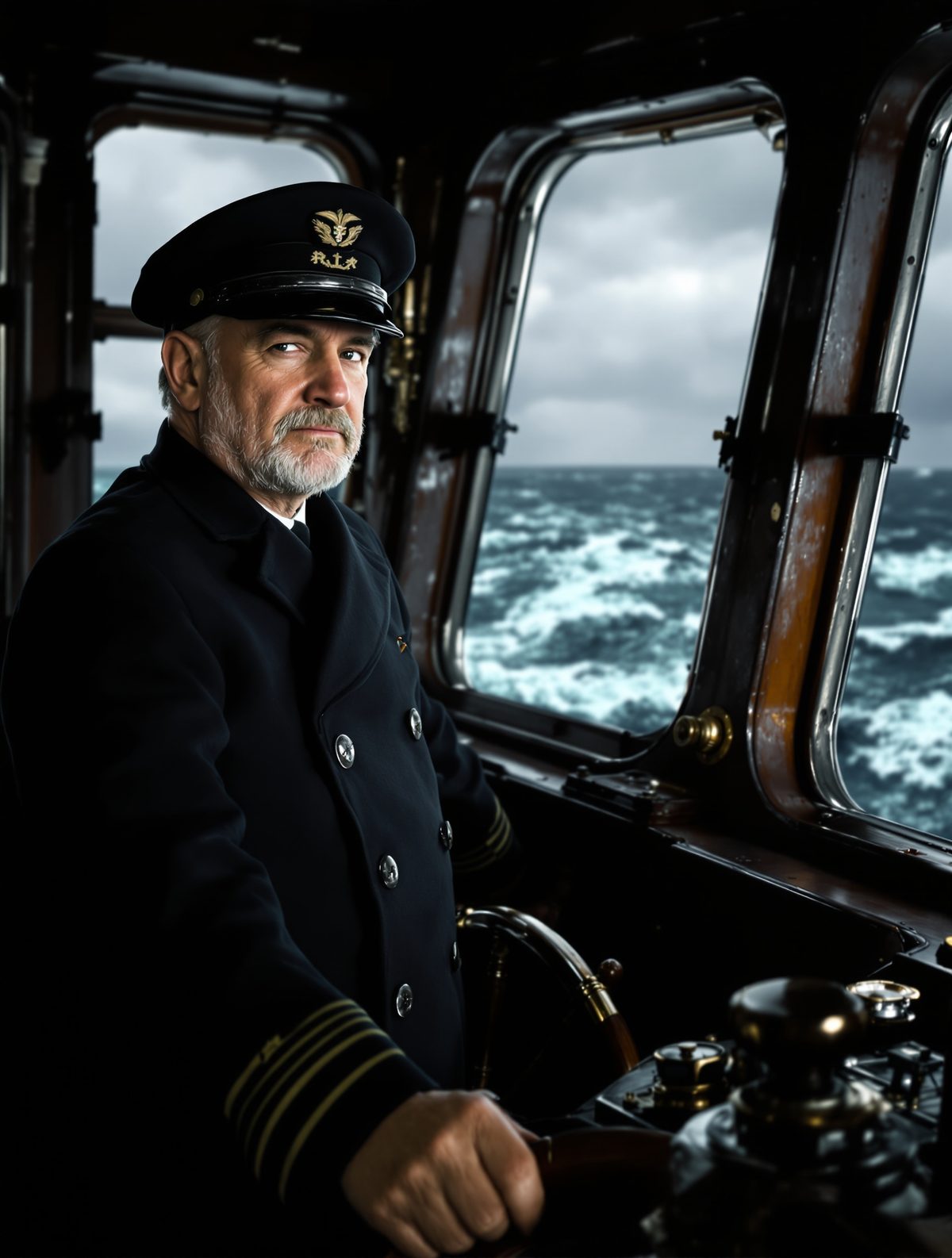
The North Sea stretched endlessly in all directions, grey and forbidding under the March sky of 1916. Captain Charles Algernon Fryatt stood on the bridge of the SS Brussels, watching the horizon with the practiced eye of a man who had navigated these treacherous waters for decades. Behind him, 286 passengers—men, women, and children—went about their daily routines, unaware that in mere minutes, their captain would make a decision that would echo through history and ultimately cost him his life.
What happened next on that fateful day would transform a humble ferry captain into an unlikely war hero, and later, a martyr whose execution would shock the world and galvanize British resolve during the darkest days of the Great War.
The Unlikely Warrior of the Waves
Charles Fryatt was nobody's idea of a military hero. Born in Southampton in 1872, he had spent his entire adult life in the merchant marine, working his way up from deck hand to captain through sheer determination and seamanship. By 1916, at age 44, he commanded the Great Eastern Railway Company's SS Brussels, a 1,500-ton passenger ferry that maintained the vital civilian link between Harwich and the Hook of Holland.
This was no glamorous posting. The Brussels was a workhorse—a sturdy, reliable vessel designed for comfort rather than speed, carrying everything from businessmen and diplomats to refugees fleeing the chaos of war-torn Europe. Fryatt himself was described by contemporaries as quiet and methodical, a man who took pride in delivering his human cargo safely across waters that had become increasingly dangerous as German U-boats prowled the shipping lanes.
Read next: The Day a British Stretcher-Bearer Refused an Order to Save Lives
What made Fryatt extraordinary wasn't his background—it was his unwavering sense of duty. He had already earned the respect of his superiors by successfully evading German submarines on multiple occasions, using his intimate knowledge of North Sea currents and weather patterns to outmaneuver the underwater predators. The Admiralty had even issued him with a gold watch in recognition of his services to the war effort.
But nothing in his experience had prepared him for what would unfold on March 28, 1916.
The Moment of Truth
At approximately 2:30 PM, as the Brussels made her regular run from the Hook of Holland to Harwich, a lookout's shout shattered the afternoon calm. Rising from the grey waters like a steel leviathan, the German submarine U-33 had surfaced directly in the ferry's path, her crew already manning the deck gun.
The international laws of war were clear: merchant vessels were expected to stop when challenged by warships, submit to search, and allow passengers and crew to take to lifeboats before any aggressive action. Captain Fryatt knew the rules—every merchant captain did. But he also knew something else: the lifeboats of the Brussels could barely accommodate half his passengers, and the March waters of the North Sea were so cold that survival time was measured in minutes, not hours.
As the U-boat's signal lamp began flashing the universal command to stop, Fryatt faced an impossible choice. Surrender meant probable death for many of his passengers. Resistance meant certain death for himself if he was ever captured. The captain who had spent his career avoiding conflict was about to embrace it with devastating consequences.
"Full speed ahead!" he barked to his engine room. "All hands, prepare for ramming!"
The Ram That Changed Everything
What happened next lasted less than sixty seconds but would reverberate for years. The Brussels, her engines straining at maximum power, bore down on the surfaced U-boat like an avenging angel. The German submarine commander, Lieutenant Commander Hans Howaldt, suddenly found himself in the nightmare scenario every U-boat captain feared—caught on the surface by a determined opponent with ramming speed.
The image must have been extraordinary: a humble passenger ferry, flying the merchant ensign, charging at full speed toward one of the German Navy's most advanced weapons of war. Aboard the Brussels, passengers pressed against windows and railings, some screaming, others standing in stunned silence as they watched their captain attempt something that seemed to defy all logic.
At the last possible moment, U-33 managed to dive, her hull disappearing beneath the waves just as the Brussels's reinforced bow cut through the water where the submarine had been seconds before. The ferry's passengers erupted in cheers, but Captain Fryatt remained grimly focused. He knew this was far from over.
The submarine surfaced again at a safe distance, but something had changed. Perhaps recognizing that this merchant captain was willing to die rather than surrender, or perhaps concerned about damage from the near-miss, U-33 withdrew. The Brussels continued her journey, and 286 civilian lives were saved.
The Price of Heroism
News of Fryatt's audacious attack spread quickly through British maritime circles. Here was proof that ordinary merchant sailors could fight back against the U-boat menace that was slowly strangling Britain's lifelines. The Admiralty was delighted—so much so that they awarded Fryatt a gold watch inscribed "in recognition of his brave conduct when in command of SS Brussels in ramming a German submarine on March 28, 1916."
But across the North Sea, the German Admiralty was furious. They had taken careful note of Captain Fryatt's name and were already planning their response. In their view, a merchant captain who actively attacked warships had crossed the line from civilian to combatant—and would be treated accordingly.
For three months, Fryatt continued his regular runs, perhaps believing that his moment of fame had passed. The Brussels maintained her schedule between Harwich and Holland, and life aboard the ferry returned to its wartime routine. Passengers may have looked at their quiet captain with new respect, but Fryatt himself seemed unchanged—still methodical, still focused on the safety of those under his care.
The trap was sprung on June 23, 1916. Four German destroyers, acting on specific intelligence about the Brussels's route, intercepted the ferry in international waters. This time, there would be no escape. Hopelessly outgunned and outnumbered, Fryatt had no choice but to surrender. As German sailors boarded his ship, the captain who had chosen to fight rather than yield knew that his fate was sealed.
Read next: The Day a Army Chaplain Gave His Coat to a Dying Stranger
Martyrdom and Propaganda
What followed was a show trial that shocked the civilized world. Taken to Bruges, Captain Fryatt was charged not with piracy or unlawful combat, but with "sinking a German submarine while not being a member of a combatant force." The evidence against him was his own gold watch—the very award the British Admiralty had given him for his heroism.
The trial was a foregone conclusion. German military courts were under pressure to make examples of those who dared resist U-boat attacks, and Fryatt's case was perfect for their purposes. Here was a merchant captain who had actively fought against the Imperial German Navy—in their twisted logic, he deserved military punishment.
On July 27, 1916, just over four months after his moment of heroism in the North Sea, Captain Charles Fryatt was executed by firing squad in the courtyard of Bruges prison. His last words, according to witnesses, were a request that his family be told he died thinking of them. He was 44 years old.
The execution backfired spectacularly on German propaganda efforts. Rather than deterring other merchant captains, Fryatt's death created a martyr whose story spread throughout Britain and her allies. Recruiting posters featured his image, newspapers lionized his sacrifice, and the Royal Navy named ships in his honor. The Germans had intended to send a message of intimidation; instead, they had created a symbol of resistance.
The Legacy of a Split-Second Decision
Today, Captain Charles Fryatt rests in Dovercourt Cemetery, his body returned to England after the war with full military honors. His grave bears the simple inscription "He died for England," but his true legacy lies in something far more complex: the question of when ordinary people are called upon to make extraordinary choices.
In our modern world, where moral decisions are often debated endlessly by committees and analysts, Fryatt's story reminds us of moments when there is no time for consultation, no opportunity for careful deliberation—only the split-second choice between what is safe and what is right. He could have stopped his ship, followed protocol, and hoped for the best. Instead, he chose to fight for the lives entrusted to his care.
The merchant captain who rammed a U-boat teaches us that heroism often comes not from those trained for combat, but from ordinary people who refuse to accept that evil should go unchallenged. His story echoes through every situation where someone must choose between personal safety and the protection of others—from the firefighter entering a burning building to the teacher shielding students from harm.
Perhaps that's why the Germans were so eager to execute him: they recognized that Captain Fryatt represented something far more dangerous than any weapon—the idea that courage is contagious, and that even the humblest ferry captain can strike a blow that resonates far beyond the grey waters of the North Sea.