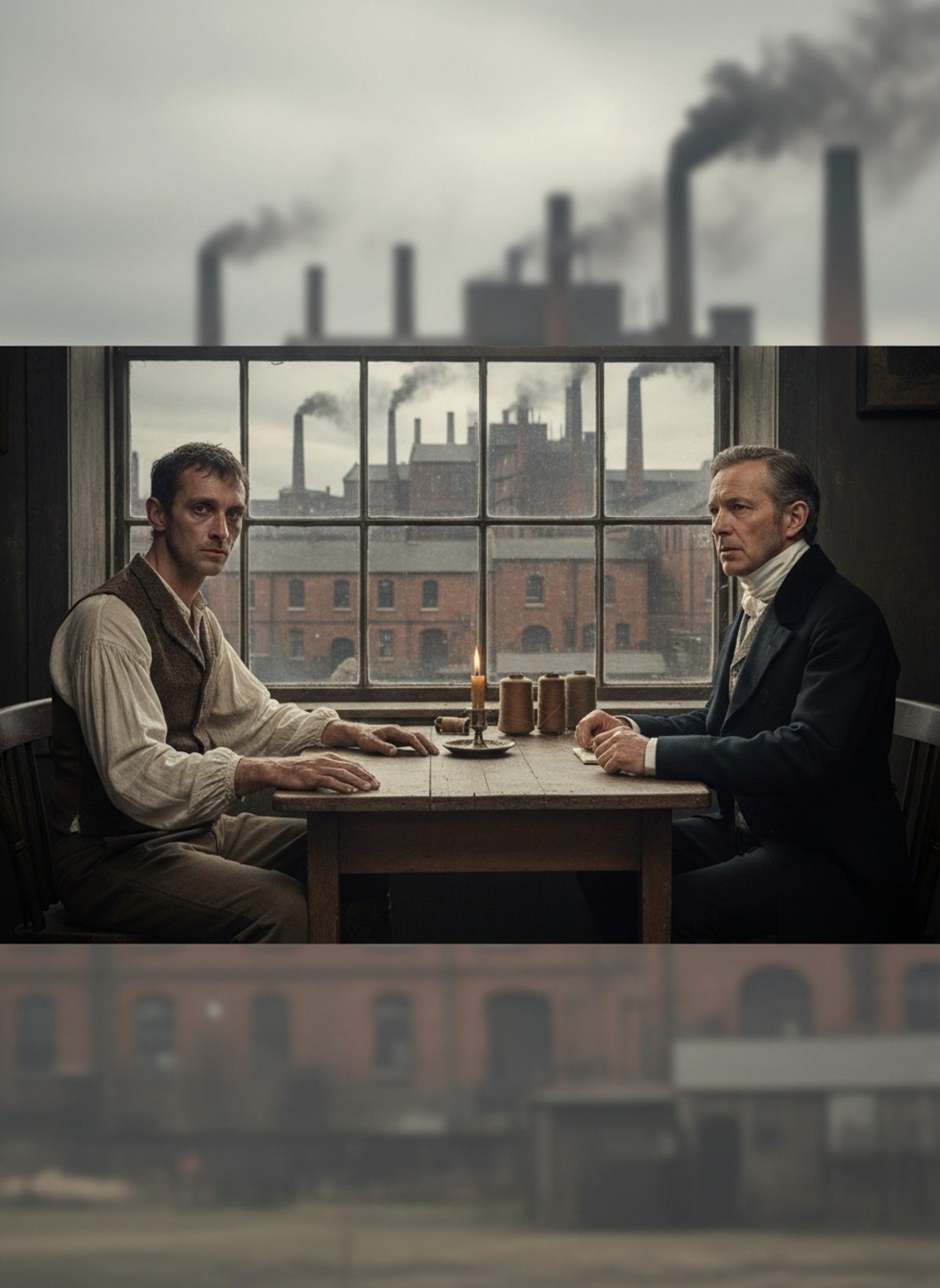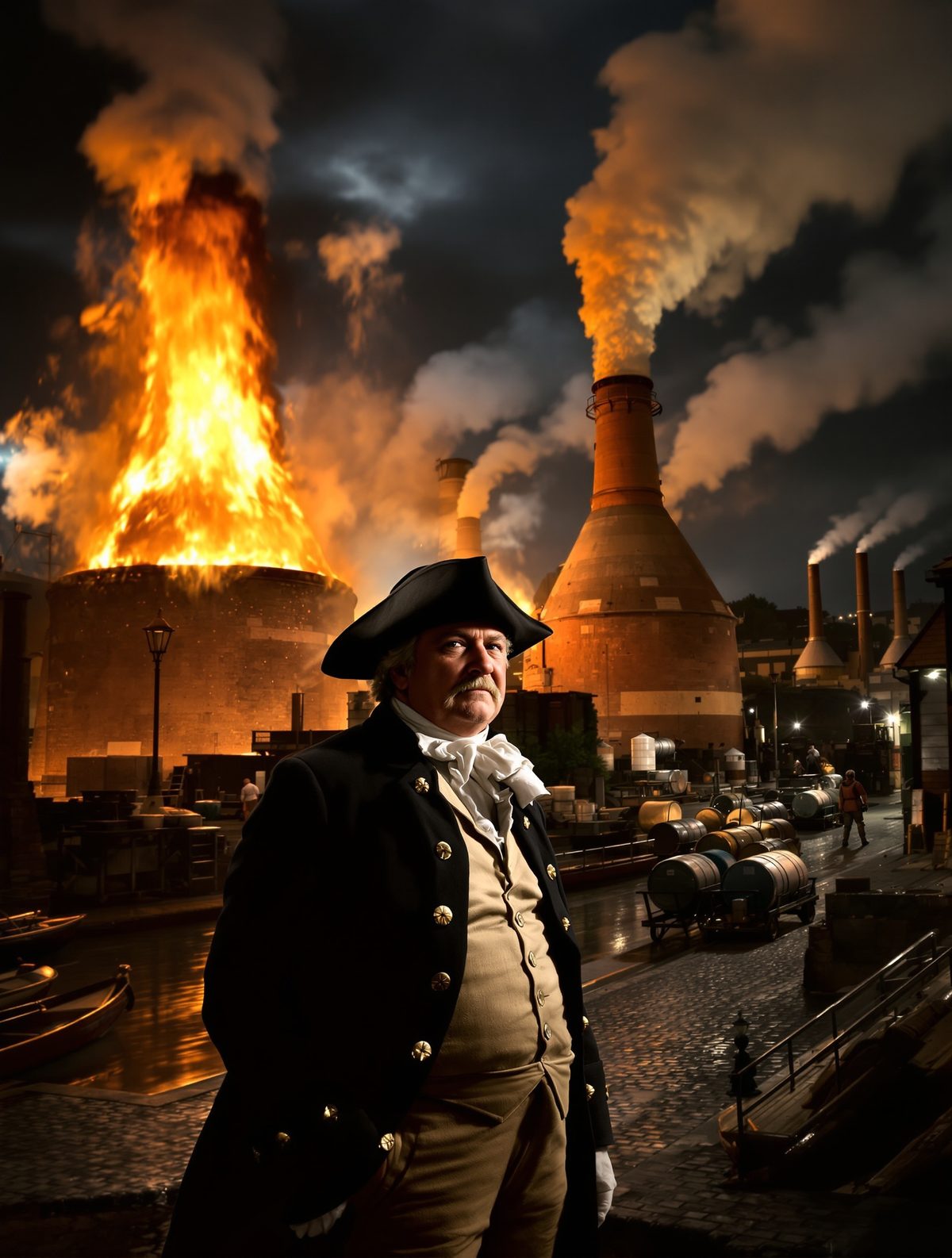
Picture this: the year is 1780, and across the smoky landscape of the Black Country, something extraordinary is lighting up the night sky. Not the usual orange glow of iron foundries or coal pits, but something different—brilliant white flames shooting from tall chimneys, casting an otherworldly radiance that can be seen for miles. Locals whisper about the "devil's fires" burning in Tipton, but what they're actually witnessing is nothing short of an industrial revolution within the Industrial Revolution. A Scottish chemist named James Keir is literally burning his way to Britain's chemical independence, one furnace load at a time.
Those spectacular flames weren't just a light show—they were the birth pangs of modern Britain's soap, glass, and textile industries. And the man stoking those fires was about to break a stranglehold that had kept Britain dependent on foreign chemicals for generations.
The Scottish Rebel Who Chose Chemistry Over Cannon
James Keir wasn't supposed to be revolutionizing British industry. Born in 1735 to a well-to-do Scottish family, he was destined for military glory, graduating from Edinburgh High School before entering the army as an ensign. For over a decade, he served dutifully, rising through the ranks and fighting in campaigns across the Caribbean. But Keir harbored a secret passion that would ultimately prove more explosive than any cannon he commanded: chemistry.
In 1768, at the age of 33, Keir made a decision that would have seemed mad to his contemporaries. He resigned his military commission—throwing away a promising career—to pursue his fascination with chemical processes. His fellow officers thought he'd lost his mind. His family worried about his financial future. But Keir had seen something they hadn't: Britain was utterly dependent on foreign sources for the chemicals that were becoming increasingly essential to its growing industries.
Read next: The Day a Mill Owner Walked Into Parliament for His Children
The problem was stark and embarrassing for a nation that prided itself on self-sufficiency. British soap makers relied on potash imported from Russia and America. Glass manufacturers depended on soda ash from Spain and the Mediterranean. Textile producers needed alkali from wherever they could get it, often paying through the nose for inferior products. Britain might have been mastering iron and coal, but it was still a chemical colony.
The Alchemy of Fire and Salt
Keir settled in the heart of the Black Country, that sooty, industrial landscape between Birmingham and Wolverhampton where the air tasted of coal smoke and ambition. In 1780, he established his chemical works in Tipton, a location chosen with the precision of a military strategist. The site had everything he needed: proximity to coal mines for fuel, canal access for transporting raw materials and finished products, and—crucially—distance from populated areas, because what Keir planned to do was going to be loud, bright, and potentially dangerous.
The process Keir pioneered was deceptively simple in concept but fiendishly difficult in execution. He would take common salt—sodium chloride—and subject it to intense heat in specially designed furnaces along with other chemicals. The result would be sodium carbonate, or soda ash, the alkali that British industry desperately needed. But here's where it gets fascinating: the process required temperatures of over 800 degrees Celsius, sustained for hours at a time.
Those spectacular white flames that lit up the Black Country night? They were sodium burning—the same element that makes fireworks glow yellow-white, but on an industrial scale. Keir's furnaces were essentially giant Bunsen burners, roaring through the darkness and consuming enormous quantities of coal. Local residents reported that on clear nights, the glow from the Tipton works was visible from Birmingham, over ten miles away.
Breaking Europe's Chemical Chains
The timing of Keir's breakthrough couldn't have been more perfect—or more crucial. The American Revolutionary War had disrupted traditional supply chains, making imported alkali even more expensive and unreliable. British manufacturers were desperate for alternatives, and Keir's operation promised not just independence, but superior quality and reliability.
By 1783, the Tipton works was producing over 400 tons of alkali per year—a staggering quantity that represented roughly one-quarter of Britain's total consumption. But Keir didn't stop there. He began experimenting with different formulations, creating specialized alkalis for different industries. Soap makers got one blend, glass manufacturers another, textile producers a third. He wasn't just supplying a commodity; he was crafting bespoke chemicals for each industry's specific needs.
The economic impact was immediate and dramatic. British soap, which had been a luxury item due to expensive imported alkali, suddenly became affordable for ordinary families. The phrase "clean as a whistle" gained new meaning as soap became a household staple rather than a rare indulgence. Glass production costs plummeted, leading to the great age of British glassmaking and the beautiful crystal that would grace Victorian tables across the empire.
Perhaps most importantly, textile producers could now afford to thoroughly clean their fabrics and machinery, leading to higher quality cloth that could compete with the finest European products. Lancashire cotton, cleaned with Keir's alkali, began dominating world markets.
The Lunar Society and the Network of Innovation
Keir's success wasn't achieved in isolation. He was a founding member of the Lunar Society of Birmingham, an extraordinary gathering of minds that met monthly (during the full moon, for better traveling light) to discuss science, technology, and philosophy. His fellow "Lunatics"—as they proudly called themselves—included pottery magnate Josiah Wedgwood, steam engine pioneer James Watt, physician and scientist Erasmus Darwin (Charles's grandfather), and the radical philosopher Joseph Priestley.
This wasn't just a gentleman's club; it was Britain's first industrial think tank. The members shared knowledge, invested in each other's ventures, and collaborated on innovations. Wedgwood used Keir's alkali in his pottery glazes. Watt's improved steam engines powered Keir's grinding mills. They were creating an ecosystem of innovation that would make the Black Country the chemical capital of the world.
The society's influence extended far beyond chemistry and manufacturing. They promoted education, supported the abolition of slavery, and championed religious tolerance. When the French Revolution erupted, several members faced persecution for their progressive views, but they continued meeting, planning, and innovating.
When Fire Met Fury: The Gordon Riots Connection
Here's a connection that history textbooks rarely mention: Keir's alkali works may have played an unexpected role in cleaning up after one of Britain's worst civil disturbances. The Gordon Riots of 1780—the same year Keir opened his works—saw anti-Catholic mobs rampage through London for nearly a week, burning buildings and looting shops. The aftermath left the capital filthy and damaged.
As London struggled to clean itself up, demand for soap and cleaning agents spiked dramatically. Keir's timing was providential; his new supply of domestic alkali helped meet this surge in demand without relying on potentially disrupted foreign imports. The irony is delicious: the flames of intolerance in London were literally cleaned away using chemicals produced by the flames of innovation in Tipton.
The Legacy of Industrial Fire
By the time of Keir's death in 1820, his chemical works had spawned an entire industry. The Black Country bristled with chemical plants, each building on his pioneering techniques. His former apprentices and competitors had spread across Britain, establishing works in Liverpool, Newcastle, and Glasgow. Britain had not only achieved chemical independence but had become Europe's dominant producer and exporter of industrial chemicals.
The social transformation was equally profound. Affordable soap meant better hygiene and lower infant mortality. Cheap glass brought light into workers' homes and enabled the spread of reading. Quality textiles made decent clothing accessible to the working classes. Keir's fires had literally illuminated a path to better living standards for millions.
But perhaps the most important legacy was the proof of concept: that scientific innovation, properly applied and scaled, could break economic dependencies and create entirely new industries almost overnight. In our modern world of supply chain vulnerabilities and resource competition, James Keir's story feels remarkably contemporary. His willingness to abandon a secure military career for the uncertain prospects of industrial chemistry, his systematic approach to scaling production, and his collaborative network of innovators created a template that Silicon Valley entrepreneurs would recognize today.
The next time you wash your hands, look through a clear window, or wear clothing that doesn't scratch like burlap, spare a thought for those brilliant white flames that once lit up the Black Country sky. James Keir's fires burned out long ago, but they ignited something that still burns today: Britain's tradition of turning scientific curiosity into industrial advantage, one breakthrough at a time.