The wind screamed like a banshee across the Farne Islands, hurling salt spray against the windows of Longstone Lighthouse with such violence that the thick glass trembled in its frames. Dawn was breaking over the North Sea on September 7th, 1838, but it brought no comfort—only the horrifying sight of a massive steamship being torn apart like paper on the jagged teeth of Big Harcar rock, less than a mile away.
Twenty-two-year-old Grace Darling pressed her face to the storm-lashed window and watched human figures clinging to the wreckage, their desperate silhouettes barely visible through the mountainous waves. Her father, William Darling, keeper of Longstone Light for over two decades, took one look at the apocalyptic seas and shook his grizzled head. "No boat could survive out there, lass. It's suicide."
Grace said nothing. She simply walked to where the lighthouse's coble—a sturdy, flat-bottomed rowing boat—was moored, picked up the oars, and prepared to prove him wrong.
Death Rides the Morning Tide
The Forfarshire had been a proud vessel—a 400-ton paddle steamer carrying 63 passengers and crew from Hull to Dundee. But pride meant nothing to the Force 10 gale that had been battering the Northumberland coast for hours. At around 4 AM, with her boilers failing and her paddle wheel damaged, the ship had been driven helplessly toward the most treacherous stretch of coastline in Britain.
Read next: The Day a London Printer Stood Trial and Freed the Press
Captain John Humble knew these waters well enough to understand his fate. The Farne Islands had claimed over 100 ships in living memory, their submerged rocks lurking like hungry predators beneath the foam. When the Forfarshire struck Big Harcar with a sound like the world splitting open, the impact was so violent that passengers were hurled from their beds. Within minutes, the ship cracked in two.
Of the 63 souls aboard, 44 would perish in those first terrible moments—swept away by waves the size of three-story buildings or crushed by the ship's disintegrating hull. But nine survivors, including a woman clutching her two young children, managed to scramble onto a piece of the wreck that had wedged against the rock. There they clung, waves washing over them every few seconds, knowing that hypothermia or exhaustion would claim them long before any rescue could arrive.
What they couldn't have imagined was that their salvation would come in the form of a lighthouse keeper's daughter who had never rowed in anything worse than a moderate chop.
The Girl Who Wouldn't Look Away
Grace Horsley Darling was no ordinary Victorian maiden. Born into a family of lighthouse keepers, she had grown up on Longstone—a barren outcrop of rock barely 100 yards long, accessible only by boat and constantly battered by some of the most violent seas in Europe. While other young women her age were learning to embroider and play piano, Grace was mastering the tides, reading weather patterns, and handling small boats in conditions that would terrify most experienced sailors.
But even Grace had never attempted what she was proposing now. The coble was 21 feet long and built for coastal fishing, not hurricane rescue missions. To reach the survivors, she and her father would have to navigate a maze of submerged rocks in seas where visibility was measured in yards and waves were breaking over 40-foot cliffs.
William Darling understood the mathematics of the situation perfectly: stay safe, and nine people would certainly die. Attempt rescue, and eleven people would probably die. But as he watched his daughter checking the boat's equipment with calm determination, he realized that Grace had already made the calculation differently.
"If we're doing this madness," he finally said, grabbing his oilskins, "we'd best do it before the tide turns."
Into the Teeth of the Storm
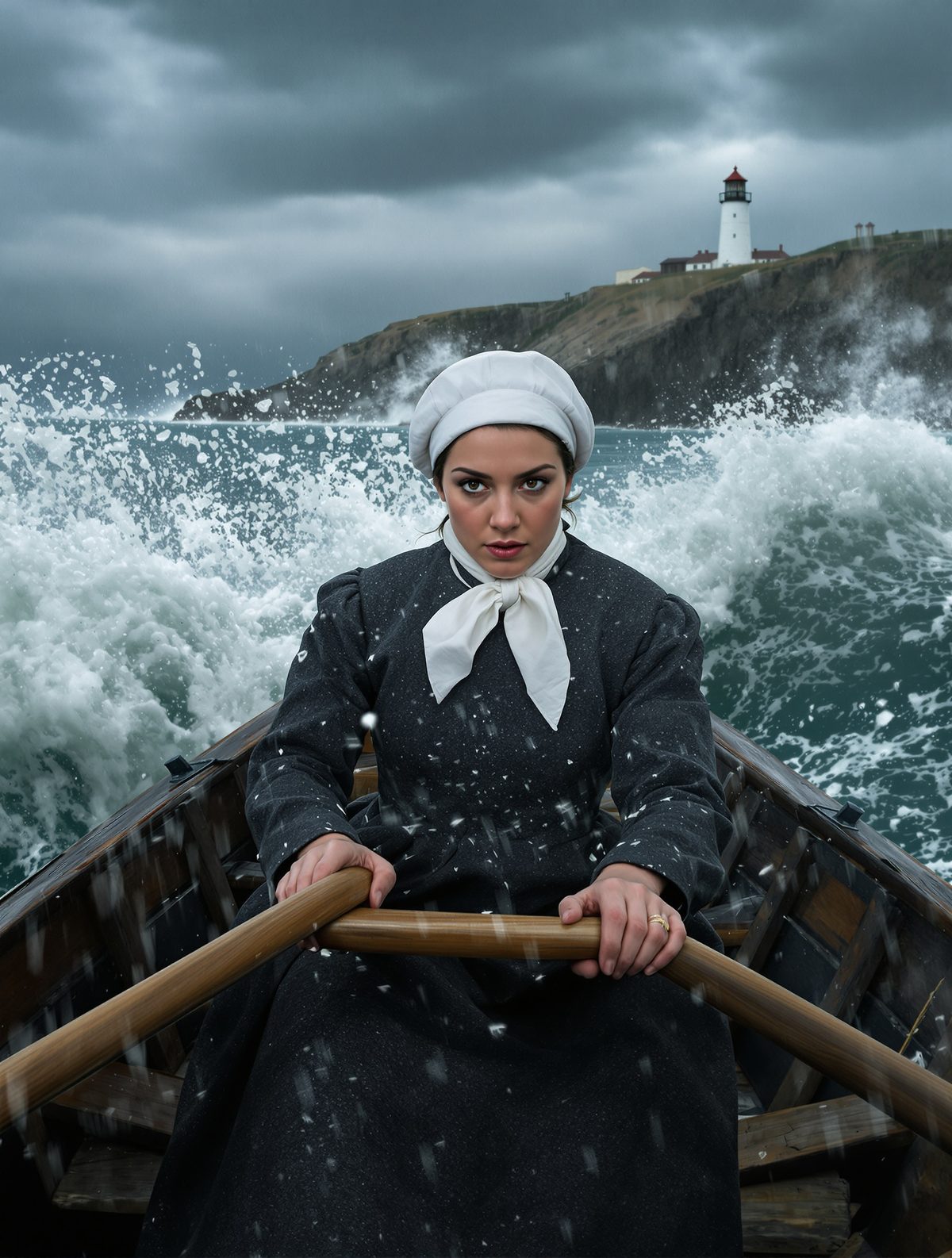
At approximately 7 AM, father and daughter launched their tiny boat into what can only be described as aquatic hell. The moment they cleared the lighthouse's small harbor, mountainous waves began tossing the coble like a cork. Grace took the bow oars while William managed the stern, but 'rowing' hardly describes what they were actually doing—it was more like controlled falling, using the oars to prevent the boat from flipping end-over-end as each wave lifted them 30 feet into the air before dropping them into valleys deep enough to hide a church spire.
The noise was indescribable—a continuous roar of wind and water punctuated by the crack of waves against rocks and the groaning of the Forfarshire's dying hull. Visibility was so poor that Grace navigated by memory and instinct, dodging submerged rocks that could punch through their hull like bullets through paper.
What makes their achievement almost incomprehensible is the precision required. Modern rescue services, with GPS navigation, weather radar, and purpose-built vessels, rarely attempt operations in such conditions. Grace and William were navigating by feel through a obstacle course that had already destroyed a ship twenty times the size of their boat.
The journey that would normally take ten minutes stretched into nearly an hour of desperate struggle. Several times, waves completely submerged the coble, and only furious bailing kept them afloat. But Grace never stopped rowing, her small hands raw and bleeding on the oars, her eyes fixed on the dark shape of Big Harcar through the spray.
Nine Souls Snatched from Death
When they finally reached the wreckage, the survivors could barely believe what they were seeing. Through the spray and chaos emerged a slight young woman in a red cloak, her dark hair plastered to her head by the storm, calmly maneuvering a tiny boat through conditions that had just destroyed a steamship.
The rescue itself required multiple trips—the coble could only safely carry five people in such seas. On the first journey, Grace and William retrieved five survivors, including Sarah Dawson, who was still clutching her nine-year-old son and seven-year-old daughter. Both children were unconscious from cold and trauma, but alive.
The return journey was, if anything, more terrifying than the outbound trip. The additional weight made the boat harder to maneuver, and the tide was changing, altering the wave patterns and exposing new rocks. Grace later recalled that she could hear Mrs. Dawson praying continuously throughout the journey, her voice barely audible above the storm.
After depositing the first group at the lighthouse, Grace and William immediately turned around for the remaining four survivors. By now they had been rowing for nearly three hours in hurricane-force winds, but Grace showed no signs of flagging. The second rescue took another hour of brutal effort, but by 10 AM, all nine survivors were safe in the lighthouse's warm kitchen, wrapped in blankets and being fed hot soup by Grace's mother, Thomasin.
When Heroes Become Legends
News of Grace's rescue spread across Britain with the speed of wildfire. In an era when communication meant letters and newspapers, her story somehow captured the public imagination like nothing before it. Queen Victoria sent her £50—equivalent to about £6,000 today—and a silver medal. The Royal Humane Society awarded her their gold medal. Artists painted her portrait, poets wrote verses about her, and entrepreneurs rushed to market everything from Grace Darling teapots to Grace Darling sheet music.
But fame proved to be a burden that Grace's constitution couldn't bear. Tourists began arriving at Longstone by the boatload, desperate to meet the "Angel of the Farne Islands." The isolation that had shaped her character was destroyed by constant intrusions. Letters arrived daily from admirers, marriage proposals, and curiosity seekers. The stress and exposure weakened her health, and in 1842, just four years after her moment of immortality, Grace died of tuberculosis at the age of 26.
What the Victorian public understood, perhaps better than we do today, was that Grace Darling represented something precious and increasingly rare: the willingness of an ordinary person to risk everything for strangers. In an age of rapid industrialization and social change, her story reminded people that individual courage could still matter, that one person's moral choice could mean the difference between life and death for others.
The nine people Grace saved that morning included future grandparents of dozens of descendants. Her single act of courage literally brought entire family trees into existence. But perhaps more importantly, her example reminds us that the most profound heroism often comes not from trained professionals or celebrated warriors, but from ordinary people who, when faced with an impossible choice between safety and conscience, simply pick up the oars and start rowing.