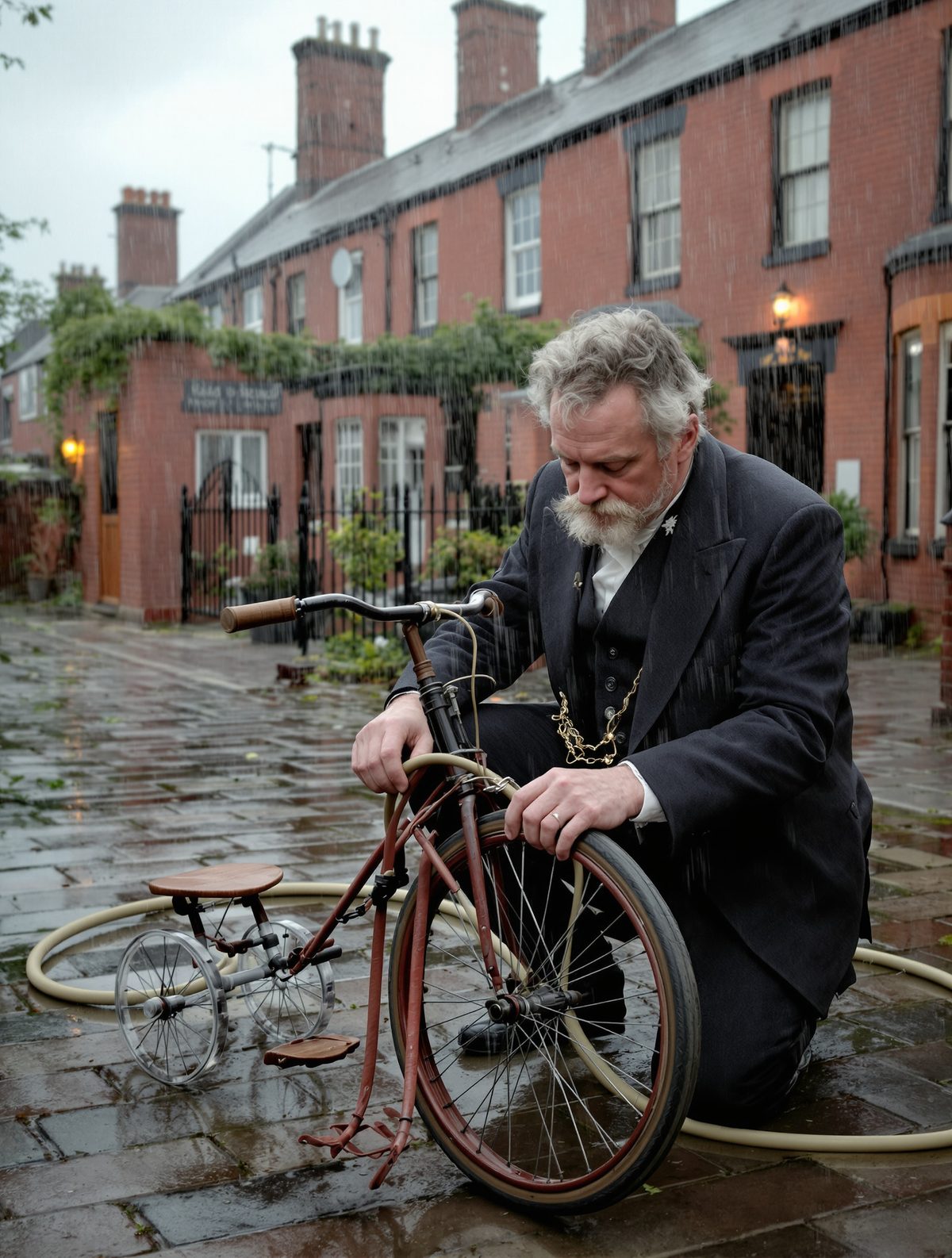
The screech of metal on cobblestone echoed through the quiet Belfast evening as ten-year-old Johnny Dunlop wrestled his tricycle across Gloucester Street. Each bump sent violent shudders through the boy's small frame, his knuckles white as he gripped the handlebars. From his surgery window, veterinarian John Boyd Dunlop watched his son's daily battle with the unforgiving streets of 1887 Belfast, where solid rubber tyres offered about as much comfort as riding on blocks of wood.
What happened next in that modest Victorian backyard would transform not just young Johnny's daily rides, but the entire future of human transportation. A father's simple desire to ease his child's discomfort was about to accidentally revolutionize everything from bicycles to Formula One racing cars.
The Bone-Shaker Problem
Victorian Belfast was a city of contradictions. By 1887, it had grown into an industrial powerhouse, its shipyards and linen mills humming with prosperity. Yet its streets remained a medieval nightmare of uneven cobblestones, rutted dirt tracks, and bone-jarring surfaces that made any wheeled journey an exercise in endurance. The bicycles and tricycles of the era, equipped with solid rubber tyres, earned the nickname "bone-shakers" for good reason.
John Boyd Dunlop understood discomfort intimately. As a Scottish veterinarian who had moved to Belfast in 1867, he spent his days treating horses whose hooves were battered by these same unforgiving streets. Born in Dreghorn, Ayrshire, in 1840, Dunlop had studied at the Royal Veterinary College in London before establishing his practice at 36 Gloucester Street. He was a methodical man, trained to observe suffering and find practical solutions.
Read next: The Day a Scots Girl Thrust Her Arm Through a Door to Save a King
But watching his son struggle was different. Young Johnny's tricycle, a typical model of the era with its solid rubber tyres, transmitted every pebble, every crack in the pavement, directly into the rider's spine. The boy would return from his rides exhausted and sore, his enthusiasm for cycling dampened by the physical punishment of Belfast's streets.
A Garden Hose Revelation
On a crisp February evening in 1888, Dunlop found himself staring at a coiled garden hose in his backyard shed. The idea that struck him seemed almost absurdly simple: what if the tyre could be filled with air instead of being solid rubber? Air would act as a cushion, absorbing the shock that was currently being transmitted directly to the rider.
Working by lamplight, Dunlop began what would become one of history's most consequential acts of DIY engineering. He took a length of rubber garden hose and fashioned it into a tube, sealing the ends to create an airtight chamber. This improvised tube was then wrapped in canvas for protection and carefully attached to one of Johnny's tricycle wheels using tacks and glue.
The contraption looked ridiculous—a bulky, makeshift affair that bore little resemblance to the sleek tyres we know today. But when Dunlop inflated it with air using a simple pump, something remarkable happened. The wheel suddenly possessed a springiness, a give that promised to absorb rather than transmit shock.
The First Revolutionary Ride
The next morning brought the moment of truth. Johnny, perhaps skeptical of his father's strange modification to his beloved tricycle, climbed aboard for a test ride. What happened next was nothing short of magical. As the boy pedaled across the cobblestones of Gloucester Street, the violent juddering that had characterized every previous journey simply vanished.
The air-filled tyre rolled smoothly over surfaces that had previously made cycling an ordeal. Johnny's face transformed from resignation to wonder as he experienced, for the first time, the sensation of gliding rather than being pounded by the road surface. Neighbors gathered to witness this curious sight—a child riding a tricycle that seemed to float over the cobblestones.
But Dunlop noticed something else, something that would prove even more significant for the future of transportation. The tricycle wasn't just more comfortable—it was faster. The pneumatic tyre reduced rolling resistance dramatically, allowing Johnny to cover ground with far less effort than before. What had started as a comfort innovation had accidentally become a performance revolution.
From Backyard to Patent Office
Recognizing the potential of his invention, Dunlop moved quickly to refine and protect it. On July 23, 1888, he filed British Patent No. 10,607 for his "Improvement in Tyres of Wheels for Bicycles, Tricycles, and Other Road Cars." The patent described a tyre consisting of a rubber tube enclosed in a canvas cover and attached to the wheel rim.
But here's where the story takes a fascinating twist that most people don't know: Dunlop wasn't actually the first person to invent the pneumatic tyre. That honor belonged to fellow Scotsman Robert William Thomson, who had patented a remarkably similar design in 1845—43 years earlier! Thomson's "Aerial Wheels" used inflated leather bags protected by metal treads, and they worked beautifully. So why isn't Thomson celebrated as the father of the modern tyre?
The answer lies in timing and technology. Thomson's invention arrived too early. In 1845, rubber manufacturing was still primitive, and vulcanization—the process that makes rubber durable and flexible—was barely understood. Thomson's tyres were expensive to manufacture and difficult to repair. Most crucially, there simply weren't enough wheeled vehicles on the road to create demand for his innovation. His brilliant idea died in obscurity.
The Bicycle Boom and Racing Glory
Dunlop's timing, however, was perfect. By 1888, the bicycle craze was sweeping through Britain and Europe. The recent invention of the "safety bicycle"—with two wheels of equal size rather than the dangerous penny-farthing design—had made cycling accessible to ordinary people. Suddenly, there was a massive market hungry for any innovation that could improve the cycling experience.
The breakthrough moment came at the Queen's College Sports in Belfast on May 18, 1889. Willie Hume, a member of the North of Ireland Cricket and Football Club, rode a bicycle fitted with Dunlop's pneumatic tyres. The other competitors watched in amazement as Hume effortlessly pulled away from the field, winning every race he entered. The crowd was witnessing the first public demonstration of the pneumatic tyre's performance advantages.
Word spread like wildfire through the cycling community. Within months, Dunlop found himself inundated with orders from cyclists who had heard about the miraculous "air tyres" that could transform their riding experience. In 1889, he partnered with businessman Harvey du Cros to form the Dunlop Rubber Company, laying the foundation for what would become one of the world's largest tyre manufacturers.
The Accidental Revolution
What makes Dunlop's story so compelling isn't just the invention itself, but the beautiful accident of its creation. He wasn't trying to revolutionize transportation or create a business empire. He was simply a father who couldn't bear to watch his son suffer through painful bicycle rides. Yet this modest act of parental love unleashed a cascade of changes that transformed the world.
The pneumatic tyre didn't just make cycling more comfortable—it made it faster, more efficient, and more appealing to the masses. This, in turn, accelerated the bicycle boom of the 1890s, which gave millions of people their first taste of personal mechanical transportation. Many historians argue that the bicycle, more than any other invention, prepared society psychologically for the automobile.
And when Karl Benz, Henry Ford, and other automotive pioneers began developing their motor cars, they turned naturally to pneumatic tyres. Can you imagine the development of the automobile industry with solid rubber tyres? Every journey would have been a bruising ordeal, every component subjected to constant violent vibration. The pneumatic tyre wasn't just a comfort feature for early cars—it was an essential technology that made automotive transportation practical.
From that February evening in a Belfast backyard to the Formula One circuits and space rovers of today, the lineage is direct and unbroken. Every air-filled tyre on every vehicle traces its ancestry back to John Boyd Dunlop's improvised garden hose experiment, born from a father's love and a child's discomfort on the cobblestones of Victorian Belfast.
In our age of planned obsolescence and engineered solutions, there's something deeply moving about this story of accidental genius. Sometimes the most revolutionary innovations come not from corporate research labs or government programs, but from the simple human desire to solve a problem right in front of us. Johnny Dunlop's bumpy tricycle rides remind us that the next world-changing invention might be hiding in plain sight, waiting for someone who cares enough to ask: "Surely there's a better way?"